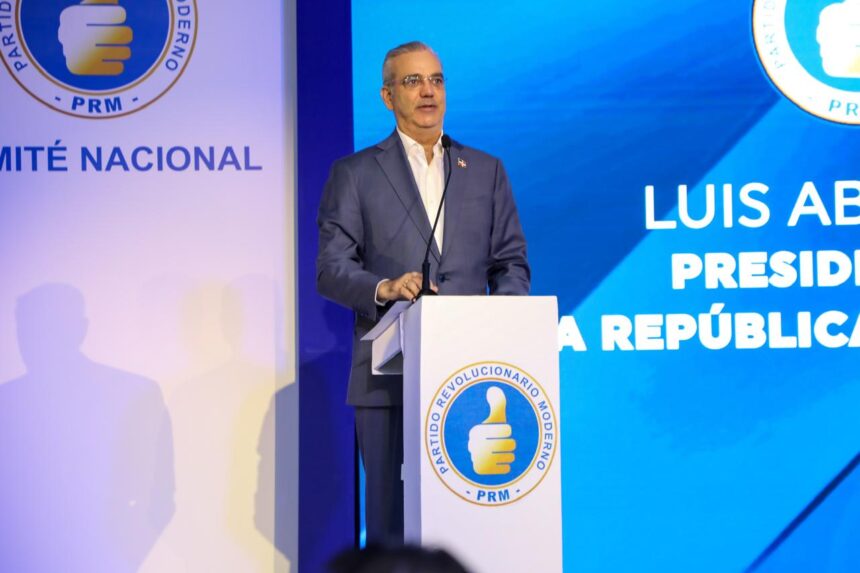
Santo Domingo.– President Luis Abinader assured that the Government will continue to promote measures to protect the middle class and the most vulnerable sectors from the impact of the international crisis, while reaffirming his commitment to strengthening citizen security through the comprehensive transformation of the National Police.
During an interview granted to journalists José Monegro and Edith Febles, the president explained that the measures contemplated in the Anti-Crisis Plan respond to current economic conditions and seek to preserve the country’s stability without affecting the majority of taxpayers.
When referring to the possibility of a comprehensive tax reform, he maintained that at this moment the conditions to carry it out do not exist.
“Right now there are no conditions to carry out a comprehensive tax reform,” he stated.
He explained that the plan especially benefits the salaried middle class, which will receive an improvement in its purchasing power through salary indexation, while the largest tax adjustments fall on companies with higher incomes and individuals with monthly earnings exceeding RD$400,000.
Likewise, he clarified that the increase in the withholding tax applied to some independent professionals does not represent a tax increase, but rather an advance payment mechanism that can subsequently be offset in the corresponding tax return.
More Read


The head of state acknowledged that the rise in prices has affected the budget of many Dominican families, although he noted that this is a reality also faced by the world’s major economies as a consequence of the international context.
In that sense, he highlighted that the Dominican Republic has managed to increase the minimum wage above inflation, seeking to preserve the purchasing power of workers.
You can also read: Abinader acknowledges that some protests contain demands that the Government must address
“We know that many families have felt the impact of rising prices and that is one of our main concerns,” he/she expressed.
Abinader explained that, despite the country’s dependence on imported fuels and the limitations inherent to an island economy, the Dominican Republic maintains a solid economic performance thanks to the dynamism of tourism, free trade zones, the recovery of the construction sector, and the constant search for new investment opportunities.
More Read

He also highlighted that the country continues to consolidate itself as one of the main destinations for foreign investment in the region.
“Last year we exceeded five billion dollars in foreign investment and this year everything indicates that it will be even higher,” he noted.
He indicated that investor confidence, together with the growth of tourism, exports, and the permanent contribution of remittances sent by Dominicans living abroad, have contributed to maintaining macroeconomic stability and the strength of the Dominican peso.