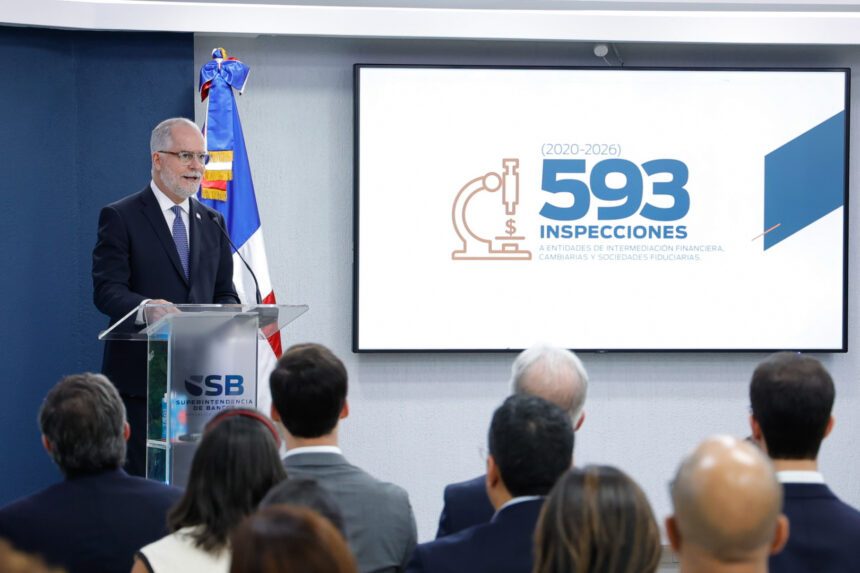
Santo Domingo.- The Superintendent of Banks, Alejandro Fernández W., presented this Thursday the results of his administration for the 2020-2026 period, highlighting progress in financial supervision, regulatory modernization, institutional strengthening, and the protection of banking system users.
During his accountability report, the official stated that the institution faced one of its greatest challenges when beginning its administration in the midst of the COVID-19 pandemic, a scenario that motivated the strengthening of supervision mechanisms, the development of early warning systems, and the implementation of measures to guarantee the stability of the financial system and protect the clients of banking entities.
Fernández reported that between 2020 and June 2026, the Superintendency of Banks conducted 593 inspections of financial entities, financial groups, and fiduciary companies, in addition to modernizing its supervision model with the creation of specialized areas in innovation and financial inclusion, consolidated supervision, the fiduciary market, and information technology and security.
One of the main achievements noted was the resolution process of Bancamérica, considered the first executed under the Monetary and Financial Law in which it was possible to transfer all assets and liabilities of a dissolved entity to a solvent bank within the legal timeframe.
The superintendent assured that all non-linked depositors recovered the entirety of their funds and that the Contingency Fund fully recovered the money used during the process.
More Read

In the regulatory sphere, the institution issued 12 instructions, 99 circulars, and 74 circular letters during the period, incorporating new provisions on financial user protection, digitalization of services, risk management, and environmental sustainability. Among the measures, the update of the Information Requirements Manual, the implementation of the fair value criterion, and the revision of the Accounting Manual stood out.

Regarding institutional matters, the Superintendency reported that it advanced in digital transformation through the adoption of electronic signatures, the digitization of processes, and the use of data-based tools. Likewise, it obtained international certifications in quality, information security, business continuity, compliance, and sustainability.
Fernández also highlighted the strengthening of the entity’s human capital. He explained that the staff in technical areas went from representing 39% to 64% of the workforce and that more than half of the employees hold postgraduate degrees. In addition, he indicated that the SB School has trained nearly 10,000 people for free in just two years.
More Read

You can also read: Superintendency of Banks presents education campaign
Regarding citizen service, he noted that through ProUsuario, more than 1.1 million contacts with financial system users were registered, and refunds totaling RD$785.9 million were managed for improper charges. He added that, through the ‘Dinero Busca Dueño’ (Money Seeks Owner) program, approximately RD$379 million were returned to 2,895 depositors of financial entities that disappeared more than two decades ago.
The superintendent also highlighted that during this administration, initiatives were promoted to expand financial inclusion, including basic accounts aimed at traditionally excluded populations and the expansion of financial access points, which allowed for the elimination of so-called “banking deserts” by ensuring the presence of at least one financial access point in every municipality in the country.
Finally, he announced that the 2025-2028 Strategic Plan contemplates strengthening risk-based supervision, maintaining compliance with international standards, and continuing to promote broader, safer, and sustainable financial inclusion.