
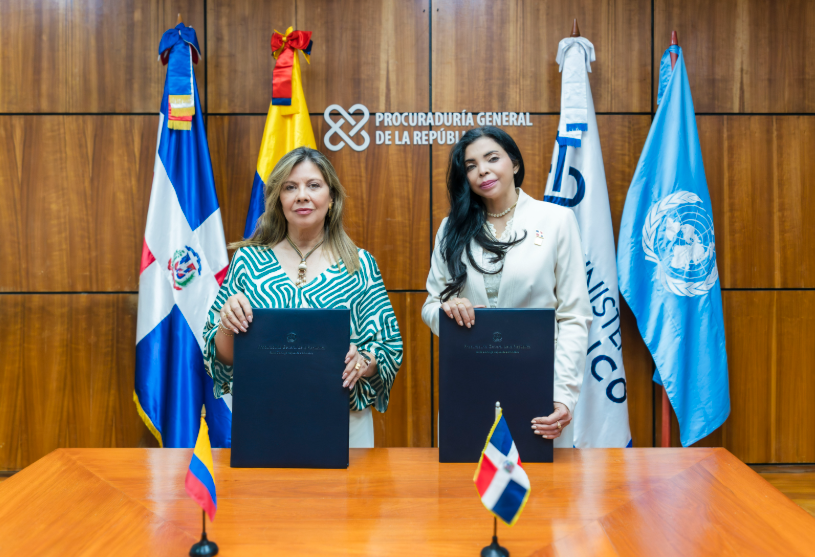
Attorney General Yeni Berenice Reynoso and Prosecutor General Luz Adriana Camargo Garzón agree to the creation of a Joint Investigation Team (JIT) to optimize international legal cooperation tools
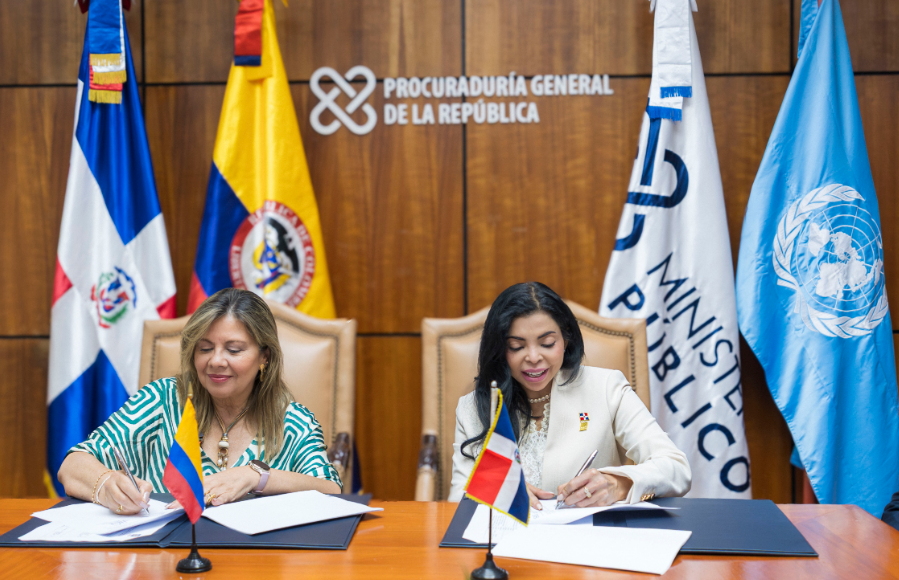
Santo Domingo.- As part of its strategy to optimize international legal cooperation tools to strengthen the fight against organized crime, the Attorney General’s Office of the Republic (PGR) signed an agreement with the Office of the Attorney General of Colombia for the creation of a Joint Investigation Team (JIT) in accordance with the United Nations (UN) Palermo Convention and the legal systems of both countries regarding criminal matters.
Attorney Reynoso and Prosecutor Camargo Garzón signed the document in a ceremony that included the participation of their respective work teams.
In that sense, the Dominican official thanked the United Nations Office on Drugs and Crime (UNODC) for its promotion of international agreements that foster a much safer world, “where the protection of people, as is the objective of this joint investigation team, becomes a reality.”
You may be interested in: President of Honduras describes DR as a regional example in border security
“For the Dominican Republic, and I know for Colombia as well, this signing of a joint investigation team has something special: it is a signing that includes its operational plan,” he indicated, while highlighting the very high commitment of both countries to maintain timely cooperation.
Reynoso highlighted that the country, which has already established a first Joint Investigation Team with Chile, will continue to make efficient use of that tool provided by the Palermo Convention to prosecutors around the world to combat crimes such as human trafficking for the purpose of sexual exploitation and migrant smuggling.
More Read
He maintained that the crime of human trafficking deeply wounds human dignity. “It is a crime whose objective is to commercialize human beings,” he said. “Just as we have stated in the CITIM (the Interinstitutional Commission against Trafficking in Persons and Smuggling of Migrants), which is chaired by our Ministry of Foreign Affairs: human trafficking is a high-priority crime for our administration,” he maintained.
“When a human being is the object of commercialization and is subjected to treatment that is more typical of slavery, it is a crime, I reiterate, that requires a holistic view and that always requires special attention,” reflected Reynoso.
In that sense, he maintained that “we have the ethical and legal obligation to work to achieve strategic objectives with high impacts on the lives of millions of people, in this case, Colombians and Dominicans, and other nationalities that come to live in our countries”.
Meanwhile, Camargo Garzón highlighted that this is the 18th ECI created by Colombia with different nations signatory to the Palermo Convention.

“I want to start by celebrating the possibility that we reach concrete agreements for the exchange of information on a topic as important as the one that brings us together today, which works directly against the trafficking of women for the purpose of sexual exploitation, which is a scourge that has burdened not only our region,” he/she said.
He recalled that the scourge of human trafficking affecting countries in the region has a major impact on different countries in Europe. “We have found that, definitely, in transnational crimes, the fight must be through instruments like this one that allow us to carry out an orderly, informed exchange, an instrument that allows us to have investigations here and there, but also that allows us to develop joint research programs,” he indicated.
“It is not enough that we just look for an instrument that serves as a vehicle for us to exchange information, but it is also necessary that, alongside or around the topic that brings us together, we can share methodological experiences on how we develop our research and can strengthen each other through the good experiences that the Dominican Republic has in this case and those that Colombia has,” he highlighted.
The Colombian prosecutor stated that her nation has a special dedication to the issue of prosecuting criminal finances, “not understood only as criminal proceeds, but also understood as that which allows an organization to mobilize, for example, a group of women from Colombia to the Dominican Republic.” “Because that involves a mobilization of money that we can and must reach if we look at Falcone’s very simple teachings, follow the money, follow the money trail,” she added.

The signing ceremony of the agreement was attended by Ambassador Rubén Silié, Vice Minister of Multilateral Foreign Policy of the Dominican Republic, and the Ambassador of Colombia in Santo Domingo, and José David Moreno, Chargé d’Affaires of that nation’s embassy in Santo Domingo.
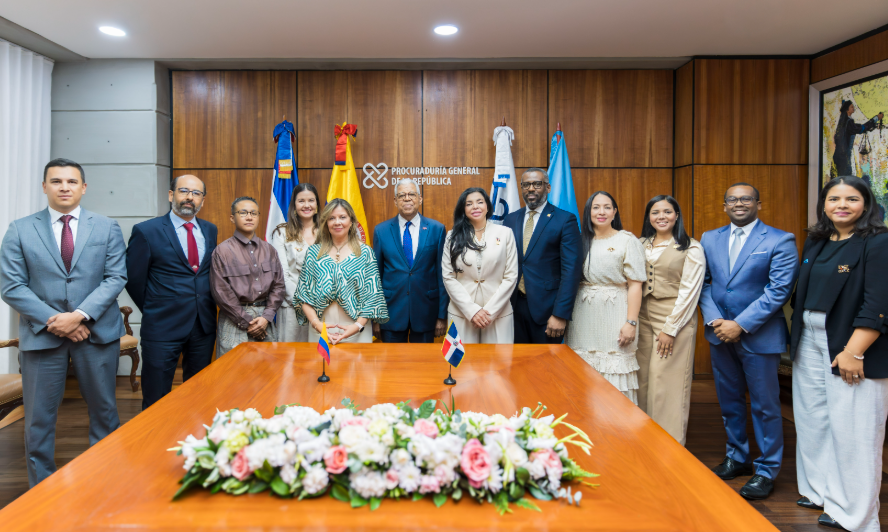
Yeni Berenice Reynoso was accompanied by Deputy Prosecutor Wilson Camacho, Director General of Prosecution of the Public Ministry; Deputy Prosecutor Osvaldo Bonilla, Director of International Legal Assistance, Extraditions and Human Rights; Court Prosecutor Yoanna Bejaran, head of the Specialized Prosecutor’s Office against the Illicit Trafficking of Migrants and Human Trafficking (PETT), who is executing the cooperation, and Court Prosecutor Danissa Cruz, Director of the Human Rights Department and the Unit for the Reintegration of Repatriates.
While Attorney General Camargo Garzón was accompanied by María Milena Méndez Moreno, Director of International Affairs of the Attorney General’s Office of Colombia, and Dayana Blanco, Specialized Director against Human Rights Violations.

Representing UNODC were Juan Daniel Ruiz, Project Coordinator of the Regional Office; Lissette Reyes, Project Coordinator of the UNODC Office for Central America and the Caribbean.
Lissette Reyes highlighted the willingness shown by the current administration of the Attorney General’s Office for the country to create joint investigation teams under the terms of the Palermo Convention. She recalled that since June of last year, the Dominican Republic and Colombia have reinforced their collaborative efforts in the fight against crimes such as human trafficking.
Also, he/she expressed gratitude for the support provided by donor countries to operationalize the Palermo Convention through initiatives such as the Turquoise Project, from the government of Canada, or the PACTS Project of Colombia funded by the European Union.
The agreement
Article 161 of the Law establishing the Code of Criminal Procedure of the Dominican Republic (No. 97-25, of December 7, 2025) states regarding joint investigations: “The Public Prosecutor’s Office may coordinate the investigation with the authorities in charge of the interested State, and for such purposes, investigation teams may be formed, directed by the Public Prosecutor’s Office and subject to the control of the judges.
The Joint Investigation Team established through the agreement between the Public Ministry of the Dominican Republic and the Attorney General’s Office of Colombia, which has the cooperation and logistical support of the UNODC, will lead to creating greater synergy and cooperation between Dominican and Colombian prosecutors to more effectively combat transnational organized crime, human trafficking, economic crimes, and corruption.
With the ECI, both countries will be able to establish a framework for cooperation and coordination in a timely manner to address specific cases of criminality. The team is framed within the United Nations Convention against Transnational Organized Crime (Palermo Convention), of which Colombia and the Dominican Republic became signatories at the conference held by the UN at the Palace of Justice in Palermo, Italy, between December 12 and 15, 2000.
Colombia ratified the Palermo Convention on August 4, 2004, and the Dominican Republic on October 26, 2006. Supported by this UN international cooperation instrument, and following the protocols of their respective criminal procedural systems, both countries enable, through the ECI, the direct exchange of physical evidence and evidentiary material, the execution of joint procedural measures, and the direct coordination of investigations.