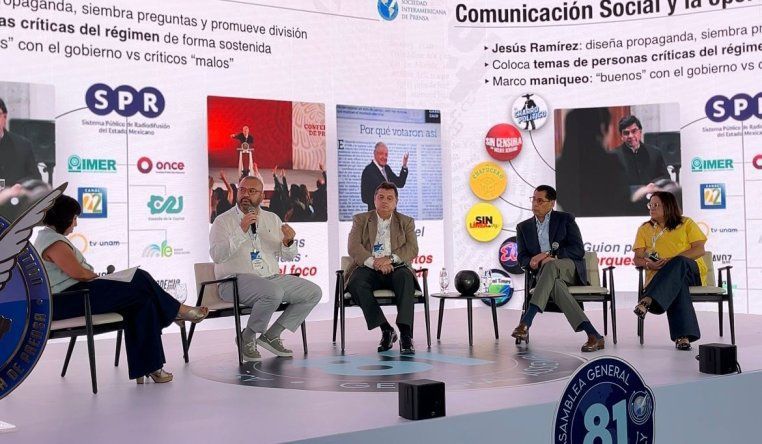
Punta Cana.- Within the framework of the 81st General Assembly of the Inter American Press Association (IAPA), journalists from different Latin American countries shared experiences and challenges they face when carrying out their work in contexts of violence, corruption, and judicial persecution.
In the panel “Journalism under harassment in hostile territories”, moderated by Carlos Jornet, the Haitian journalist Joseph Guyler Delva, recognized for his work in defense of freedom of the press and expression, spoke about the worrying situation of the press in his country. The SIP recently collaborated to facilitate Delva’s departure from the country, given the imminent risk to his life.
“The government is determined to silence the press. They don’t want the truth to be known, that’s why journalists are a problem,” Delva said. Furthermore, he assured that the executive branch uses state money to finance people who discredit and defame journalists.
“They have accused several journalists, including myself, of having been linked to gangs. They use those messages to discredit the press, so that we are not taken seriously”, he commented.
From Peru, Rodrigo Salazar Zimmermann, executive director of the Peruvian Press Council (CPP) described a panorama of violence and judicial harassment in a context of high political instability. “In Peru we have a kind of black hole in politics and there is a corrupt, criminal, organized crime current. Within that scenario, we journalists are unprotected,” he mentioned.
Salazar Zimmermann added that around 30 complaints are filed each year against journalists, and 80% are brought by public officials or their families. Some communicators are burdened with processes that last for more than seven years, which generates an effect of intimidation and exhaustion.
Mariano Sandoval, New Business Manager of the newspaper
Prensa Libre, warned that in Guatemala accusations and judicial processes against journalists and media outlets persist, led by the Public Ministry. He especially mentioned the case of José Rubén Zamora, detained in July 2022, who continues to be unable to fully exercise his defense, amidst a deliberately slow and opaque process.
“Guatemala is very close to becoming ungovernable, unfortunately the press and freedom of expression are affected. In several areas of the country there is no state protection or guarantees for journalistic work,” said Sandoval.
In the panel “Judicialization and censorship”, moderated by Martha Ramos, the executive director of Televicentro, Honduras, Sebastián Pastor, described a situation of democratic weakening and increasing self-censorship in his country, where judicial processes are used as a weapon to intimidate media and journalists. He recalled that in the last two decades more than 100 communicators were murdered and that 88% of the cases remain unpunished.
“There is no deep civic awareness about the importance of freedom of expression and the press as a cornerstone of all freedoms and as a crucial element of democracy,” Pastor said.
For her part, Rita Vásquez, from La Prensa de Panamá, denounced the economic impact of the millionaire lawsuits for libel and slander, which already amount to some 60 million dollars. “These resources could have been used to do good journalism, but they end up in legal defense,” she pointed out. Vásquez warned about the government’s tendency to punish critical media and condition state advertising.
Luciano Pascoe, from TV Azteca, warned that in Mexico, judicialization seeks to silence the critical voices of the majority regime, through harassment, public exposure, and violence against journalists. “We are at risk, we must be more united than ever. We will continue to fight. We are here and we will continue to be here,” he said at the end of the panel.
The SIP is a non-profit organization dedicated to the defense and promotion of freedom of the press and expression in the Americas. It is made up of more than 1,300 media outlets from the Western Hemisphere and is headquartered in Miami, Florida, United States.