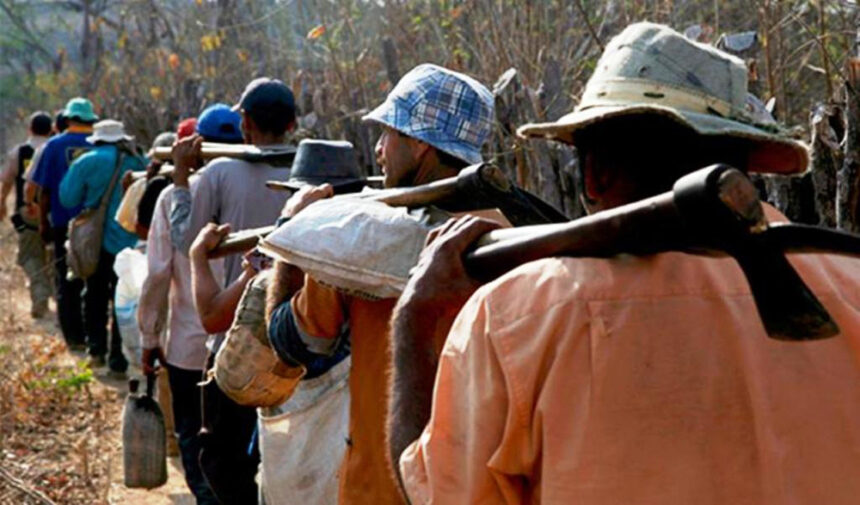
SANTO DOMINGO. – The senator for San Juan, Félix Bautista, warned this Wednesday about a disadvantage that, according to him, the Dominican Republic faces in international trade and presented a bill to the Senate to prohibit the entry into the country of merchandise and goods produced through forced labor.
During his speech at the Senate session, Bautista explained that the initiative seeks to protect workers, but also to create conditions for greater competitiveness for Dominican products in international markets.
You might be interested in: https://deultimominuto.com/nacionales/politica/bournigal-recupera-la-voz/
The legislator maintained that forced labor includes any work activity performed under threats, confinement, debt bondage, or intimidation, including cases in which employers withhold passports or identity documents from migrant workers to prevent them from leaving their jobs.
“It is any work that involves coercion of the worker,” explained Bautista.
More Read

As an example, he mentioned the withholding of migrant workers’ documents and threats related to their immigration status, a practice that, he noted, constitutes a form of forced labor.
Bautista also referred to international experiences and recounted that during a visit to South Korea, he observed companies displaying signs certifying that their goods were not produced through forced labor.
The business problem
The senator explained that the proposal also arises from an evaluation carried out by the United States regarding the policies of different countries to prevent the entry of goods produced through forced labor.
As detailed before the plenary, the evaluation covered 60 countries and determined that 17 had laws to prevent the entry of this type of merchandise, while another 43 did not have specific legislation.
Bautista maintained that this difference ended up having commercial consequences for the Dominican Republic, which was among the countries to which the United States applied a 12.5% tariff.
The United States effectively included the Dominican Republic among the countries affected by an additional 12.5% tariff, arguing that the country had not established or effectively enforced a ban on the importation of goods produced in whole or in part by forced labor.
The senator stated that this situation places Dominican exporters in a less favorable position compared to competitors from countries that have legal mechanisms against these types of products.

“We have a competition problem,” stated Bautista, when comparing the Dominican situation with that of countries like Mexico.
What does the initiative propose?
Given this scenario, Bautista presented the bill titled Law for the Prevention and Prohibition of the Importation of Goods and Merchandise Produced Through Forced Labor.
More Read

The proposal seeks to establish by law a prohibition on importing into the Dominican Republic goods produced in countries where the use of forced labor is determined.
The legislator pointed out that other countries in the region have already adopted similar measures, including Mexico, Honduras, Guatemala, El Salvador, Argentina, and Ecuador.
Bautista acknowledged that the Executive Branch has already taken measures on the matter through Decree 502-26, issued by President Luis Abinader on July 23.
The provision establishes an administrative procedure to prevent, identify, verify, and restrict the importation of merchandise, products, and goods produced in whole or in part through forced labor. Furthermore, it empowers the General Directorate of Customs to order an import ban when it is determined that the goods were produced under such conditions.
However, Bautista considered that the decree is not sufficient because, in his view, an administrative provision cannot establish the same sanctions or obligations as a law passed by Congress.
“The decree is not enough,” maintained the senator, who insisted that the new legislation would allow for a more specific prohibition on the import of goods linked to forced labor.
Multiparty project
The initiative has the backing of several senators from different political sectors. Among the signatories mentioned by Bautista are Félix Bautista, Omar Fernández, Eduard Espiritusanto, Andrés Guillermo Lama, Moisés Ayala, Johnson Encarnación, Carlos Manuel Gómez, Cristóbal Venerado Castillo, Rafael Barón Duluc, Manuel María Mercedes, Ramón Rogelio Genao, Alexis Victoria Yeb, and Anedys Ortiz Sajiún.
Bautista requested that the project be referred to the Industry, Commerce and MSME Commission for its study.
The proposal reaches Congress in a context where the Dominican government has already begun to implement administrative controls against goods linked to forced labor, while the export sector faces the challenge of maintaining its competitiveness against countries with lower tariff burdens.
For Bautista, the approval of specific legislation would allow not only for combating labor exploitation practices, but also for strengthening the position of the Dominican Republic in the face of new international trade demands.