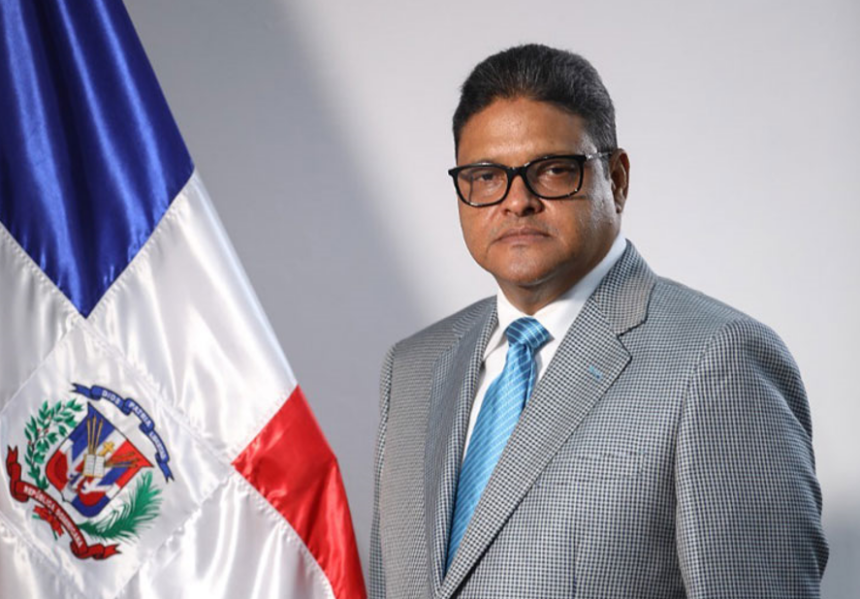
Santo Domingo.- The government of President Luis Abinader has once again moved the pieces at the National Institute of Transit and Land Transportation (Intrant). Retired Major General Juan Manuel Méndez García, who for more than two decades was at the head of the Emergency Operations Center (COE), has assumed the leadership of one of the institutions with the greatest impact on the daily lives of Dominicans.
Their arrival comes at a time when traffic continues to be marked by congestion, disorder on the roads, fragmented public transport, motorcycles, traditional routes, and high mortality from road accidents.
The Presidency explained that the appointment of Méndez, through Decree 551-26, is part of a reorganization of different areas of the public administration and replaces Milton Morrison, who submitted his resignation.
But beyond the name change, the question that remains on the table is another: What will the new director be able to do differently to face a problem that has survived several administrations?
From emergencies to daily transit
Méndez arrives at Intrant with a different experience than his predecessors. For approximately 21 years, he was linked to the COE management, where he coordinated responses to hurricanes, floods, accidents, and other emergency events.
More Read

Now he must go from coordinating responses to critical situations to trying to prevent thousands of them from occurring daily on the streets.
During his inauguration, the new official avoided promising immediate solutions. He acknowledged that the traffic problem cannot be solved overnight and stated that it will be necessary to work with the different sectors.
Its first definition was clear: to enforce Law 63-17 on Mobility, Land Transport, Transit and Road Safety.
He also assured that he will give continuity to the initiatives that have worked and will apply the necessary improvements. This approach places him before a first question: Which initiatives is he receiving underway and which ones have been waiting for years to become a reality?
What Milton Morrison leaves behind
During Milton Morrison’s two years of management, Intrant promoted a transformation of the driver’s license system and advanced in transport reorganization processes.
The new license issuance system began operating in March 2026. By mid-August, it had issued more than 329,000 documents. Morrison, upon handing over the institution, also highlighted progress in terms of institutional framework and ISO certifications in Quality, Anti-bribery, and Compliance.
You can also read: Abinader appoints Juan Manuel Méndez as the new director of Intrant
Méndez, therefore, does not start from scratch.
However, an important part of the pending agenda remains the same.
More Read

The first major challenge: deaths on the streets
The most difficult data to ignore is in the road safety statistics. During 2025, 2,992 people died in traffic accidents in the Dominican Republic. More than 65% of those victims were motorcyclists, according to the information presented by Intrant itself to the United Nations.
The Government declared road safety a matter of high national interest and proposed to reduce deaths by 50% by 2030.
To reach that goal, it is not enough to carry out occasional operations.
The new director will have to demonstrate whether they can turn oversight, road safety education, and compliance with regulations into a permanent policy.
Motoconchos: regulating without leaving behind those who make a living from them
Motorcycles represent one of the system’s greatest challenges.
In June, during the Morrison administration, Intrant led a national motorcycle taxi regularization operation that intervened in 488 stops and impounded 599 motorcycles. Thousands of operators were also registered and inspections were carried out in different provinces.
The operation shows the scale of the problem, but it also raises a question for the new management:
Will the solution be to continue with operations or to create a permanent system that allows us to know who provides the service, where they can do it, under what conditions, and what consequences those who fail to comply will face?
The institution itself has proposed the formalization of the motorcycle sector and compliance with regulations as objectives of its mobility policy.
Public cars and routes: the other difficult terrain
The Dominican public transport is not a homogeneous system either.
The Metro, the Cable Car, OMSA, and organized corridors coexist with traditional routes of public cars, buses, unions, private operators, and motoconchos.
In 2026, progress has been made in the integration of corridors. The Independencia Corridor began operating in February and the 27 de Febrero Corridor started operations in August with an integrated fare to facilitate connection with other transport systems.

But the ordering of traditional routes continues to be a challenge.
In July, the Intrant intervened in 17 routes in Santiago due to unauthorized fare increases and fined dozens of vehicles.
The problem is not only determining how much a ticket should cost.
It also involves answering questions such as:
- Who is authorized to operate a route?
- How many units does each corridor need?
- Where should the stops be located?
- What happens when an operator encroaches on a route?
- How are informal routes addressed?
- How are public vehicles integrated into the mass transit system?
- What will happen to the unions and associations that currently control certain routes?
There will be one of the most important political tests for Méndez.
The point-based license: a promise that remains pending
Another file that the new director will find is the points-based license.
The mechanism is contemplated in Law 63-17 and its regulations, but its comprehensive implementation remains pending. The Intrant Institutional Strategic Plan 2025-2028 keeps the points system on its agenda.
The importance of this tool lies in creating a regime of consequences for repeat offenders.
The question for Méndez will be simple, but politically complicated:
When will it actually start working?
ITV: the file that has been waiting for decades
The Technical Vehicle Inspection is another of the major pending issues.
The Dominican Republic has a vehicle fleet of millions of units, and a significant portion is over ten years old. Without generalized technical inspection, the State faces greater difficulties in ensuring that the vehicles circulating on the streets meet minimum safety conditions.
The project has gone through bidding processes and public-private partnership models without there being a national system operating in a general manner so far.
For the new director, launching the ITV would mean entering one of the most sensitive areas of transport: determining whether millions of vehicles are truly roadworthy.
The challenge of converting operations into public policy
There is a difference between intervening in an avenue for a few hours and permanently modifying the behavior of those who use the roads.
That may be one of the biggest challenges for Méndez.
Intrant, Digesett, the National Police, city councils, and other institutions have distinct responsibilities regarding traffic. Therefore, the new director will need to convert the coordination experience he acquired at the COE into a permanent working structure.
In other words: the challenge will not only be to make them operational, but to ensure that order remains when the agents withdraw.
An Intrant under greater scrutiny
The new administration also begins with an institution whose image was affected by the case related to the Greater Santo Domingo traffic light network contract and the so-called Operation Chameleon.
The RD$1.3173 billion contract awarded to Transcore Latam was suspended in 2023 after Public Procurement detected signs of irregularities. The judicial process continues and the accused maintain their presumption of innocence until there is a final sentence.
This means that any new technological project or major hiring that Méndez promotes will have to face special scrutiny.
The real test for Méndez
The new director has in their favor an image built over years of public service and considerable experience in inter-institutional coordination.
But Intrant is not the COE. In the COE, an emergency has a beginning, an operation, and a closing moment. Traffic is a permanent crisis: it happens every day, at all hours, and in every province.
Therefore, Juan Manuel Méndez’s success should not be measured by the number of operations carried out during his first months, but by concrete indicators: fewer deaths, fewer traffic violations, better-organized routes, more integrated public transport, regularized motorcyclists, vehicles in safe conditions, and citizens who respect the rules.
Méndez himself has said that he cannot solve the problem alone and that compliance with the rules must become a collective responsibility.
Now the hard part begins: turning that statement into results.