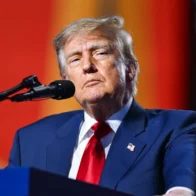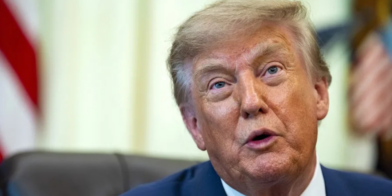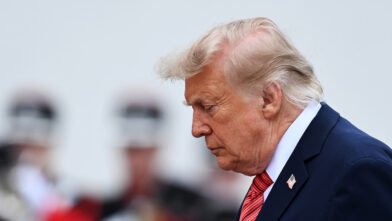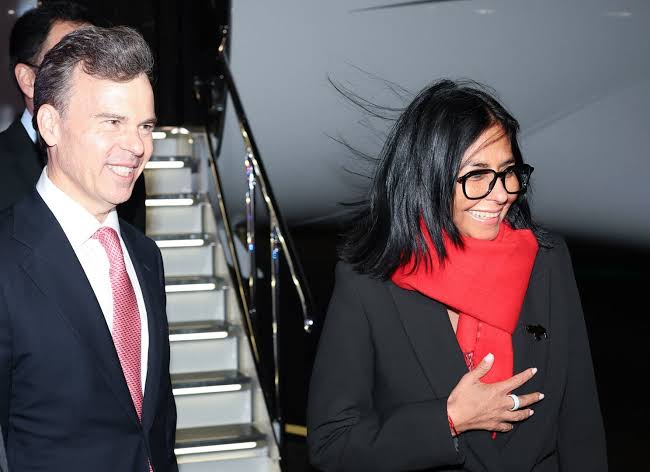
New York.- US President Donald Trump will meet this Tuesday for the first time with the interim president of Venezuela, Delcy Rodríguez, in an unprecedented rapprochement between Washington and Caracas, less than a year after Nicolás Maduro was arrested and deposed in a US military operation.
According to the White House, it will be a brief meeting at 7:40 p.m. (23:40 GMT) in New York, on the sidelines of a leaders’ reception for the UN General Assembly, which Rodríguez is attending for the first time as interim president of Venezuela.
You may be interested in: Donald Trump will visit the DR in the framework of the Summit of the Americas
The format, more informal than the bilateral meetings Trump will hold with the leaders of France, the United Kingdom, or Japan, does not diminish the significance of a face-to-face meeting that was unthinkable just a year ago, when Washington and Caracas had severed their relations.
The meeting will take place shortly after the controversial agreement by which Venezuela ceded part of its oil reserves to the United States and just a few kilometers from the New York prison where Maduro remains detained, accused of drug trafficking.
More Read
Rodríguez, who was Maduro’s vice president and assumed power after his capture, had pledged loyalty to the Chavista leader before initiating an unexpected progressive rapprochement with Washington.
An image to seal the turn
Meanwhile, opposition leader María Corina Machado remains in Panama awaiting authorization from the United States to enter the country, three months after Washington blocked her entry.
Machado gave Trump her Nobel Peace Prize medal in an attempt not to be excluded from the transition process in Venezuela.
More Read
Since the Chavista leader was deposed in the U.S. operation on January 3rd in Caracas, the United States and Venezuela have gone from being arch-enemies to strengthening their cooperation in various areas, especially in the oil sector, within what Washington has defined as a “tutelage” over the South American country.

Trump, who is facing growing political attrition due to the war with Iran just weeks before the legislative elections on November 3rd, often claims the “success” of the operation in Venezuela and the benefits that, according to him, it has brought to the United States in terms of oil.
The photograph of both posing together in New York would seal this new stage in bilateral relations.
The meeting between Trump and Delcy will also be the first between a U.S. president and a Venezuelan ruler in more than eleven years, since the brief meeting held by Barack Obama and Maduro during the 2015 Summit of the Americas, held in Panama.
Oil, amnesty and legitimacy
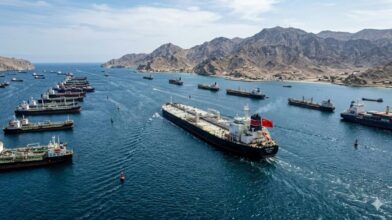
The main sign of the rapprochement came recently with the announcement of an oil deal that would allow the United States to control a fifth of Venezuela’s crude oil reserves.
The pact has sparked suspicion among sectors that believe the Trump administration is only interested in oil and is not actively promoting a democratic transition in Venezuela.
More Read

In parallel, there have been some advances in human rights, such as the approval of an amnesty law that has facilitated the release of political prisoners and the announcement of the closure of El Helicoide, an emblematic detention and torture center in Caracas.
The dialogue process initiated in August between Chavismo and a sector of the opposition facilitated last week the lifting of censorship on the websites of some media outlets, including the EFE Agency.
The close relationship between Washington and Caracas has also given the Rodríguez government a certain regional legitimacy. The interim president received the Paraguayan leader, the conservative Santiago Peña, in Caracas on Saturday, in an approach aimed at restoring diplomatic relations that had been broken since 2025.