Austin.- From a detention center in South Texas, and with one of the bullets fired at him by an agent of Immigration and Customs Enforcement (ICE) still inside his body, Venezuelan Wilber Garcés recounted by phone to local reporters the last 24 hours of his life, in which he went from working as a delivery driver to being detained in South Texas.
“I did not receive adequate medical attention,” said Garcés, 29, during a press conference in which his lawyer, Kate Lincoln-Goldfinch, called her client and put him on speakerphone. His wife, Elizdar, was also present at the media event, as were dozens of activists and local politicians.
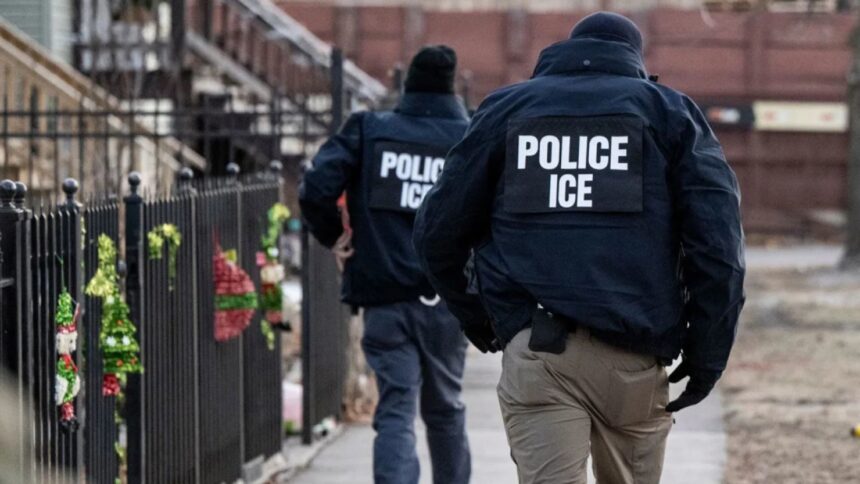
Garcés was intercepted on Sunday around 1:00 p.m. local time north of Austin, Texas by ICE agents who were in a black pickup truck, with no markings identifying it as a police vehicle. The officers, whose names have not been released, fired at his car and wounded him in the back.
The incident, which sparked protests in the Texas capital and a wave of backlash from activists and lawmakers in the U.S., was the turning point that marked a 180-degree change to the life he was building with his wife since arriving in the country in 2024.
You can also read: ICE agent shoots a Venezuelan in Texas
“I thought I was a normal person”
On Sunday afternoon, Garcés was working delivering food orders through the DoorDash app. While he was driving his car, a blue Toyota Corolla, in North Austin, near Research Boulevard, a black pickup truck hit him from the side.
More Read

“I think he is a normal person,” Garcés recounted. Then, a man, who identifies himself as an immigration agent, gets out of the car and asks him to hand over his documents. “I asked them why they were stopping me, that I have everything in order; he tells me to get out of the vehicle,” he added.
Garcés said that he told the officers he agreed to get out of his car, but that he was going to park it first so it wouldn’t be left “blocking” the middle of the street. “I made a U-turn, he started chasing me and (the officer) thinking that I was going to escape… he crashed again and shot at me“. He also claimed that he felt only one shot, but that he is not sure how many he received.

“How is he going to leave the bullet in there?”
After Garcés was shot, one of the officers got into his car “by force” to turn it off. “He left me in there, he didn’t help me at all,” the migrant stated.
More Read

It is unclear how much time passed between Garcés being shot and the arrival of the ambulance, which took him to a local hospital. There, one of the doctors told him that they could not perform surgery to remove the bullet, which is near his spine, “because they were in a hurry” to discharge him.
“I told the doctor: ‘How are you going to leave the bullet in there if it still hurts?’, he pointed out. Around four in the afternoon, according to his lawyer, Garcés was discharged, handed over to the custody of federal agents, and in the early hours of this Monday, he entered the Pearsall detention center, about 220 kilometers from Austin.
An administrative error and a deportation order in absentia
Garcés arrived in the U.S. in 2024 and entered the country using CBP One, a program of former President Joe Biden’s administration (2021-2025) that allowed migrants who wanted to seek asylum in the U.S. to schedule an appointment to appear at a port of entry on the border with Mexico.
According to his lawyer, the migrant filed an asylum application, had a work permit, and his case was being processed by an immigration court. Due to an administrative error—Garcés changed his address and the system did not process his new residence—the letter with the date for his final hearing did not reach his current address.
He missed his hearing because he did not know he had one, and the immigration judge ordered his deportation “in absentia,” the lawyer explained. These types of rulings have skyrocketed during the administration of U.S. President Donald Trump: so far this year, judges have ordered the expulsion of some 281,867 migrants who did not show up for their appointments, according to official data.
The Department of Homeland Security (DHS), for its part, asserts that it has already opened an investigation into what happened and insists that Garcés entered the U.S. “illegally” and that ICE agents approached him as part of a “police operation” in Austin.