
Moscow.- The constitutional majority achieved by the Kremlin party, United Russia, in the legislative elections gives the Russian president, Vladimir Putin, carte blanche to continue the war in Ukraine and his policy of antagonism toward the West.
Putin, who had called on Russians to vote to contribute to Russia’s victory -the only point in the program of the party that has monopolized the Duma or chamber of deputies since 2003-, was congratulated this Monday by several of his partners and allies.
You might be interested in: Russia said it is preparing meetings with the United States in the coming weeks to address their differences
The result, which exceeds that achieved in 2021, before the start of the military campaign, contrasts with what the polls say: 59% of Russians advocate for the cessation of fighting and the start of peace negotiations.
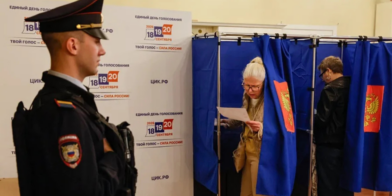
Although the turnout during the three days of voting was higher than expected—almost 60%—the impression is that the opposition to the war failed to mobilize the protest vote, something the Kremlin did successfully with its electoral base: pensioners, military personnel, and civil servants.
More Read

Historic victory
As reported on Monday by the Central Election Commission (CEC) after the counting of 95% of the votes, the ruling party would obtain 355 of the 450 seats in the lower house of the Russian Parliament, the best result in its 25-year history.
Neither the drones -Moscow suffered on Sunday the largest attack of the entire conflict– nor the internet blockade nor the fuel deficit prevented the Kremlin’s electoral machinery from achieving the desired result.
RU, whose best result had been 343 deputies in 2016 -two years after the annexation of the Ukrainian peninsula of Crimea-, achieved 57.83% of the votes by party lists, which translates into 147 seats, to which must be added 208 seats by electoral districts.
More Read

In this way, UR would far exceed the 301 seats necessary to achieve the majority that allows for the introduction of constitutional reforms. In the Russian mixed system, half of the seats are distributed by lists (225) and the other half by constituencies (225).
This already allowed him in 2020 to eliminate the constitutional clauses that prevented Putin from running for reelection in 2024 and 2030.

Total monopoly of institutions
In the image and likeness of the Communist Party of the Soviet Union (CPSU), United Russia won the elections in all regions of the country, including the four annexed by Moscow in Ukraine, as highlighted by Vladimir Yakushev, general secretary of the ruling party.
In addition, the nine RU governors who ran in the regional elections were re-elected directly or by local assemblies. The record was set by the feared Chechen leader, Ramzan Kadyrov, who obtained 99.85% of the votes.
Meanwhile, the communists achieved only 13.81% of the votes by lists and five seats by districts, for a total of 40 seats in the Duma. They are followed by the ultranationalists of the Liberal Democratic Party with 8.98% by lists and 25 deputies, and the liberals of New People with 7.96% and 20 seats.
Independent analysts expected the communists and liberals to achieve better results, as the opposition in exile asked their supporters to back them in the so-called Smart Vote to take seats away from A Just Russia. With the count yet to be concluded, it is still unknown whether A Just Russia will finally enter the parliamentary fold.

The pacifist opposition is left out of Parliament
The only party opposed to the war, Yabloko, which was excluded from the lists by the Supreme Court, did not win a single parliamentary seat. Its best results were the second-place finishes achieved in several electoral districts of the Russian capital.
One of those candidates is Grigori Grishin. In this regard, he considers that “the announced results correspond to the political-administrative situation in the country, but not to the mood of the people.”
“The situation is tragic. The authorities do not want to listen to the supporters of peace. They are moving further and further away from the citizenry,” he commented to EFE. Regarding the future of his party, he assured that he will try to “survive” and that the support of the youth during the campaign is an “encouragement” to continue working.
The leader of that party, Nikolai Rybakov, stated after the polls closed that Yabloko would have been the second most-voted party in the first parliamentary elections of the entire war had it appeared on the ballots.
In response to allegations of irregularities from the opposition, especially regarding electronic voting, the chairwoman of the CEC, Ella Pamfilova, replied that the voting had proceeded cleanly despite attacks, pressure, and cyberattacks from Ukraine and the West.
“Everything is a farce. I don’t know anyone who voted for United Russia,” a Muscovite commented to EFE after the polls closed.