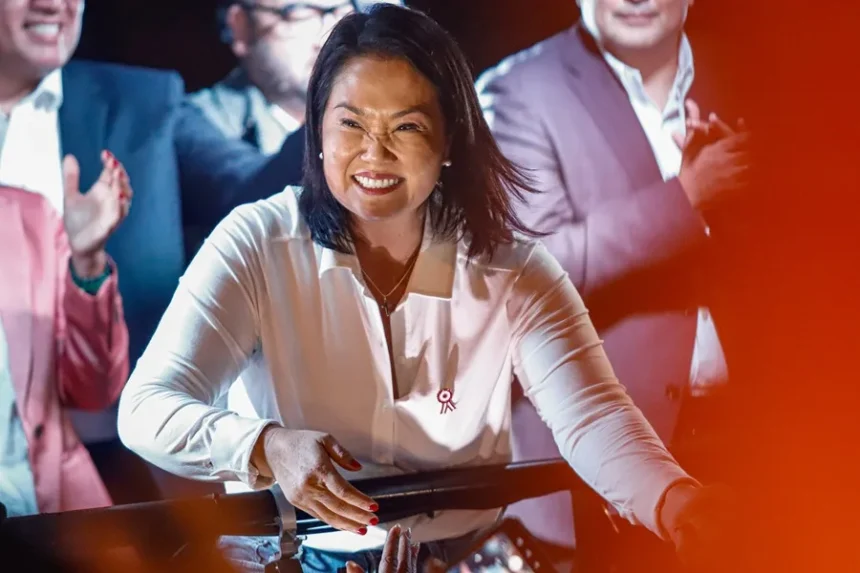
Lima.- Keiko Fujimori, the daughter and political heir of former Peruvian president Alberto Fujimori (1990-2000), will inaugurate the second era of Fujimorism in Peru when she is sworn in as president of Peru this Tuesday for the next five-year term (2026-2031), a moment she has been seeking throughout her entire political career, for more than twenty years.
Fujimori, who won the election on her fourth attempt after having lost in the runoff in the three previous occasions, leads the return of Fujimorism to the Government of Peru, almost twenty-six years after her father resigned by fax from Japan amidst a major corruption scandal that also involved his right-hand man, Vladimiro Montesinos.
In that quarter of a century, the former president’s eldest daughter took the reins of Fujimorism with the purpose of freeing her father, who was sentenced to 25 years in prison for crimes against humanity and corruption, and of regaining power to vindicate him and attempt to clear his name.
The leader of the Fujimorist party Fuerza Popular, who had come from three tough defeats and spent nearly a year and a half in pretrial detention between 2018 and 2020 for alleged money laundering in her electoral campaigns, won this year’s election by fewer than 50,000 votes over leftist Roberto Sánchez.
Total vindication of Alberto Fujimori
The 51-year-old right-winger won without renouncing her principles and with a total vindication of Alberto Fujimori’s legacy, especially to address citizen insecurity in the face of increased organized crime activity in the form of extortion against the population, popular businesses, and public services.
More Read

Keiko has promised to combat criminal gangs in the same way her father defeated the terrorism of the subversive groups Shining Path and Túpac Amaru Revolutionary Movement (MRTA), a strategy that achieved its purpose but led to the former president being convicted for human rights violations.
We recommend reading:

This makes anti-Fujimorism, and especially the victims of state violence, distrust his calls for reconciliation and remain vigilant regarding his first decisions.

First Peruvian woman to be elected president
Fujimori, the first woman to be elected president in Peru, will take office after a decade of great political instability that has led the country to have eight heads of state in ten years, due to a series of presidential removals promoted by Parliament, most of them with votes from Fujimorism when the leaders did not align with their demands.
For this reason, her detractors accuse her of being behind the spiral of political volatility into which the country has fallen, while she defends herself by saying that she has never been in the Government.
Everything indicates that Keiko will have sufficient support in Parliament to avoid being removed during her five-year term, while in economic matters she has the backing of business leaders, especially after guaranteeing the continuity of Julio Velarde at the Central Bank, the face of Peru’s monetary stability, as he has held the position for twenty years.
Peru joins Latin America’s shift to the right
Fujimori’s victory also sharpens Latin America’s shift to the right, which will be reflected in the heads of state who will attend his inauguration, including the presidents of Argentina, Javier Milei; of Bolivia, Rodrigo Paz; of Chile, José Antonio Kast; of Ecuador, Daniel Noboa; and of Panama, José Raúl Mulino, all of them from the right and far-right.
Also present will be the King of Spain, Felipe VI, and the President of Uruguay, the leftist Yamandú Orsi, as well as some leaders and former presidents with whom Fujimori maintains a good relationship, such as the president of the People’s Party (PP) of Spain, Alberto Núñez Feijóo; and former presidents Jamil Mahuad (Ecuador), Eduardo Frei (Chile), Jeanine Áñez (Bolivia), and Mireya Moscoso (Panama), among others.