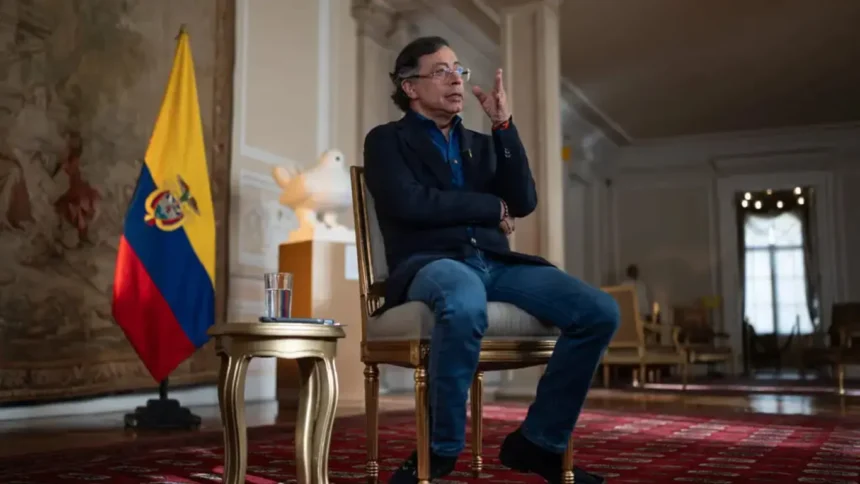
Bogotá.- The outgoing president of Colombia, Gustavo Petro, unveiled his portrait this Monday in the gallery of former leaders at the Casa de Nariño, the seat of government, four days before leaving the office where he will be succeeded by the far-right Abelardo de la Espriella.
After a press conference in which he insisted on the alleged fraud in the presidential elections, Petro, accompanied by members of his cabinet, unveiled amidst applause the painting by Jaime Rojas that remained hidden under a red cloth, hanging next to the official portrait of his predecessor in office, Iván Duque (2018-2022).
The artwork shows Petro full-length, dressed in white and wearing sports shoes of the same color, sitting in an armchair with a pencil in his left hand, a gesture he often repeats when speaking from the podium in his speeches, surrounded by three yellow butterflies that represent the work of Nobel laureate Gabriel García Márquez.
The president also wears on his wrist two of the symbols that have defined his public image: a bracelet with the colors of the “war to the death” flag, associated with a decree issued by Simón Bolívar in 1813 during the independence, and the wooden Tau cross, a Franciscan symbol of peace that he has worn for years.
You can also read: Gustavo Petro says his successor was elected with a system
Behind the armchair, a farmhouse can be seen with a crop that appears to be coffee and, on the horizon, the mountains under a sky of glowing clouds.
More Read

Petro previously explained that this portrait would be exhibited when “the painting of the Black president Carlos (sic) Nieto and the indigenous president General José María Melo is put up,” two historical figures to whom he often alludes in his speeches and whose portraits, however, are not yet displayed in the gallery of former presidents.
The Black president to whom Petro alludes is Juan José Nieto, who governed the Granadine Confederation, one of the names held by the current Republic of Colombia, for a period of less than six months, between January 25 and July 18, 1861.
The indigenous leader José María Melo was a military man who joined the army of the Liberator Simón Bolívar, fought in several wars of independence in South American countries, and between April 17 and December 4, 1854, was the de facto president of the Republic of New Granada, created after the dissolution of Gran Colombia.
More Read
The installation of the portrait is one of the last acts of the outgoing leader before next August 7, when the president-elect, Abelardo de la Espriella, will be inaugurated in Cali, the main city in the southwest of the country.