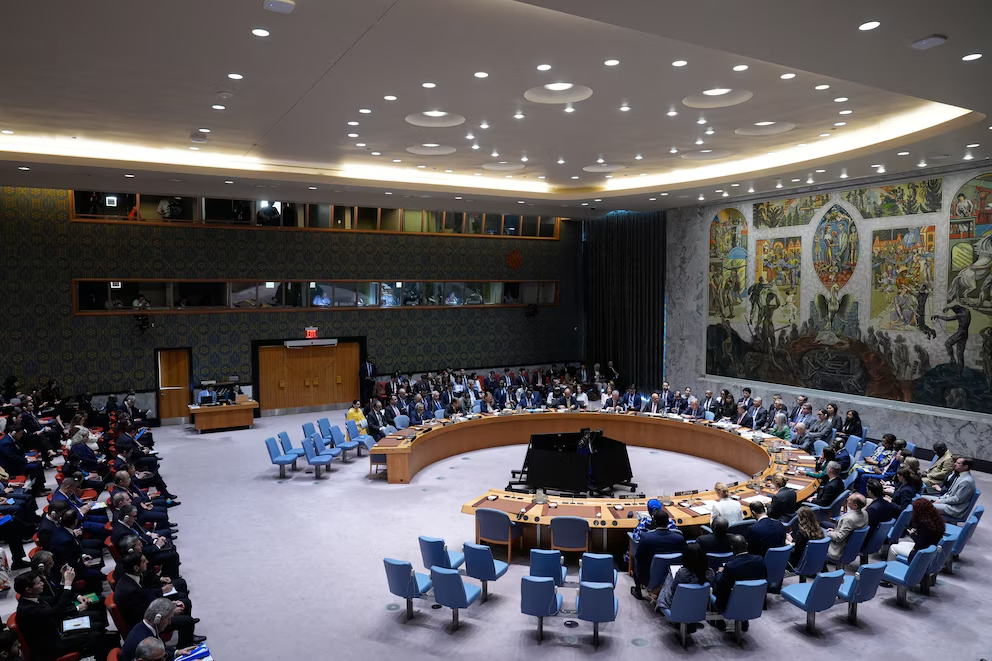
The United States walked out of a United Nations Security Council session on Monday as France was taking the floor, in protest of comments by the European country that compared Washington’s human rights policy to that of North Korea and other authoritarian states. The gesture, rare among permanent members of the body, occurred during a meeting focused on the war in Ukraine.
Dan Negrea, alternate representative of the United States to the General Assembly and a high-ranking official of the U.S. delegation, accused Paris of engaging in “dishonest grandstanding”. “There is a member of this council that feigns moral outrage and pretends to lecture the rest on any topic, whether it be the conflict we are discussing once again today or matters unrelated to international peace and security, such as human rights,” stated Negrea, as reported by the AFP agency.
“That is why we withdrew during France’s intervention” in the session, the U.S. official added. The Security Council is the United Nations’ body with the greatest decision-making weight, and both France and the United States are among its five permanent members with veto power, along with China, Russia, and the United Kingdom.
The background of the incident dates back to the previous Friday, when the United States voted in the General Assembly against extending Volker Türk’s mandate as UN High Commissioner for Human Rights. Washington thus joined a group of ten countries that rejected the renewal, including North Korea, Russia, and Nicarag
Following that vote, the French mission to the United Nations in Geneva published a message in English that set the tone for the subsequent diplomatic confrontation: “The United States used to be a beacon of human rights. It is no longer. Today it stands alongside North Korea, Nicaragua, Mali, and Russia, isolated. And the world is no longer listening to it.”
More Read

That comparison was the direct trigger for the American reaction on Monday. Negrea responded with no room for ambiguity: “I remind you that it is the United States that remains the beacon of freedom for the world. For that reason, we will not grant you the benefit of listening to your politicized speech,” he said, in reference to France.
The French ambassador, Jérôme Bonnafont, responded to the U.S. withdrawal by appealing to the historical relationship between both countries. “This year we celebrate the 250th anniversary of the United States. And everyone knows the role that France played in that,” he noted. The diplomat added that France is working at the UN, both in the Security Council and in the General Assembly, “to preserve this institution, its independence, and its capacity to act in the service of the Charter, human rights, and peace.”
The episode is part of a broader deterioration of multilateralism regarding human rights during the current U.S. administration, which has reduced its participation in international oversight mechanisms and has questioned the role of bodies such as the Human Rights Council, from which Washington formally withdrew at the beginning of the year. The tension with historical allies like France over these positions had not, until now, led to gestures of protocol rupture within the Security Council itself.

The altercation exposes an increasingly visible fracture between Washington and its European partners over the place that human rights should occupy on the international diplomatic agenda, at a time when the Security Council itself is facing growing criticism for its paralysis in the face of conflicts in Ukraine and Gaza.