The US ambassador to Lebanon, Michel Issa, informed President Joseph Aoun this Thursday that a US military delegation will arrive in Beirut in the coming days to coordinate on the ground the implementation of the so-called “pilot zones” in the south of the country. The visit marks the formal start of the operational phase of the framework agreement signed on June 26 in Washington, the first direct pact between Lebanon and Israel in decades, and places the US Central Command as an arbiter on the ground for a process whose concrete schedule remains unset.
Issa held a round of meetings this Thursday with the country’s three main institutional figures: President Aoun, Prime Minister Nawaf Salam, and Parliament Speaker Nabih Berri. In all of them, he conveyed the same message: Washington has entered the “implementation phase” of the agreement and the launch of the first pilot zone will take place “in a matter of days,” according to a US official who spoke to the media on condition of anonymity. The ambassador stressed the need to avoid “any security vacuum” at the moment Israeli troops leave the designated positions.
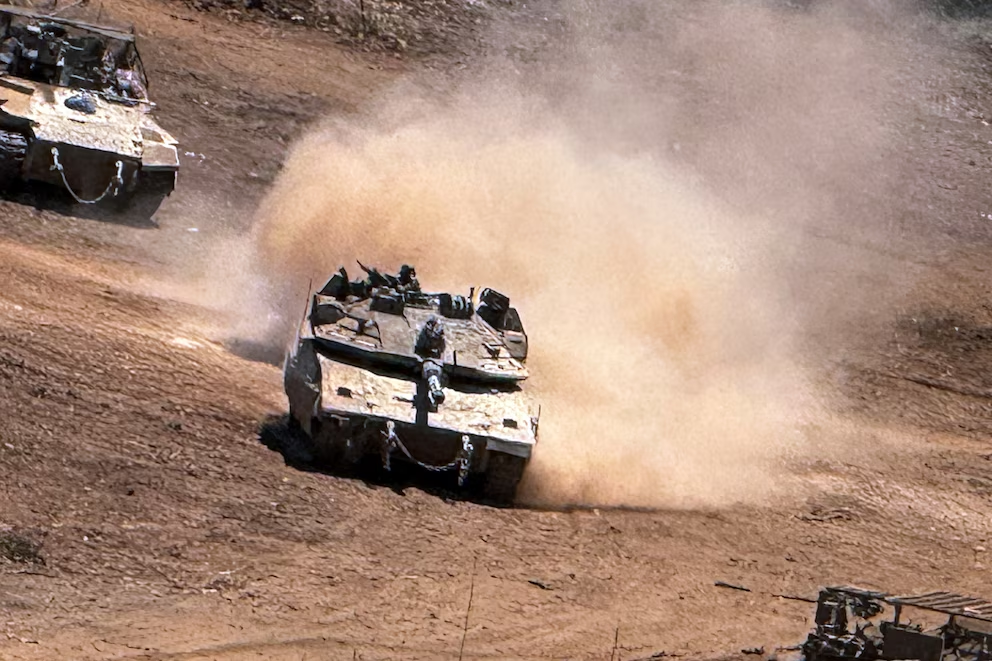
The “pilot zones” are demarcated areas in southern Lebanon where the Lebanese army must deploy and assume full control as Hezbollah withdraws and Israeli forces pull back. The text of the pact states that Lebanon will only exercise full responsibility over those zones once the “successful disarmament of non-state armed groups” is confirmed, a formula that directly alludes to Hezbollah. The agreement does not set any timetable for the Israeli withdrawal, and Israel’s Defense Minister, Israel Katz, reiterated this Thursday that its forces will remain in the south “as long as necessary” as long as the Shiite terrorist group remains armed.
We recommend reading:An airport in Florida officially changes its name in honor of Donald Trump

The absence of a timeline has turned implementation into the first diplomatic battlefield of the process. Beirut has conditioned its participation in the next round of negotiations, scheduled for July 15 and 16 in Rome, on Israel executing the withdrawal from the first two pilot zones before that date, according to a Lebanese diplomatic source cited by AFP. A U.S. official responded that the Rome talks will be held regardless, at the level of technical teams and behind closed doors.
More Read

The June 26 agreement was the result of five rounds of U.S.-sponsored negotiations in Washington. The pact provides for the gradual withdrawal of Israeli forces from southern Lebanon—where they maintain positions that can extend up to ten kilometers from the border—and the progressive deployment of the Lebanese army in their place. In return, it links that withdrawal to the disarmament of Hezbollah, a condition that Beirut cannot unilaterally guarantee. The precedent most cited by analysts is the May 17, 1983 agreement, which set a timetable for Israeli withdrawal but made it conditional on the departure of Syrian troops. Damascus never met that condition, and Israel remained in the south for sixteen more years.
Hezbollah, which dragged Lebanon into a new regional war in March 2026 in support of Iran, rejects the agreement in its entirety and did not participate in any of the negotiations. The group’s secretary-general, Naim Qassem, described the pact as “illegitimate” and “unconstitutional” in televised statements on Wednesday on the Al-Manar channel, and warned that the agreement “will not pass” and that Lebanese authorities will be “unable to implement any of its clauses.” President Aoun once again asked Washington to pressure Israel to cease military operations: the Israeli army carried out a drone strike on Wednesday that killed two people in Nabatieh, according to Lebanese state media.
The arrival of the U.S. military delegation in Beirut turns Washington into an active guarantor of an agreement that faces rejection from Hezbollah, Israeli ambiguity regarding the withdrawal timeline, and pressure from a Lebanese government that needs tangible results before sitting down to negotiate again in Rome.