Germany will purchase Tomahawk missiles from the United States and deploy them on its own territory, as announced on Thursday by Chancellor Friedrich Merz before the German Parliament, after returning from the NATO summit in Ankara.
The agreement, concluded with the government of President Donald Trump, puts an end to months of uncertainty and marks a shift in the country’s defense strategy. Merz described the measure as closing “a significant strategic gap” in national defenses.
The defense ministers of both countries signed a letter of intent on Tuesday through which Washington committed to granting formal approval for the sale of the missiles and their Typhon ground-based launchers before August. The exact number of units acquired will remain classified.
The new scheme differs from the plan negotiated under the Biden administration, which envisioned a U.S. battalion deployed on German soil to operate the systems. Now, Berlin assumes direct operational control, an aspiration that various governments had pursued since 2023.
German Chancellor Friedrich Merz attends a plenary session of the lower house of Parliament, the Bundestag, in Berlin, Germany. July 9, 2026.
More Read

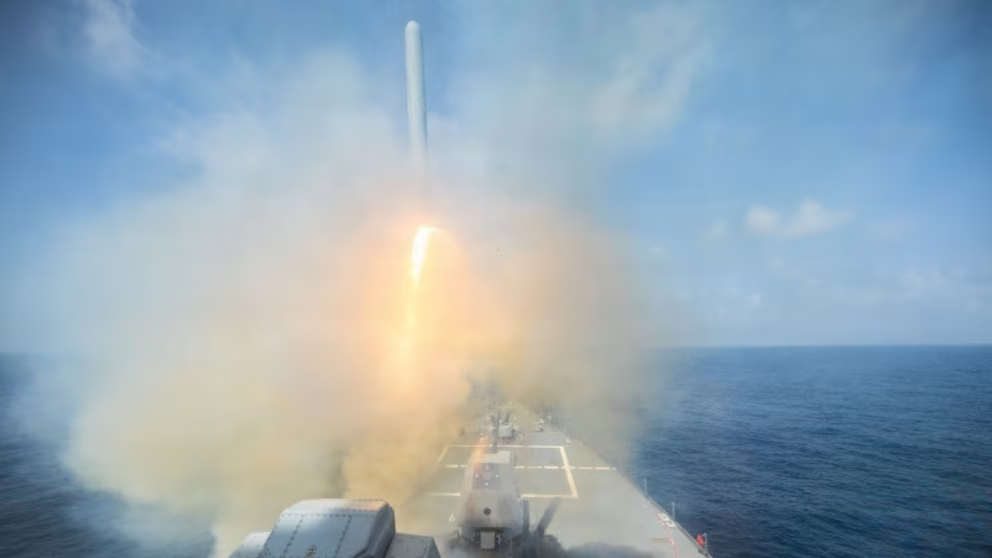
The Tomahawk has been part of the U.S. arsenal since the 1980s. It flies about 30 meters above the ground, which makes it difficult for enemy defense systems to detect, and has a range of around 1,600 kilometers (1,000 miles). Germany considers it indispensable against Russia, which maintains Iskander missiles in the Kaliningrad enclave capable of striking targets in several Alliance countries.

We recommend reading:The United States will send a military delegation to Beirut to oversee the first Israeli withdrawal from southern Lebanon
“The United States possesses key capabilities that we in Europe cannot do without,” stated Defense Minister Boris Pistorius, who described the acquisition as “the only way” to meet commitments to NATO regarding deterrence. The domestic alternative, the Taurus missile, covers barely 500 kilometers (311 miles), between three and five times less.

The path to this understanding was marked by setbacks. In May, Merz suggested that the plan would be canceled, citing the depletion of arsenals due to the conflicts in Iran and Ukraine, and a dispute with Trump over the Iranian war. Added to that was the president’s previous announcement to reduce the U.S. military presence on German soil. Friedrich Merz and Donald Trump, among other NATO leaders, during the Ankara summit where they sealed the Tomahawk missile sale agreement. July 8, 2026.
The Ankara summit reversed that scenario. Merz stated that the meetings “exceeded his expectations” and that the pact was reached on the sidelines of the formal sessions.
In parallel, the United Kingdom announced on Wednesday that a dozen NATO allies will jointly allocate approximately $50 billion over the next decade to develop long-range precision strike weaponry. Berlin plans to contribute about half of that amount.
Pistorius detailed that the group “will develop long-range cruise missiles and hypersonic glide vehicles, and will acquire long-range drones available on the market.” The purchase of Tomahawks operates, in that scheme, as a bridge that covers the capability gap while Europe builds its own systems.