
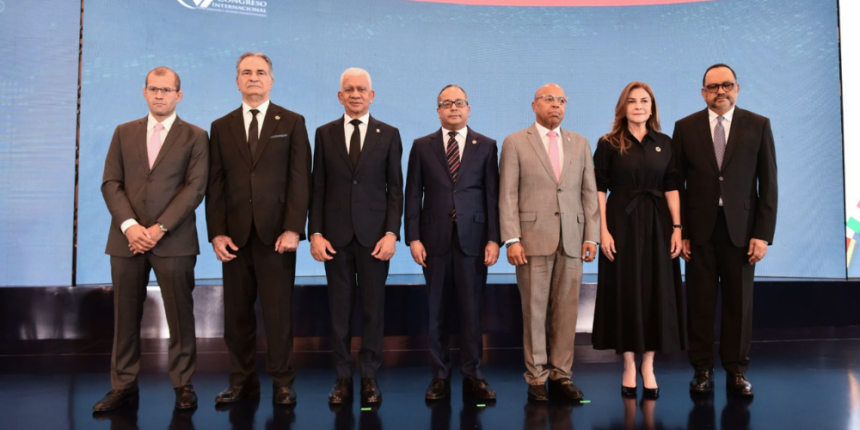
Santo Domingo.– The Constitutional Court (TC) inaugurated this Monday the VI International Congress on Constitutional Law and Justice, dedicated to the analysis of “Constitutional due process in criminal matters,” with the participation of more than 45 national and international experts.
During the opening ceremony, the president of the Constitutional Court, Magistrate Napoleón R. Estévez Lavandier, highlighted that the guarantees of due process constitute limits on the exercise of power within a democratic society.
“Defending due process does not mean defending impunity: it means defending the Constitution; it means defending human dignity as a supreme value and, above all, it means defending the very idea of justice,” stated Estévez Lavandier.
The magistrate recalled that article 69 of the Dominican Constitution establishes the fundamental guarantees of due process, which, as he explained, should not be understood as mere formalities, but as constitutional limits on the exercise of power.

Likewise, he cited decisions of the plenary of the Constitutional Court related to the judicial review of habeas corpus, the limits on the confidentiality of the Public Prosecutor’s case file, the notification of sentences to the lawyer of a defendant deprived of liberty, the provisional and definitive archiving of cases, and the presence of the defendant’s lawyer during evidentiary proceedings.
Estévez Lavandier pointed out that these criteria were taken into account in the comprehensive reform of the Criminal Procedure Code, approved through Law 97-25.
More Read

During his speech, he also raised several of the challenges facing the criminal justice system, including judicial backlog, the excessive duration of proceedings, penal populism, pressure from public opinion, the advance of organized crime, and new forms of criminal activity.
“I invite you, starting today, to rethink due process not only as a set of guarantees, but as a true legal culture,” he/she expressed.
Tribute to Robert Alexy
The president of the Constitutional Court also dedicated part of his speech to remembering the German jurist Robert Alexy, whom he defined as a benchmark of contemporary constitutionalism.

When referring to his legacy, he highlighted the importance of legal decisions being based on reasons that can be justified and are compatible with fundamental rights.
More Read

The ceremony also featured welcoming remarks from the Mayor of the National District, Carolina Mejía, who highlighted the holding of the congress as a space for reflection and dialogue on constitutional justice.
The Minister of Justice, Antoliano Peralta, also participated in the event and highlighted the importance of debating the challenges of the judicial system, while emphasizing the work of the Constitutional Court in strengthening due process guarantees.
Analysis of artificial intelligence use in the justice system
As part of the opening day, the jurist from the Humboldt University of Berlin, Luis Greco, gave the keynote lecture “The power to judge without the intervention of a judge: the legal impossibility of the robot judge.”
Greco raised a critical position regarding the use of automated systems to perform functions inherent to judges. Although he acknowledged that it is technically possible to use algorithms and generative artificial intelligence models in this field, he maintained that there are ethical and normative questions related to the individual responsibility of those who make a judicial decision.
More than 45 experts participate in the congress
The VI International Congress on Constitutional Law and Justice brings together more than 45 specialists from Argentina, Costa Rica, Spain, the United States, Germany, Peru, Puerto Rico, Colombia, and the Dominican Republic.
The meeting began this Monday, September 21, and will run until Wednesday, with an agenda focused on the main challenges of criminal, criminal procedural, and constitutional law.