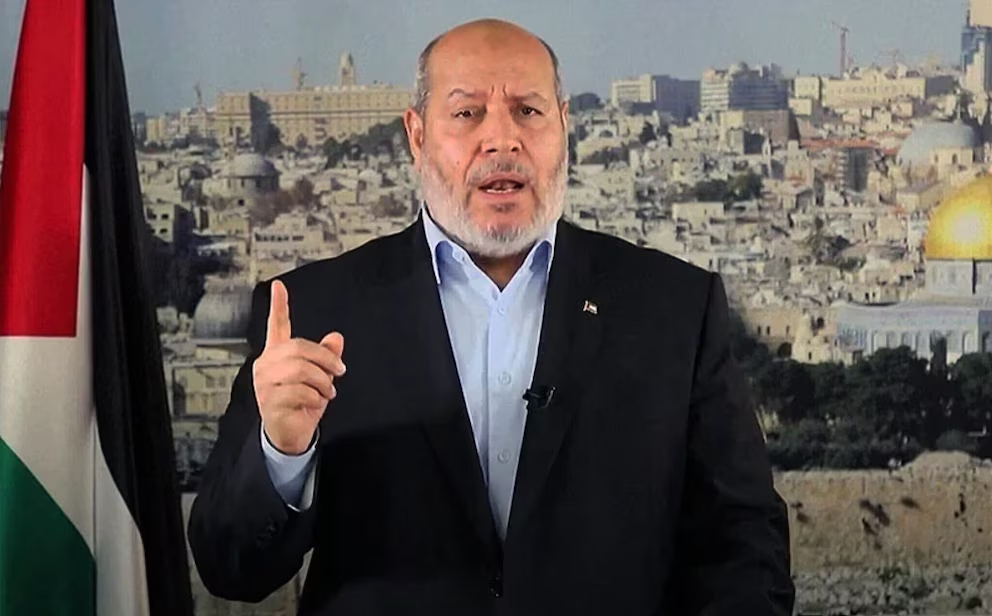
The terrorist group Hamas appointed Khalil Al-Hayya as its new supreme leader, in an election that analysts interpret as a sign that the group will maintain its stance of rejecting disarmament and its commitment to armed struggle.
Al-Hayya, 65, was elected by the terrorist movement’s General Shura Council—a 50-member body composed of representatives from Gaza, the occupied West Bank, and the diaspora—following a runoff against former political chief Khaled Meshaal, after neither candidate reached the required majority of more than 50% in the initial votes. He will hold the position until 2027, when the current electoral term expires.
The new leader replaces Yahya Sinwar, killed in combat by Israeli forces in October 2024, who in turn had taken over after the death of Ismail Haniyeh in Iran in July of that same year.
Born in Gaza on November 5, 1960, Al-Hayya obtained a bachelor’s degree from the Islamic University of Gaza in 1983, a master’s degree from the University of Jordan in 1986, and a doctorate in Hadith sciences in Sudan in 1997. He was a founding member of the terrorist group Hamas in 1987 and was imprisoned repeatedly by Israeli forces during the first Intifada. In 2006, he entered the formal political arena by winning a seat in the Palestinian Legislative Council, where he led the movement’s parliamentary bloc.
We recommend reading: Israel claims that Colombia will move its embassy to Jerusalem and resume its diplomatic relations
More Read

Since the outbreak of the war in October 2023, Al-Hayya acted as Hamas’s lead negotiator in indirect ceasefire and hostage exchange talks mediated by Qatar and Egypt. He operated primarily from Doha—the headquarters of the terrorist movement’s political office since 2012—which allowed him to coordinate diplomatic efforts while bypassing the blockade on Gaza.
Palestinian political analyst Reham Owda pointed out to Reuters that Al-Hayya’s victory “is a message that Hamas remains committed to armed struggle, rejects disarmament under any conditions” and intends to rebuild its military capacity while preserving its alliance with Iran and the so-called “Axis of Resistance.” “This indicates that negotiations related to disarmament will likely face significant difficulties and obstacles,” warned Owda. Al-Hayya is considered more hardline than Meshaal, his main rival in the internal contest.
Hamas is facing its greatest difficulties since its founding in 1987. The terrorist attack of October 7, 2023, triggered a large-scale Israeli offensive that reduced vast areas of the enclave to rubble.
More Read
Since the ceasefire negotiated by the United States last October, Israel controls more than 60% of the coastal enclave and the attacks continue. On Monday, an Israeli airstrike killed at least three Palestinians traveling in a vehicle in Khan Yunis, in southern Gaza, according to local medical services. The Israeli military confirmed to Reuters that it struck a militant in the area without providing further details.
U.S. President Donald Trump‘s ceasefire plan demands the disarmament of Hamas and an Israeli military withdrawal, and envisions the enclave being administered by a Palestinian technical authority overseen by his so-called Peace Council. Talks between Hamas, mediators, and envoys from that body—with the participation of Egypt, Qatar, and Turkey—have so far failed to reach a broad agreement to end the conflict. Inside Gaza, Hamas has faced criticism for the devastating human cost of the war.