
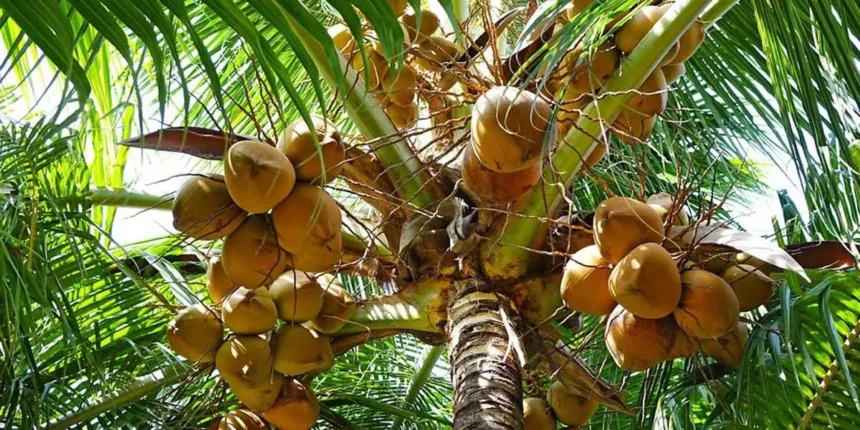
The Dominican Republic has an opportunity to expand its participation in the global coconut industry, driven by demand growing at a rate of over 10% annually and a market that reached approximately 65 million tons in 2024, according to figures presented during the first Coconut Summit, DominiCoco.
The data was presented by the president of the Dominican Agribusiness Board (JAD), Osmar Benítez, who pointed out that the behavior of international demand represents an opportunity that the Dominican Republic still has room to take advantage of. In his view, the country can gain greater participation in that market by increasing production, incorporating technology, and developing an industry capable of generating greater value from coconuts.
He also indicated that the international scenario favors the expansion of a sector that in the Dominican Republic has a growing cultivation area, thousands of producers, and a processing industry that has already managed to position coconut-derived products in international markets. Indonesia, the Philippines, and India account for nearly 70% of the global commercialized production, while demand continues to rise due to the consumption of water, oil, milk, cream, and other derivatives.
The scale of the activity is reflected in the data from the National Agricultural Registry, which identifies 5,141 coconut producers, 5,383 plots, and more than 396,000 “tareas” planted. The JAD, however, estimates that the area currently dedicated to the crop is around 880,000 “tareas,” due to the expansion of new plantations recorded over the last few years.
Production is mainly concentrated in Samaná, María Trinidad Sánchez, La Altagracia, and Monte Plata, provinces that account for about 64% of producers and nearly 70% of the planted area. María Trinidad Sánchez leads in cultivated area, with more than 103,000 tareas, while Samaná concentrates the largest number of producers, with about 1,250.
More Read

Benítez also highlighted that Dominican production has recorded growth of more than 10% annually over the last four years, in contrast to an expansion of around 2% in the global supply. That difference, he suggested, places the country before an opportunity to increase its participation in a market that demands more and more raw materials and processed products.
The possibility of growth is not limited to fresh coconut. Industrial transformation considerably increases the value of production and allows for serving specialized markets. In that segment, the Dominican Republic already has a relevant position in the United States.
For his part, Horacio Lerva, general manager of Consorcio Cítricos Dominicanos of Grupo Rica, presented figures according to which the country exports around US$33.87 million in coconut cream to the United States, compared to about US$3.6 million corresponding to all of Southeast Asia in that category. In coconut milk, Dominican exports to that market are around US$20 million.
More Read


Export performance, however, faces a limitation in the supply of raw materials. “We are leaders in the category, but we are leaders in importing coconut,” pointed out Lerva, explaining that the Dominican industry has managed to compete internationally, but still does not have enough national production to support its full growth potential.
In fact, the Dominican Republic has allocated around US$83 million to coconut imports over the last five and a half years, equivalent to about RD$5.8 billion. For sector representatives, that figure reflects an additional opportunity: to progressively replace part of those external purchases by increasing local production.
Expansion, however, requires overcoming obstacles that affect productivity. According to data presented by the Ministry of Agriculture, 83% of coconut plots operate under rain-fed conditions and only 17% have irrigation. Added to this is the fact that 49% of producers receive technical assistance, barely 16% have access to public financing, 6% have insurance, and nearly 4% have formal marketing contracts.
Another challenge is generational turnover. 71% of producers are 50 years old or older, a reality that forces the search for mechanisms to make farming a more attractive activity for young people through technology, financing, mechanization, and higher levels of profitability.
The strategy proposed during DominiCoco also contemplates taking full advantage of the fruit. The industry is already working with processes to use the husk as an agricultural substrate and the shell as fuel, in addition to developing alternatives to transform dry coconut water and other waste into new products.
For Carlos Grullón, president of RAAS Irrigation Systems and the main promoter of the summit, the growth of the activity must be measured by its ability to increase productivity and the value generated, rather than solely by the increase in planted areas. “It is not simply about planting more,” he stated, but about producing more per unit of land, making better use of water, and adding value to production.

The first Coconut Summit brought together representatives from 11 countries, as well as producers, entrepreneurs, technicians, investors, and national and international specialists, with the purpose of promoting a long-term vision for the sector.
With expanding global demand, an increased productive surface area, and an industry that already competes in international markets, the Dominican Republic faces the challenge of turning that advantage into greater production, less dependence on imports, and a value chain capable of generating more income within the country.