Bolivia recorded a cumulative inflation of 4.82% during the first half of 2026 and after seven weeks of protests and road blockades -between May and June- against the government of President Rodrigo Paz, the National Institute of Statistics (INE) reported on Monday.
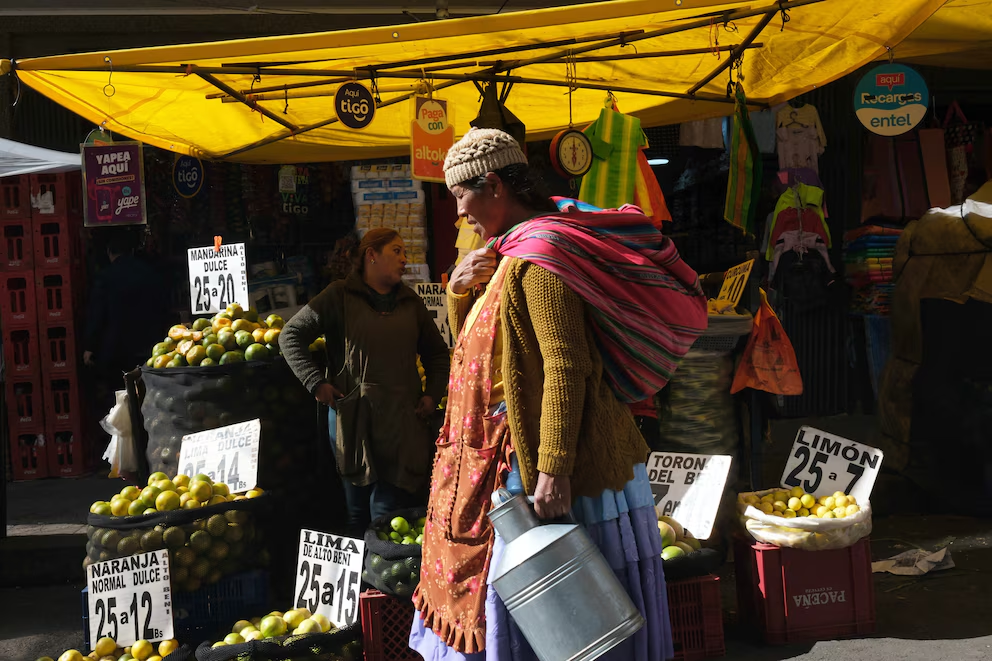
The Consumer Price Index (CPI) increased by 2.15% in June, above the 2.13% recorded in May. According to the report presented by the INE, the increase was mainly due to rising prices in food and non-alcoholic beverages, food consumed outside the home, and transportation. The year-on-year price variation stood at 9.23%.
The highest monthly variations were recorded in Oruro (3.86%), seven municipalities in the department of Cochabamba (3.65%), the cities of La Paz and El Alto (3.40%), and Potosí (3.08%). Increases were also observed in Sucre, Cobija, Trinidad, and Tarija, while Santa Cruz, the largest and most populous region of the country, showed a negative variation of 0.02%.
Several people try to ride bicycles amidst the barricades set up by protesters on the highway connecting La Paz to Oruro, near El Alto, Bolivia, on Saturday, May 16, 2026.
We recommend reading:
More Read
The pattern of price increases coincides with the regions where pickets were concentrated and prevented the passage of food and basic supplies: mainly in the Andean region of the west and in the center of the country. Meanwhile, in the regions where there were no blockades, to the east, prices tended to fall due to the oversupply of some products obtained in the region.
Among the foods that recorded the largest price increases during June are bananas, beef, chicken, and tomatoes, among others. In contrast, prices decreased for disposable baby diapers, laundry detergent, school supplies, cheeses, personal hygiene products, and lettuce.

The blockades, which lasted for nearly 55 days, were initially driven by the Túpac Katari Peasant Federation of La Paz, which demanded the resignation of President Paz amid accusations of betrayal and failure to fulfill his campaign promises.
More Read

Progressively, other organizations joined, such as the Bolivian Workers’ Center (COB), sectors affiliated with former president Evo Morales (2006-2019), and some neighborhood councils. The conflict caused shortages of food, fuel, and essential supplies, especially in the Andean cities of La Paz and El Alto, whose access roads remained closed.
People make purchases at a supermarket in La Paz as a shortage of some products is recorded due to the blockades. May 29, 2026. REUTERS/Claudia Morales
During this period, at least 14 deaths related to the protests were recorded, some of which occurred due to a lack of timely medical attention due to the picket lines. According to international trade and industry entities, the economic loss from the blockades exceeded 3 billion dollars, equivalent to 5% of the Gross Domestic Product (GDP).
After reaching agreements with the COB on June 19, the Government decreed a state of exception that authorizes it to deploy the Armed Forces to intervene at blockade points for 90 days; a measure that caused the progressive withdrawal of the other mobilized sectors.
Before the conflict, the Executive branch projected an annual inflation rate of 14%, after the country closed 2025 with an inflation rate of 20.4% amidst an economic crisis marked by the collapse of the oil industry, the depletion of international reserves, and a shortage of dollars.