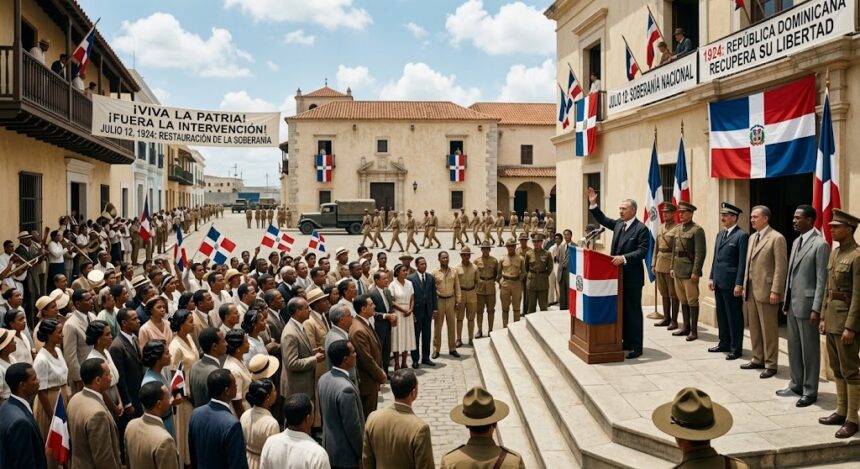
Santo Domingo. Every July 12, the Dominican Republic commemorates one of the least known patriotic dates, but one of great historical significance for the country. That day marks the recovery of national sovereignty following the end of the U.S. military occupation of 1916-1924, an event that marked the restoration of the Dominican government and the return of political independence.
With the purpose of preserving that historical memory, the then-president Juan Bosch enacted Law 50-63 on July 22, 1963, through which he declared July 12 as a Day of Rejoicing and Patriotic Commemoration, a provision intended to recognize the courage of those who defended the sovereignty and self-determination of the Dominican people.
The origin of the commemoration
The date of July 12 is closely linked to the process that ended the first United States military occupation of Dominican territory. After nearly eight years of intervention, the country began a transition process that culminated in the restoration of national institutions and the recovery of control over its public administration.
That process allowed Dominicans to resume the management of State affairs, laying the foundations for a new republican stage and strengthening the sense of national identity.
We recommend reading: Duartians honor the legacy of Francisco del Rosario Sánchez 165 years after his death
More Read

The recovery of sovereignty was the result of intense diplomatic efforts, as well as the pressure exerted by various political, intellectual, and social sectors that demanded the right of the Dominican people to govern themselves without foreign intervention.
Law 50-63
During his brief constitutional term, President Juan Bosch promoted various initiatives aimed at strengthening democracy and rescuing the national historical memory.
Among those measures is the enactment of Law 50-63, signed on July 22, 1963, through which July 12 was officially established as a date of Rejoicing and Patriotic Commemoration.
More Read

The legislation sought to institutionalize the recognition of an event considered fundamental to republican history, highlighting the value of independence, sovereignty, and self-determination as essential principles of the Dominican State.

The 1916 United States occupation
The United States military occupation began on May 16, 1916, when United States forces landed on Dominican territory, claiming the need to ensure political stability and compliance with international financial commitments.
During that period, the military government reorganized the public administration, created the Dominican National Guard, reformed various aspects of the state apparatus, and assumed control of the country’s main institutions.
However, the foreign presence also generated a strong nationalist movement. Various groups of Dominicans expressed their rejection of the occupation through political, diplomatic, and resistance actions, defending the country’s right to fully exercise its sovereignty.
The return of the Dominican government
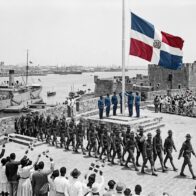
After several years of international negotiations and growing internal pressures, the withdrawal of U.S. troops began in 1924.
The restoration of a government led by Dominican authorities represented the closing of one of the most complex episodes in national history and reaffirmed the country’s commitment to the defense of its independence.
More Read
Since then, July 12th has been associated with the restoration of national sovereignty and the recovery of republican institutions.
A date to strengthen historical memory
Although it does not possess the same notoriety as other national holidays, July 12th constitutes an opportunity to reflect on the importance of sovereignty, independence, and the self-determination of peoples.
Historians consider that remembering this date allows us to value the efforts made by generations of Dominicans to preserve the integrity of the State and consolidate democratic institutions.
More than six decades after the enactment of Law 50-63, the commemoration continues to be a reminder of the Dominican Republic’s ongoing commitment to the defense of its national sovereignty and the values that underpin its republican life.