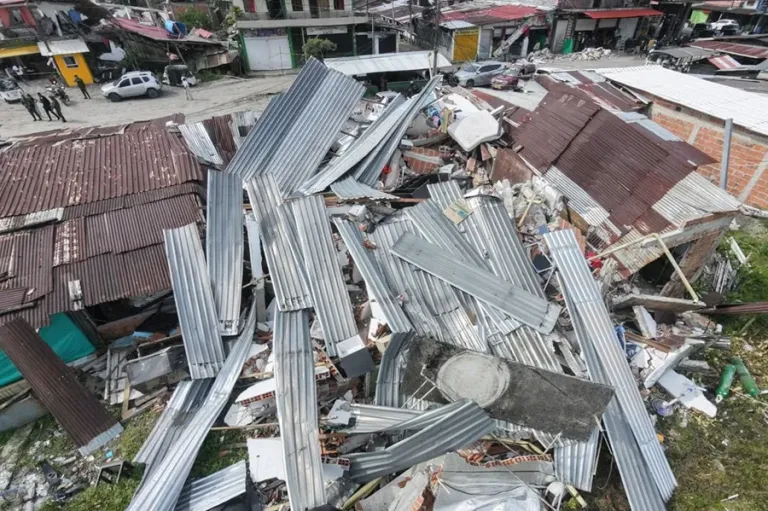
Quibdó (Colombia) .- The Ombudsman of Colombia, Iris Marín, warned this Wednesday in Quibdó, one of the cities shaken by Monday’s 7.4 magnitude earthquake, that the lack of a census prevents establishing the real number of victims and hinders the assistance of thousands of families.
During a tour of the affected sectors of Quibdó, capital of the Chocó department, in which EFE was present, Marín said that, although local authorities have declared search and rescue efforts concluded, the emergency is now entering a stage in which it is necessary to determine with precision the number of people affected and their needs.
«It is urgent to take the censuses because there is no real estimate of how many people are affected, how many people currently have nowhere to sleep», the defender stated to EFE.
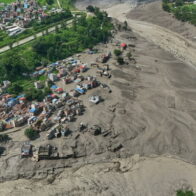
Quibdó authorities have confirmed nine deaths in the city as a result of the earthquake, and there are 13 fatalities in the department, while they continue to assess the damage and register the affected families.
The figures provided by the Government of Colombia
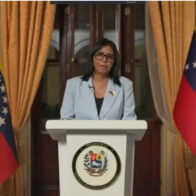
The national death toll from the earthquake rose this Wednesday to 265 and the number of injured to 3,494, while 496 people remain missing, reported today the Colombian president, Abelardo de la Espriella, who declared an “economic emergency” to face the crisis caused by the earthquake.
However, the advocate acknowledged that there is a disparity between the figures handled by the national government and those reported from the regions, a difference that, in her view, can only be resolved with a census.

The earthquake had its epicenter in the vicinity of the municipality of San José del Palmar, precisely in the department of Chocó, according to the Colombian Geological Service.
Concerns regarding health response
For Marín, one of the main concerns is the responsiveness of the healthcare system because in Quibdó, for example, the San Francisco de Asís Hospital, the city’s main one, has an overcrowding rate of 160%.
More Read

Although it has a power plant, the hospital needs to ensure stable connectivity to avoid problems in service provision, in addition to continuous internet access.
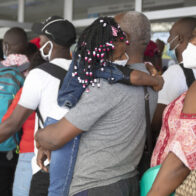
Regarding the people who were left homeless, the ombudsperson explained that a city coliseum was set up as a shelter, but she considered that its conditions are still precarious to accommodate all the families.
The official also drew attention to the suspension of classes and the damage recorded at the Technological University of Chocó, the department’s main higher education institution, in addition to requesting the implementation of psychosocial support mechanisms, especially for children and adolescents affected by the earthquake.
The Ombudsman’s Office also requested to verify the situation of 32 indigenous settlements and communities in other municipalities of Chocó for which there is still not enough information.