Guatemala rejected this July 22, 2026, the statements by Daniel Ortega regarding the end of elections in Nicaragua and warned that this decision denies the alternation of power, restricts political rights, and deepens the democratic deterioration in a country governed by the president since 2007.
The statement was released in a communiqué from the Guatemalan Ministry of Foreign Affairs. In it, the Government maintained that the suppression of electoral processes eliminates any possibility of a transfer of power and weakens the rule of law, the separation of powers, and political pluralism.
The Government of Guatemala stated its position in a Foreign Ministry communiqué, after Daniel Ortega Saavedra stated in recent days that elections will not be held again in Nicaragua.
For the Guatemalan authorities, that position implies a direct denial of the alternation of power and the exercise of the citizens’ political rights. The Ministry of Foreign Affairs of Guatemala, in a statement on July 22, 2026, rejects the statements made by the President of Nicaragua, Daniel Ortega, regarding the non-holding of elections.
We recommend reading:
More Read
Guatemala stated that the suspension of elections violates international commitments
According to the statement, Ortega’s declarations contradict international instruments assumed by Nicaragua: the United Nations Charter, the Universal Declaration of Human Rights, the Inter-American Democratic Charter, and the International Covenant on Civil and Political Rights.
Those frameworks establish the right to vote and to be elected in periodic, genuine, free, and fair elections, by universal and secret suffrage.
The Guatemalan Foreign Ministry summarized its objection in a literal sentence: “The suppression of electoral processes eliminates any possibility of alternation in the exercise of power, restricts the political rights of the citizenry, and weakens the principles of the rule of law, the separation of powers, and political pluralism.”
More Read

Guatemala‘s response is part of a broader concern regarding democratic backsliding in Nicaragua. The document highlights that the Nicaraguan president’s announcement not only affects electoral competition but also the basic functioning of a democratic society.
Ortega has been in power since 2007 and the 2021 elections had already been questioned
Daniel Ortega has held the presidency of Nicaragua since 2007. During that period, the source text describes the consolidation of centralized power, with control over state institutions, the judicial system, and electoral bodies.
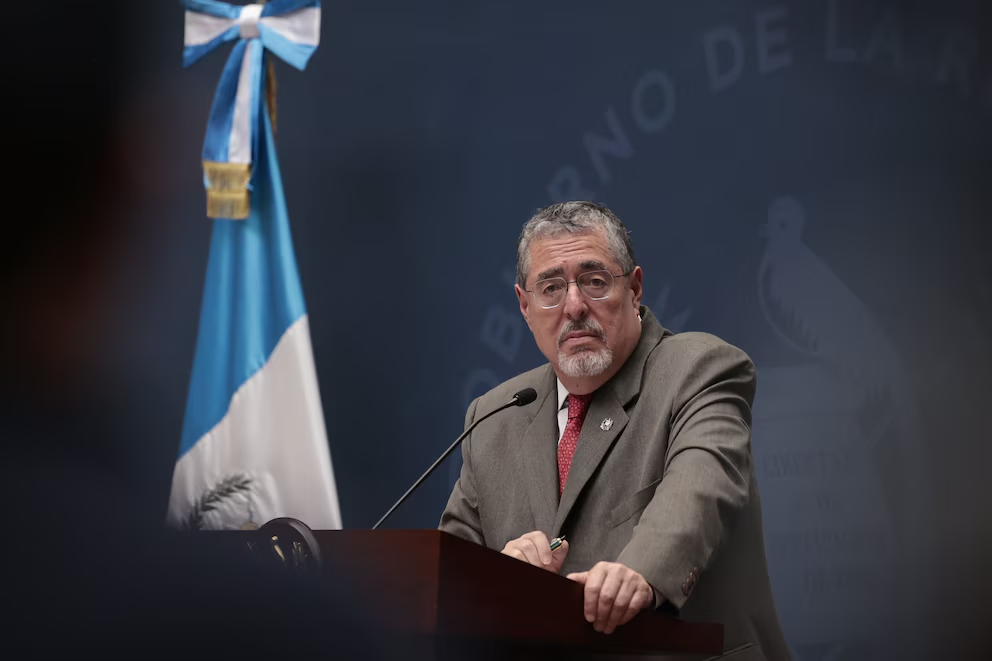
A Guatemalan official expresses their rejection of the end of elections in Nicaragua, while a chained ballot box symbolizes the suppression of the vote. (Illustrative Image Infobae)
The general elections of November 2021 had already received international criticism, because several opponents were detained or disqualified and foreign observers reported irregularities. Since those elections, the opposition’s margin of action was drastically reduced and human rights organizations reported restrictions on freedom of expression and the press.
Organizations such as the OAS, the Inter-American Commission on Human Rights, and the United Nations have expressed their concern in recent years regarding the deterioration of democracy and fundamental rights in the country. Ortega’s recent announcement, according to the Guatemalan statement, reinforces that pattern by explicitly suppressing the holding of periodic and free elections.
Guatemala’s official position coincides with the claims of other governments and organizations that condemn attempts to remain in power indefinitely, as well as obstacles to political participation. The text adds that the Nicaraguan crisis has already produced diplomatic tensions and individual sanctions from the European Union and the United States against officials of the country.
More Read
ADVERTISING
In the final part of its statement, the Foreign Ministry reiterated: “Guatemala expresses its solidarity with the Nicaraguan people and calls for full respect for the freedoms of expression, association, and political participation, which are essential elements to guarantee a democratic society that exercises the right to hold periodic, free, and fair elections.”