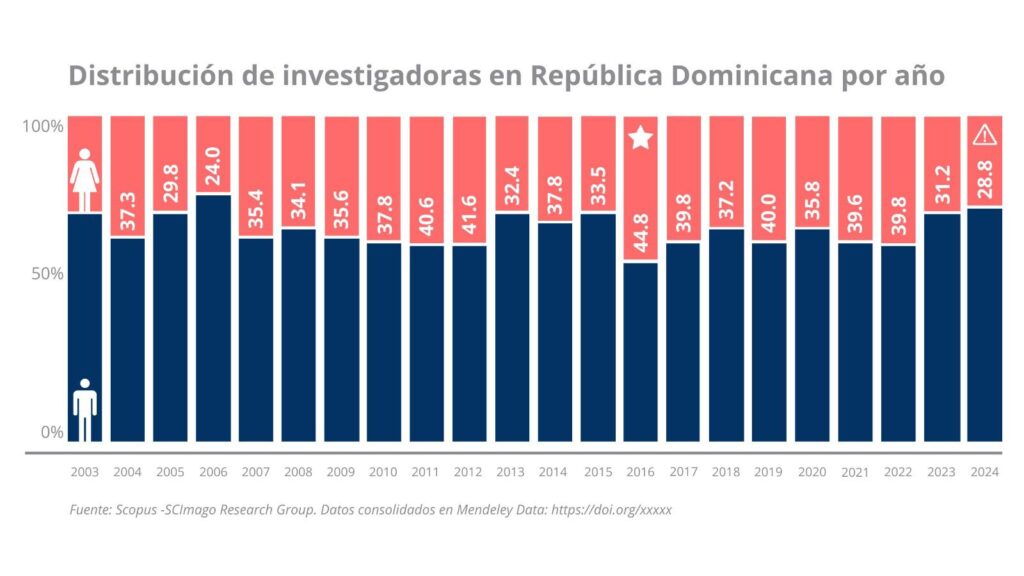
In the country, the number of female scientists dropped in 2024 to the lowest point in the last two decades, despite the growth figures in the areaSanto Domingo.- The Pontifical Catholic University Madre y Maestra (PUCMM) presented this Tuesday the results of a study on the evolution of scientific talent in the Dominican Republic, which reflect an increase in the number of researchers in the last 20 years, and at the same time warns that female participation has experienced a significant setback, representing only 28.8%.
In the last two decades, in general terms, the number of Dominican researchers multiplied by 15: it went from 36 scientific authors in 2003 to 545 in the year 2024. However, in the scenario of women there was a break in growth, and it is at its lowest point in history, according to the research entitled “Cienciometric Report of the Dominican Republic”, which analyzes national scientific activity from 2003 to 2024, and whose complete results will be announced by PUCMM in the coming months.
The chapter addressing national scientific talent indicates that since 2003 the number of female scientists increased from 30.6% to 44.8% in 2016, the year it reached the closest point to parity. But since 2017, participation decreased to 28.8% in 2024, the lowest number in the last two decades, even below the figures recorded in 2003.
The research references countries with similar economies and scientific systems (Costa Rica, Panama, Jamaica, Paraguay, Uruguay) and warns that the Dominican Republic is the only one in this sample whose current indicator of female participation is lower than it was two decades ago. In addition, the Dominican Republic registered only 10 researchers per 100,000 economically active people (EAP), when the average of these compared reference countries is 76*100,000 of the EAP.
“The most alarming finding lies in the collapse of female participation in areas that they previously dominated. In dentistry, female participation exceeded 60% in 2013 and plummeted by 21.6% in 2024. Similar trends are observed in the areas of psychology and social sciences,” the study warns.
This trend, she adds, demonstrates that the progress towards equity is fragile, the balance achieved was unstable and its maintenance requires active and sustained policies.
Martha Báez, director of Research and Innovation at PUCMM and lead author of this research project, highlighted that this scenario presents an opportunity to create public policies that support national scientific talent.
“This involves training new generations of researchers, attracting and retaining talent, and promoting active diversity, because a robust scientific system requires critical mass, balance, and diversity in its areas of knowledge,” he added.
In disciplines such as veterinary medicine, 75% of research is produced by women; followed by immunology and biochemistry, where women maintain a presence of over 40%. At the other end, energy, mathematics, physics, and engineering exhibit extreme gaps, with male participation exceeding 80%.
Hyper-collaboration could have an impact The country, the research explains, has had an accelerated growth in the collaboration of scientific publications signed by 15 or more authors, typically associated with projects of international scope. This boom coincides with the beginning of the decline of the authors.
One of the research hypotheses is that, by integrating more intensely with global scientific networks (especially in biomedical disciplines), the Dominican system would unintentionally import the gender imbalances present in those international networks. In this sense, the study warns that a system that relies excessively on external agendas becomes vulnerable to changes in international funding.
The research carried out recognizes the progress in the production of scientific research and its insertion in global networks, thanks to public policies aimed at strengthening research, particularly the National Fund for Innovation and Scientific and Technological Development (Fondocyt) and the National Career of Researchers.
“We are more researchers than ever and we are more connected to the world, but the system continues to operate on a limited scale that restricts its capacity for renewal and autonomous leadership,” analyzes Martha Baez. The researcher concludes that public policies must continue working to promote national research talent and to guarantee the conditions for full and sustainable development within the country.
The “Cienciométrico Report of the Dominican Republic” is funded by Fondocyt. Martha Báez is the main author and Víctor Bohórquez, co-investigator. The study has the technical support of SCImago Research Lab, an international group specializing in scientific information analysis that supports strategic decision-making in the academic and public policy fields. To quantify the scientific workforce, the Scientific Talent Pool (STP) indicator was used, which estimates the number of people active in scientific production, based on the number of unique authors affiliated with institutions that have published at least one document in a determined period.