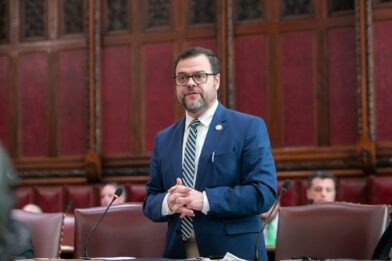

Santo Domingo.- President Luis Abinader confirmed Héctor Valdez Albizu this Wednesday as governor of the Central Bank of the Dominican Republic, through Decree 575-26, issued on August 19, 2026.
The presidential decree establishes that Valdez Albizu will continue to lead the monetary authority, while Clarissa de la Rocha was also confirmed as vice governor of the Central Bank.
You might be interested in: Luis Martín Gómez, former Communications Director of the Central Bank, dies
The decree recalls that the Monetary and Financial Law establishes that the governor of the Central Bank is appointed by the president of the Republic for a period of two years, with the possibility of renewal. The same provision applies to the position of vice-governor.
The decision provides continuity to the team leading the monetary institution, after both officials were previously confirmed through Decree 442-24, of August 2024.
More Read

The official document states that the confirmation is carried out by virtue of the powers conferred upon the president by Article 128 of the Dominican Constitution, which contemplates his authority to appoint and remove officials whose designation corresponds to him in accordance with the Constitution and the laws.
Likewise, the decree highlights that the Central Bank is a public entity of public law with its own legal personality and autonomy, in accordance with the provisions of Monetary and Financial Law 183-02.
The presidential provision also orders the decree to be sent to the Monetary Board, the Central Bank, the Ministry of Public Administration, the Chamber of Accounts, and the Comptroller General of the Republic, as well as to the other corresponding institutions for their knowledge and execution.

With this decision, Héctor Valdez Albizu remains at the head of the Central Bank, from where he will continue to lead the institution responsible for executing the country’s monetary and exchange rate policies within the framework established by Dominican legislation.

Héctor Valdez Albizu’s Career at the Central Bank
Héctor Valdez Albizu has an extensive career at the helm of the Central Bank of the Dominican Republic, an institution from which he has participated in the conduct of monetary policy and the monitoring of the country’s main economic variables.
His tenure in office has been linked to different periods of the Dominican economy, including moments of growth, inflationary pressures, changes in interest rates, and international scenarios that have forced monetary authorities to adopt measures to preserve economic stability.
At the helm of the Central Bank, Valdez Albizu has participated in decisions related to monetary policy, inflation behavior, interest rates, and the stability of the financial system. The institution also has among its responsibilities contributing to preserving price stability and maintaining conditions that favor the functioning of the economy.
The new confirmation through Decree 575-26 represents the continuity of the current leadership of the Central Bank. The decree also ratifies Clarissa de la Rocha as vice-governor, thus maintaining the entity’s management team.
Dominican legislation establishes that the governor and vice-governor of the Central Bank are appointed by the Executive Branch for two-year terms, with the possibility of renewal. This provision is expressly cited in the decree issued by President Luis Abinader.

The ratification also occurs in a context in which the Central Bank’s decisions maintain special relevance for households, companies, and markets, due to the impact that monetary policies have on variables such as credit, interest rates, liquidity, and inflation.
The decree establishes that the presidential decision must be communicated to the Monetary Board, the Central Bank, the Ministry of Public Administration, the Chamber of Accounts, and the Comptroller General of the Republic, for the corresponding purposes.
In this way, the Valdez Albizu administration will continue to head the monetary authority during the new term established by the Executive Branch, monitoring national and international economic conditions and the objectives set for the Central Bank within the framework of the Monetary and Financial Law.