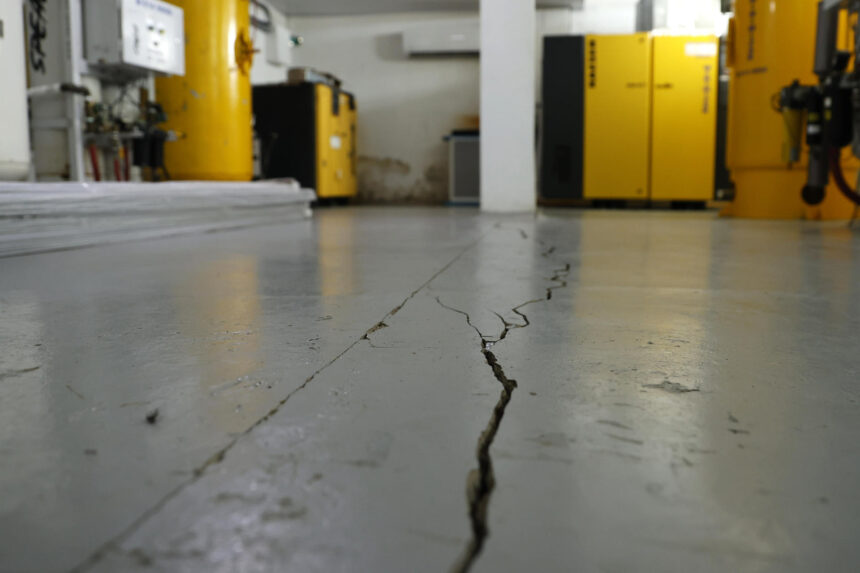
Quibdó (Colombia).- A crack runs from top to bottom of the wall and extends to the floor of the oxygen plant at the San Francisco de Asís Departmental Hospital, in Quibdó, an image that summarizes the crisis at the main healthcare center in the Chocó department following Monday’s 7.4 magnitude earthquake in Colombia.
A few centimeters from the fracture, the yellow pipes of the oxygen system remain exposed amidst the cracked concrete, while the hospital’s interim manager, Ovidio Garrido Córdoba, explains to EFE the damage caused by the earthquake in one of the most sensitive areas of the health complex.
You might be interested in: De la Espriella activates an unprecedented transition in Colombia
When the earthquake occurred, which left 13 dead in Chocó, the hospital activated emergency protocols and evacuated patients, who were temporarily attended to outside while authorities verified the state of the structure.
Although an initial inspection concluded that the building could continue to operate, subsequent studies identified problems in two critical points: the oxygen plant and the surgical area corridor.
“Users were attended to outside the institution and, subsequently, the evaluations determined that there were areas that required immediate intervention,” Garrido explained to EFE.
The structural damages coincided with a series of power supply failures that ended up damaging equipment essential for the hospital’s operation.
The earthquake deepened the crisis of an institution that operates at over 160% capacity, suffered damage to critical areas, and lost essential equipment while attending to hundreds of victims in one of the poorest regions of the country.
More Read

Damaged equipment
Power outages damaged the refrigerator where blood components used in blood transfusions were stored, as well as the equipment intended to preserve laboratory reagents, which forced the staff to improvise solutions to keep the most urgent services operational.
“The refrigerator where we store blood components burned out, and so did the refrigerator for the reagents,” explained Yandy Vanessa Aguilar, coordinator of the laboratory and transfusion unit, to EFE.
The specialist stated that the transfer of blood units to an alternative piece of equipment altered the normal operation of the service and complicated the maintenance of the cold chain.
Furthermore, the shortage of reagents forced the suspension of outpatient consultations, a decision that affects both hospitalized patients and those requiring ambulatory care.
Help is on the way
In the midst of the emergency, solidarity began to fill some of the gaps left by the earthquake.

In the hospital courtyard, several volunteers carefully unload a white refrigerator donated by the community of Colombian hematologists to replace the broken equipment and ensure the safe storage of blood.
More Read
In another area of the healthcare center, health workers sort medications, syringes, gloves, suture materials, and medical-surgical supplies sent from different regions of the country, while organizing the aid that arrives to respond to a demand that does not stop growing.
“Thanks to solidarity, we have received medicines, medical-surgical supplies, and blood units,” stated Garrido, who requested continued national and international support to guarantee the continuity of care.
The doctor and activist Camilo Prieto, who is participating in the collection of aid, detailed that the hospital needs elastic and plaster bandages, syringes of any volume, examination gloves, sterile gloves, and suture materials of different gauges.
In the case of medications, Prieto recommended consulting the lists published by the Health secretariats and hospitals, as needs vary from one institution to another.
Now, in addition to attending to the wounded and affected, the main healthcare center in Chocó is trying to recover from the damage caused by the earthquake while its workers, supported by a network of volunteers and donors, try to prevent the health emergency from worsening.
Hospital in crisis
The 7.4 magnitude earthquake that shook Colombia last Monday, August 10, had its epicenter near San José del Palmar, in the department of Chocó, and became one of the most devastating seismic events recorded in the country in recent decades. The movement caused damage to homes, hospitals, roads, and other infrastructure, with Quibdó among the affected areas.
In the department of Chocó, the emergency struck a population that was already facing significant difficulties in accessing basic services and healthcare. In Quibdó, the San Francisco de Asís Departmental Hospital, the main healthcare center in the region, was left in an especially vulnerable situation due to the damage caused by the earthquake and problems it was already facing before the emergency.
The magnitude of the hospital crisis has forced authorities and medical staff to work under extraordinary conditions. Recent reports place the healthcare center’s occupancy well above its capacity, while several areas have been affected and there are difficulties in maintaining essential services.
The situation was aggravated by power supply failures following the earthquake. Among the affected equipment are systems used to preserve blood and laboratory reagents, which put the continuity of medical procedures at risk and forced the search for alternative equipment and external aid.
In the face of the emergency, medical organizations, volunteers, and citizens from different parts of Colombia began mobilizing medicines, blood, equipment, and surgical supplies to Quibdó. The hospital has requested continued support due to the increase in demand and the difficulties in quickly replacing damaged equipment.
The seismic emergency also highlighted once again the historical vulnerability conditions of Chocó, one of the regions with the greatest socioeconomic difficulties in Colombia. In Quibdó, numerous families were affected and some homes were destroyed or suffered damage that forced their residents to seek shelter in the homes of relatives or remain outside their homes.