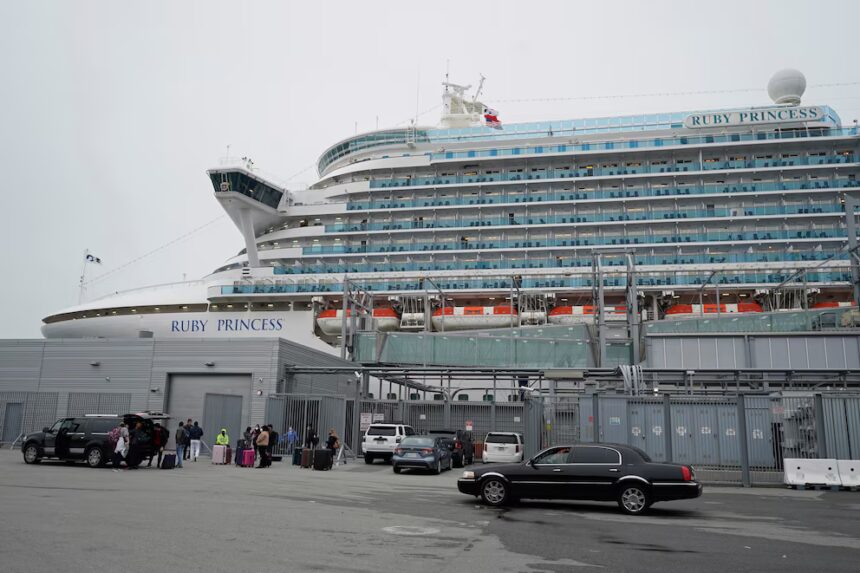
More than 100 passengers and 23 crew members of the Ruby Princess cruise ship fell ill during a 20-day trip through Alaska and Canada in a suspected norovirus outbreak, according to the CDC. The ship, operated by Princess Cruises, docked on July 2 in San Francisco, where it underwent disinfection before resuming its route that same afternoon.
The outbreak makes this episode the third to affect a Princess Cruises vessel so far this year.
What happened aboard the Ruby Princess
The cruise ship departed from San Francisco on June 12 with 3,032 passengers and 1,144 crew members on board, bound for ports in Alaska and Canada, according to the CDC. Of that total, 102 passengers—3.4% of the contingent—and 23 crew members reported mild gastrointestinal symptoms during the voyage.
The CDC received notification of the Ruby Princess outbreak on June 28 and confirmed that the 3% threshold of passengers with symptoms was exceeded
The formal notification of the outbreak reached the CDC on June 28, more than two weeks after departure, as reported by SFGATE. The agency defines an outbreak as when 3% or more of the passengers exhibit symptoms, a threshold that was exceeded in this case.
More Read

We recommend reading: Violence in Honduras: transport company suspends operations in Colón due to extortion threats
The last port before the return was Prince Rupert, in British Columbia, Canada. The ship docked at San Francisco’s Pier 35S on the morning of July 2, according to the same source.
What is norovirus and why is it so difficult to contain
Norovirus is the leading cause of vomiting and diarrhea in the United States, according to the CDC. Symptoms—nausea, vomiting, diarrhea, and abdominal pain—appear suddenly and typically last between one and three days, according to CBS News San Francisco. Norovirus causes vomiting, diarrhea, nausea, and abdominal pain, and its symptoms usually last between one and three days, according to the CDC (Charles D. Humphrey/U.S. Centers for Disease Control)

The pathogen is transmitted when microscopic particles of fecal matter or vomit reach the mouth, either through direct contact or through contaminated surfaces and objects, according to The Guardian. A particularity that makes it especially resistant: it can survive on surfaces for days or weeks and does not easily yield to common disinfectants, warned CBS News San Francisco.
People who develop severe dehydration should seek medical attention, according to the CDC.
Why cruise ships amplify contagion
Cruise ships have conditions that favor the spread of norovirus: confined living spaces, shared dining areas, and a rapid turnover of passengers between voyages, according to CBS News San Francisco. Added to that is the fact that the virus is resistant to many commonly used disinfectants.

Cruise ships facilitate the spread of norovirus through shared spaces, common dining areas, and the rapid turnover of passengers between voyages
All in all, the CDC clarifies that outbreaks on cruise ships represent barely 1% of the total norovirus outbreaks reported in the country, according to the same source. In 2025, 23 outbreaks were recorded on cruise ships, 17 of them caused by norovirus.
Measures applied during the trip
Following the appearance of the first cases, the ship’s staff intensified cleaning and disinfection protocols in all common areas, according to the Los Angeles Times. Sick passengers and crew members were isolated from the rest of the vessel.
More Read

The onboard team also consulted the CDC regarding health procedures and the reporting of new cases, according to the same source. Princess Cruises stated in a release, cited by USA Today, that “cases have declined and remain at low levels.”
Princess Cruises’ history in 2026
The Ruby Princess is not the company’s first vessel to face this problem this year. In March, norovirus affected 153 people aboard the Star Princess during a Caribbean cruise. In May, 160 passengers and crew members fell ill on the Caribbean Princess, on a voyage that departed from Fort Lauderdale, Florida, according to CBS News San Francisco.
Princess Cruises accumulated three norovirus outbreaks in 2026, including those recorded on the Ruby Princess, the Star Princess, and the Caribbean Princess (Princess Cruises)
The CDC has recorded a total of seven outbreaks of gastrointestinal illness on cruise ships so far in 2026 that exceeded the public notification threshold. Two were caused by E. coli and the remaining five by norovirus, according to the agency’s official registry.
Princess Cruises accounts for three of those five norovirus outbreaks, more than any other cruise line.
How to prevent contagion: CDC recommendations
Handwashing with soap and water is the most effective measure to reduce the transmission of norovirus. The CDC recommends:
- Wash your hands after using the bathroom and before eating.
- Do not rely solely on hand sanitizer, as hand sanitizer alone is not enough against norovirus.
- Avoid sharing personal items with other people.
- Consult a doctor if symptoms worsen or severe dehydration appears.
Disinfecting the boat before its next trip
Upon docking in San Francisco, the Ruby Princess was immediately subjected to a comprehensive cleaning and disinfection process, according to a Princess Cruises spokesperson cited by Los Angeles Times. The procedure concluded before the vessel set sail again that same afternoon bound for Ketchikan, Alaska.
The Port of San Francisco also issued a statement. Its spokesperson Eric Young specified, according to SFGATE, that “the port’s role is to ensure that its tenants follow the required notification procedures with the appropriate public health authorities,” and confirmed that the vessel complied with the protocols before receiving new passengers.