“n
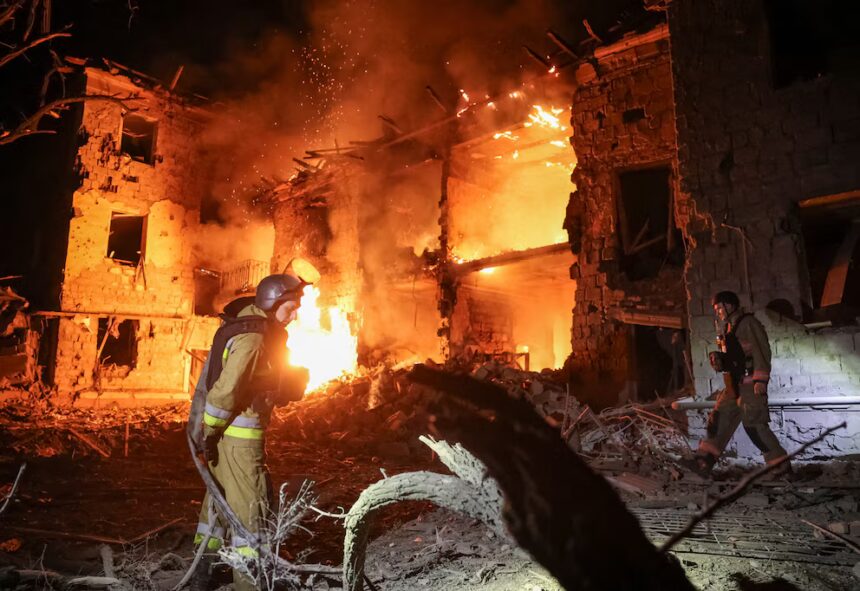
Russian forces reduced the intensity of drone and missile attacks on Ukrainian territory in June, following several months of constant aerial offensives that punished the civilian population and critical infrastructure in different cities across the country.
n” “nAccording to official data from the Ukrainian air command, Moscow used 5,749 drones and 180 missiles throughout the month: a reduction of 29% and 15%, respectively, compared to May. That decline marked the first drop in the number of projectiles launched since the start of the escalation of attacks.
n” “nThe decrease in the volume of attacks occurred in a context of a hardening Ukrainian response. During that period, the Ukrainian army intensified operations on Russian soil and concentrated its efforts on refineries, oil terminals, and weapons factories.
n” “nWe recommend reading:Three dead in Russia as a result of Ukrainian drone attacks
More Read

Those actions included a successful attack against a component plant for Iskander missiles in Voronezh and a bombing of a refinery located southeast of Moscow, which caused a large-scale fire and a cloud of smoke visible in the suburbs of the Russian capital.
n” “nThe Ukrainian aerial offensive disrupted energy production in several areas of Russia and generated long queues of vehicles at gas stations in Moscow and other regions, due to fuel shortages resulting from the attacks. According to motorists’ accounts, there were waits of up to an hour and trips to several stations before finding available gasoline.
n” “nLong lines for refueling became a daily postcard in Moscow and other Russian cities.


In parallel, the Russian attacks in June continued to leave civilian casualties and significant material damage, although to a lesser extent. One of the missiles struck a UNESCO-protected monastery in the heart of Kyiv, setting fire to the roof of the main cathedral and causing alarm in the international community. Despite the decrease in the total number of missiles and drones used, the Russian offensive maintained its indiscriminate nature, with impacts on both strategic targets and residential areas and historical monuments.
n” “nThe reduction in Russian air pressure coincided with movements on the ground front. Kremlin forces added 84 square kilometers of Ukrainian territory throughout June, mainly in the vicinity of Kostiantynivka, in the Donetsk region, and in border and southeastern areas. Although that figure exceeded the record for May, when the Russian territorial advance was limited to 14 square kilometers, it remained below the highs reached in the second half of 2024, which evidenced a relative stagnation compared to previous months.
n” “nOn the other hand, President Vladimir Putin addressed the energy crisis in an emergency meeting: he admitted difficulties for private drivers and companies, but reiterated that the State would guarantee the country’s security and the protection of its borders, amidst growing pressure from Ukrainian attacks and internal social reaction.
n” “nVladimir Putin publicly acknowledged the energy crisis generated by Ukrainian attacks on Russian territory.
n” “nIn this scenario, Ukrainian and European analysts assessed that a single month of decline in drone and missile launches is not enough to claim that Moscow is facing a structural depletion of its military capacity.
n” “nSome experts pointed out that the drop could be linked to supply issues with Iranian drones and a tactical need for Russia to reposition its air defense systems in the face of the threat of deep Ukrainian strikes. Others suggested that the Kremlin could be building up reserves of war materiel with a view to a new escalation in the autumn.
More Read

Meanwhile, Ukrainian President Volodymyr Zelensky announced on Friday the approval of a 40-day influence operation, framed within Kyiv’s strategy to pressure Russia toward a negotiation that would end the conflict.
n”