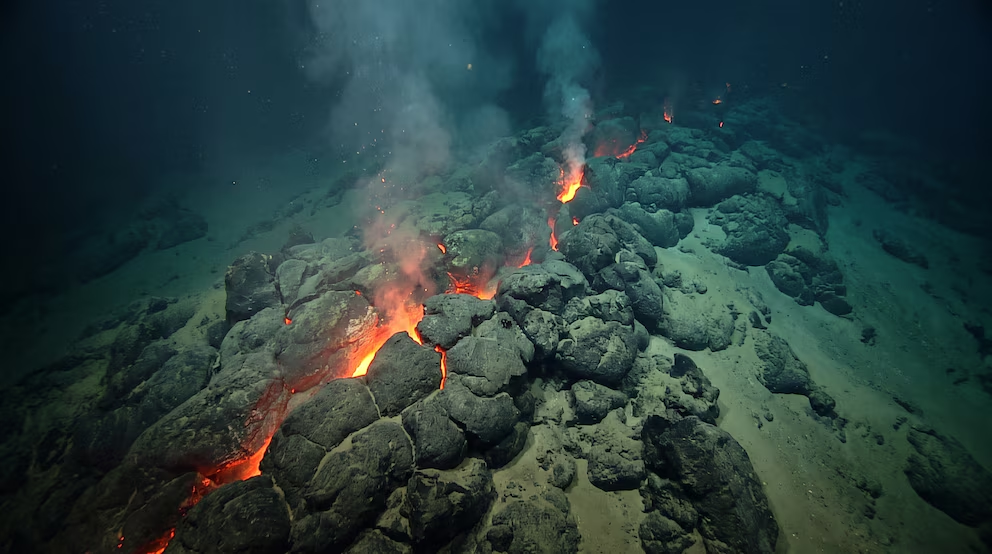
Mid-ocean ridges mark the areas where the seafloor spreads apart and the Earth forms new crust. In these places, great tectonic forces open cracks and allow magma to rise from deep layers, which creates new seafloor and modifies the underwater geography. This activity, invisible from the surface, is key to understanding how the ocean renews itself and how earthquakes and volcanoes are distributed across the planet.
An international team of scientists has managed to document for the first time and directly an episode of seafloor spreading in the South Indian Ocean. They used seismic measurement technologies and systems to precisely record the displacements of the ocean floor, installed specifically for this purpose. The study published in Nature gathers unprecedented data on the behavior of the crust at an active ridge and reveals unknown aspects of the Earth’s internal dynamics.
A real-time underwater expansion episode
A mid-ocean ridge is an underwater mountain range that spans great distances across the seafloor. It forms where two tectonic plates move apart, allowing magma to rise from the Earth’s interior, cool, and create new oceanic crust. This process renews the seafloor and shapes the structure of the ocean over time.
On April 26, 2024, a monitoring system placed by the scientific team over a sector of the Southeast Indian Ridge, near Amsterdam Island, recorded the beginning of an unusual episode: a series of tremors that traveled along the seabed for several kilometers. The event began with small earthquakes that moved rapidly along the ridge axis, followed by more intense movements, equivalent to moderate seismic events.
We recommend reading:They create a robot that can fly and swim like a diving bird: the method to explore ocean ecosystems
More Read

The experiment in the South Indian Ocean combined hydrophones, acoustic beacons, and pressure measurement to record seismic movements and seafloor deformations (Royer, JY., Olive, JA., Bazin, S. et al. (2026))
According to the study data, the seafloor of the submarine valley dropped by up to 4.2 meters in less than a week and spread laterally by more than a meter. The authors explain that this phenomenon resulted from the sudden loss of magma from a chamber located beneath the seabed, which opened large cracks called dikes along the ridge. Through these cracks, some 160 million cubic meters of lava emerged and formed new layers on the ocean floor in just 16 days.
The research indicates that most of the displacement of the faults bordering the valley occurred without causing perceptible earthquakes, which is called “aseismic slip.” According to the team’s model, only a quarter of the total movement was accompanied by detectable earthquakes, and the rest corresponds to a slow advance caused by the movement of magma.

These findings offer a possible explanation for the low number of earthquakes on many faults located on the ocean floor, as, despite moving enormous blocks of crust over millions of years, they do not always generate obvious tremors. “Large-scale slip without earthquakes, driven by magmatic processes, could be the primary mechanism by which normal faults at mid-ocean ridges accumulate displacement, which would explain their well-known seismic deficit,” the scientific paper concludes.

How the underwater evidence was obtained
About 160 million cubic meters of lava emerged through cracks called dikes, which renewed the ocean floor in just 16 days (Illustrative Image Infobae)
To obtain this data, an international group of scientists, gathered under the OHA-GEODAMS project, installed a series of instruments at the end of February 2024 in the studied area of the Southeast Indian Ridge and the neighboring Amsterdam Transform Fault. The team placed five underwater microphones, capable of detecting sounds and vibrations from the seabed, and fifteen devices that measure the distance between different points on the ocean floor with great precision. They also installed a bottom pressure recorder, which allows for identifying whether the seafloor is rising or falling, and repeated measurements of the underwater relief before and after the event.
Thanks to these instruments, scientists were able to know exactly where the tremors were occurring and how the seafloor was moving, even when the displacements were only millimeters. The pressure recorder showed sharp drops in the ground, while the microphones recorded thousands of “H-waves”, small sound explosions produced when hot lava comes into contact with water.
According to the article, the simultaneous use of these methods allowed for reconstructing step-by-step the entire process of the event, something that had never been achieved at an active mid-ocean ridge. The data analysis reveals that the seafloor subsidence was faster during the first 16 hours, with an average speed of five centimeters per minute.
The value of measuring the seabed minute by minute
Most of the fault displacement occurred without causing perceptible earthquakes, a phenomenon known as aseismic creep (Illustrative Image Infobae)
More Read

The episode recorded on the Southeast Indian Ridge illustrates, according to the study’s authors, how the seafloor can undergo major changes in a very short time after many years of stress accumulation beneath the surface. Scientists call these types of episodes “quantum events,” as they allow the ocean floor to expand suddenly through the combined action of magma forcing its way through and faults slipping underwater.
The minute-by-minute monitoring of this process allowed, for the first time, to accurately calculate how much corresponds to sudden movements (earthquakes) and how much to slower and quieter displacements. Furthermore, they observed that the opening of cracks filled with magma and the movement of nearby faults occurred almost at the same time, which indicates that these systems are more connected to each other than previously thought.
The report notes that during this episode, which lasted about two weeks, the seafloor moved as much as it would under normal conditions over nearly forty years. The authors highlight that the expansion of mid-ocean ridges occurs in separate episodes and not continuously, and that most of the movement happens without causing earthquakes. According to the OHA-GEODAMS team, the technology used in this experiment can be applied in other regions of the planet to improve the monitoring and understanding of the Earth’s internal processes.