The United Kingdom announced this Monday a new package of sanctions against seven Russian citizens and two scientific institutes that it holds responsible for having participated in the development of chemical weapons used in attacks attributed to Moscow, including the poisoning of opposition leader Alexei Navalny and the attempted assassination of former intelligence agent Sergei Skripal on British soil. London maintained that the measures target those who were involved in a chemical weapons program that it described as “illegal” and contrary to the international obligations assumed by Russia.
The restrictions were communicated by the British Ministry of Foreign Affairs, which identified among those sanctioned scientists and high-ranking officials linked to research on the nerve agent Novichok and the toxin Epibatidine. According to the British government, both substances were used in operations that caused casualties inside and outside of Russia.
Among those reached by the sanctions are Artur Zhirov, Andrei Antokhin, Sergei Chepur, Vladimir Kondratyev, Aleksandr Makhlay, Ivan Kravstov and Viktor Taranchenko. Also included were the state institute SC Signal and the State Scientific Research and Testing Institute of Military Medicine (GNIII VM), identified by London as entities involved in the development and research of prohibited chemical agents.
We recommend reading:
Police investigators arrive at the residential complex on Muggleton Road, in Amesbury, England, where two people were exposed to the Novichok nerve agent.
The British Ministry stated that these individuals and organizations participated in the production and study of toxic substances whose use is prohibited by the Chemical Weapons Convention. It also recalled that in October 2020 it had already imposed sanctions against the State Scientific Research Institute of Organic Chemistry and Technology (GosNIIOKhT), where Vladimir Kondratyev works.
According to information released by the British Government, Kondratyev co-authored a study on the toxic properties of Epibatidine, while Antokhin and Taranchenko were linked to research on the Novichok nerve agent.

British Foreign Secretary, Yvette Cooper, maintained that “the repeated use of chemical weapons by Russia constitutes a disgusting violation of international law and a direct threat to global security.”

The official added that “from the use of the Novichok nerve agent in Salisbury to Epibatidine in Siberia, which poisoned Dawn Sturgess and Alexei Navalny, Russia continues to use barbaric tools to cause death and suffering to innocent civilians, also in Ukraine. The UK Foreign Secretary, Yvette Cooper, participates in a videoconference with the First Lady of Ukraine, Olena Zelenska
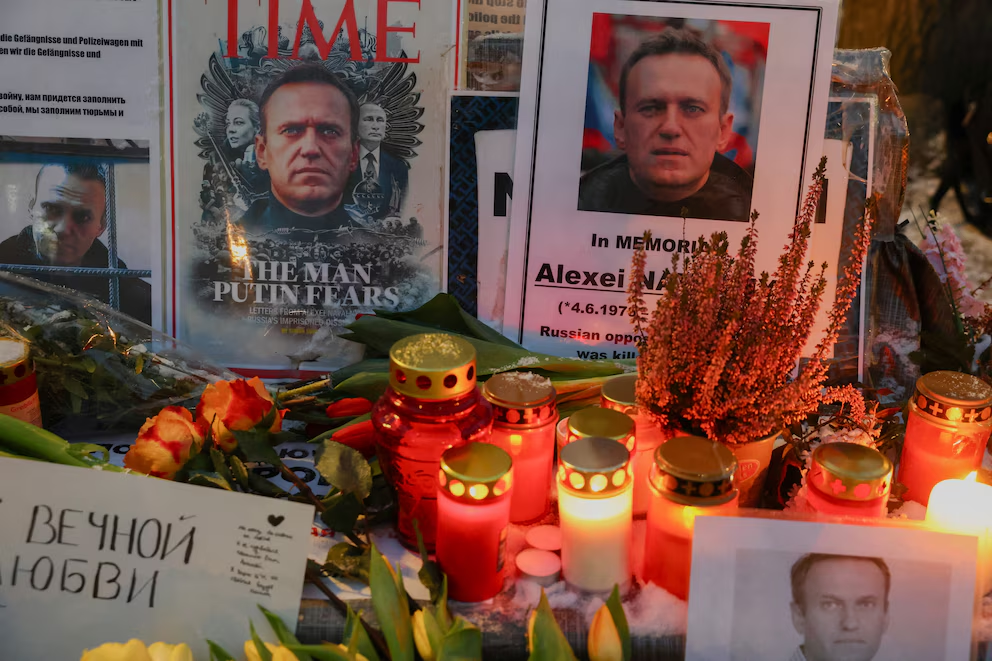
The Navalny case continues to be one of the main points of friction between London and Moscow. The United Kingdom maintains that the Epibatidine toxin was used against the opposition leader, who died in 2024 while being held in a penal colony located in the Russian Arctic. Russian authorities reject that version.
Novichok also occupies a central place in British accusations. That nerve agent was used, according to London, in the 2018 attack carried out in the English city of Salisbury against former Russian spy Sergei Skripal and his daughter Yulia. Both survived after remaining hospitalized in critical condition, but months later, the British woman Dawn Sturgess died after coming into contact with a container that held traces of the substance.
The announcement of the sanctions coincided with a new episode of military tension between both countries. The British Ministry of Defence reported that F-35 fighter jets took off from the aircraft carrier HMS Prince of Wales to intercept a Russian Bear-F maritime patrol aircraft that, according to London, approached the British naval group while it was conducting NATO operations in the Norwegian Sea.
According to the official statement, the Russian aircraft flew “at a low altitude and unnecessarily close” to the aircraft carrier and dropped several sonobuoys in its vicinity, devices used to detect submarines using sonar systems.
“This activity was unsafe and unprofessional,” stated the British Ministry of Defence. The ministry added that British fighter jets escorted the Russian aircraft “until it left the area,” in a new episode of friction between both countries in northern Europe.