
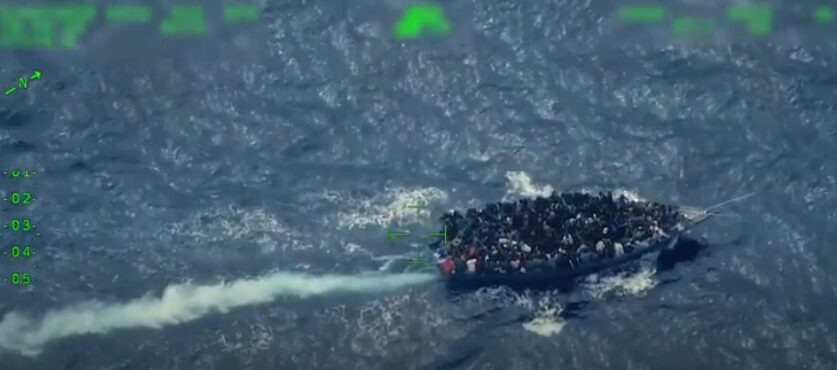
An overloaded vessel with 240 Haitian migrants was intercepted last Sunday in Caribbean waters, about 24 kilometers south of the Turks and Caicos Islands, following an emergency report alerting of the imminent risk of sinking. The operation, which involved air and maritime units from the United States and the British Overseas Territory, concluded without casualties and with the custody of the migrants transferred to local authorities.
The Coast Guard reported this Thursday that Miami air authorities guided two units of the Royal Turks and Caicos Islands Police Force and the archipelago’s Regiment to the location. Both units secured the vessel and towed it to port. The Air and Marine Operations (AMO) office of the United States Customs and Border Protection (CBP) also participated in the operation. The archipelago’s Border Force took custody of the 240 occupants, who claimed to be of Haitian nationality.
“The successful interception and safe extraction of these individuals from a dangerous situation was made possible by the close collaboration and rapid response of the Coast Guard, CBP AMO personnel, and the authorities of the Turks and Caicos Islands,” noted Lieutenant Chelsea Garcia, Deputy Director of Operations for the U.S. Coast Guard for the Bahamas and the Turks and Caicos archipelago.
We recommend reading:Costa Rica creates residency and employment program for migrants from four countries
The operation is part of Operation Vigilant Sentry (OVS), the interagency program coordinated by the U.S. Department of Homeland Security that guides the response to migration flows from Cuba and Haiti. The program involves more than 50 federal, state, and local agencies. The Coast Guard patrols three priority corridors in the region: the Bahamas-Florida Straits, the Windward Passage between Cuba and Haiti, and the Mona Passage between the Dominican Republic and Puerto Rico.
More Read

A child sleeps in a shelter for families displaced by gang violence in Port-au-Prince, Haiti, on Tuesday, January 27, 2026 (AP Photo/Odelyn Joseph

The Turks and Caicos Islands, located southeast of the Bahamas and north of Hispaniola, are a recurring stop on routes departing from Haiti. Geographic proximity and differences in living standards make the archipelago a frequent destination. In January 2024, the London-appointed governor, Nigel Dakin, already warned that the territory’s police and migration resources were “under great pressure” following the arrival of 275 Haitians on three boats in just one week.
The episode occurs as the Haitian crisis deepens. Between January and March 2026, at least 1,642 people were killed and 745 injured in incidents linked to violence, according to a UN report published on May 8. Gangs have controlled more than 90% of Port-au-Prince since the assassination of President Jovenel Moïse in July 2021, and internal displacement affects more than 1.4 million people, according to the International Organization for Migration.
More Read

Pressure is pushing tens of thousands to attempt the sea crossing despite the extreme risks. According to the Support Group for Repatriates and Refugees (GARR), more than 68,000 Haitians were deported in the first quarter of 2026, mainly from the Dominican Republic, the United States, and the Bahamas, a figure that exceeded the records for the same period of the previous year. Among the deportees were 121 pregnant women and 246 nursing mothers. More than five million Haitians suffer from acute food insecurity, according to international estimates.
You can also read: More than a thousand migrants will accompany Pope Leo XIV at the Canary port of Arguineguín
It is not the first time that this corridor has recorded incidents of this magnitude. In October 2025, the Coast Guard intercepted another vessel with 103 Haitian migrants at the same distance from the islands. In July 2025, the archipelago’s authorities repatriated 194 migrants in a similar operation. The repetition of these episodes illustrates that the reinforcement of the surveillance apparatus fails to counteract the magnitude of the crisis that pushes Haitians out to sea.