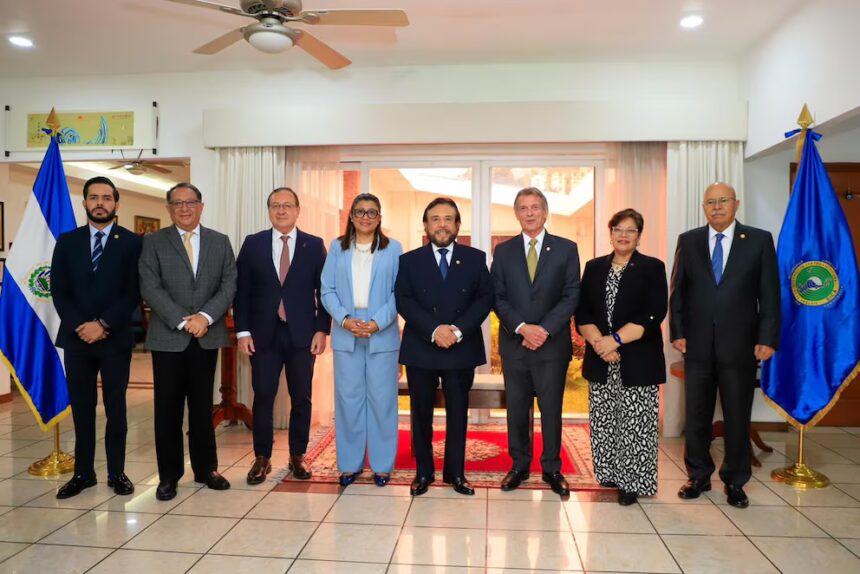
The Vice President of El Salvador, Félix Ulloa Jr., led a meeting in San Salvador with diplomatic representatives from Central America and Belize to promote Central American integration. According to the Salvadoran Vice Presidency, ambassadors from Guatemala, Costa Rica, Honduras, Panama, Nicaragua, and Belize participated.
During the session, the diplomats ratified the need to maintain permanent communication on the priority issues of the regional agenda.
The Vice Presidency indicated that the initiative was developed during the period in which the Dominican Republic holds the Pro Tempore Presidency of the Central American Integration System (SICA).
They also analyzed the activities carried out under that presidency and the process linked to the upcoming election of the new secretary general of SICA.
We recommend reading:Trump to appoint Kristi Noem’s running mate as ambassador to El Salvador, according to CBS News
Training programs and publications
Ulloa presented the progress of the training programs promoted by his office, in particular the diploma courses on Central American integration in their basic and specialized modalities. Some of the diplomats present participated in these training sessions, which are aimed at expanding the technical capabilities of the region’s officials.
In the meeting, they also reviewed publications and studies prepared by the integration team of the Vice Presidency of El Salvador. Among the topics addressed are the Central American mortgage, social security, the status of regional integration, the law of the sea, and community law.
Upcoming conferences in San Salvador
In addition, Ulloa announced the holding of the II International Conference on State and Democracy (CIED), scheduled in San Salvador for November 16 and 17. He also reported on the upcoming edition of the Conference on the Future of Central America, which will hold its third edition in the Salvadoran capital.
More Read

The authorities present exchanged perspectives on the main challenges facing the region and agreed on the need to advance the integration process through coordinated actions.

The ambassadors of Guatemala, Costa Rica, Honduras, Panama, Nicaragua, and Belize ratified the need to maintain permanent communication regarding the regional agenda. (Courtesy: Vice Presidency of the Republic of El Salvador)
The axes of the integration process
The Vice Presidency of El Salvador reiterated its commitment to the promotion of spaces for dialogue, training, and research for the consolidation of regional integration.
The Central American Integration process, led by the Central American Integration System (SICA), is organized into five fundamental pillars: economic integration, institutional strengthening, democratic security, climate change, and social development.
Regional work areas
The Central America region is advancing in customs and trade integration with the implementation of digital tools and regional agreements, the Secretariat for Central American Economic Integration (SIECA). The Northern Triangle, made up of Guatemala, Honduras, and El Salvador, operates as a single customs territory, which accounts for more than half of intra-regional trade.
In economic integration, the goal is to consolidate the Central American Customs Union and Common Market through the adoption of a uniform tariff and trade facilitation, coordinated by the Central American Economic Integration Subsystem. Diplomats analyzed the activities of the presidency and the process to elect the new secretary general of SICA. (Courtesy: Vice Presidency of the Republic of El Salvador)
More Read

You can also read: Two bitcoin banks will open operations in El Salvador, according to the ambassador to the United States
On the diplomatic and academic front, initiatives such as the Conference on the Future of Central America are being promoted to unify guidelines among member countries.
Regarding institutional matters, work is underway on the ratification of community instruments to improve regional entities such as the Central American Parliament and the Central American Court of Justice.
In the environmental and social area, policies are coordinated to address climate change and improve the equitable development of more than 50 million inhabitants of the isthmus.