
Twenty-two countries, including France, Germany, United Kingdom, Canada, Japan and Australia, demanded on Monday that Israel “immediately fully resume aid to the Gaza Strip”, and that it be organized by the United Nations and NGOs.
The UN and humanitarian organizations “cannot support” the new model for the supply of aid to that Palestinian territory decided by the Israeli government, wrote the diplomatic services of those countries in a joint statement transmitted by the German Ministry of Foreign Affairs.
Nine United Nations humanitarian aid trucks were authorized to enter the Gaza Strip on Monday, announced the UN humanitarian operations chief, Tom Fletcher, and called the entry a “drop in the ocean”.
The Israeli government only confirmed the entry of five trucks with aid.
The population in Gaza “is facing famine” and “must receive the aid it desperately needs,” urge the foreign ministries of Australia, Canada, Denmark, Estonia, Finland, France, Germany, Iceland, Ireland, Italy, Japan, Latvia, Lithuania, Luxembourg, Netherlands, New Zealand, Norway, Portugal, Slovenia, Spain, Sweden, and the United Kingdom.

The head of its diplomacy, the European Union, Kaja Kallas, also signed.
The “new distribution model” that Israel has just decided “endangers beneficiaries and humanitarian workers, affects the role and independence of the UN and our trusted partners and links humanitarian aid to political and military objectives,” deplore the signatories.
“Humanitarian aid should never be politicized and the Palestinian territory should not be reduced or subjected to any demographic change,” they add.

In addition, France, Canada, and the United Kingdom asked Israel to end its “scandalous actions” in Gaza and promised to respond with “concrete measures” if it does not cease its military offensive and does not unblock humanitarian aid.
In a joint statement, French Emmanuel Macron, Canadian Mark Carney and British Keir Starmer joined the growing pressure on the Israeli government to allow the entry of humanitarian aid.

“Israel suffered a heinous attack on October 7. We have always supported Israel’s right to defend Israelis against terrorism, but this escalation is totally disproportionate,” they write in their statement.
The three leaders promise that they will not remain “idle while [Israeli Prime Minister Benjamin] Netanyahu’s government continues with these outrageous actions.”
“If Israel does not end the new military offensive nor lift its restrictions on humanitarian aid, we will adopt other concrete measures in response,” they add without specifying which ones.
Macron, Carney, and Starmer also condemn the “hateful language recently used by members of the Israeli government” and warn that the permanent forced displacement of civilians violates international humanitarian law.
More Read

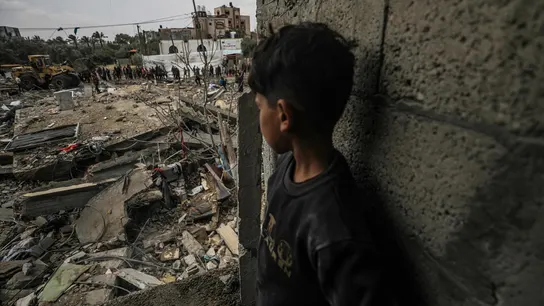
Israel resumed its military operations in the Gaza Strip on March 18, breaking a two-month truce, and in early May revealed a plan that foresees its “conquest” and the displacement of most of its 2.4 million inhabitants to the southern end of that territory.
“The fighting is intense and we are making progress. We will take control of the entire territory of the strip,” Netanyahu emphasized.
“We will not yield. But to succeed, we have to act so that they don’t stop us,” he added, explaining why Israel announced on Sunday the limited entry of humanitarian aid to the bombed enclave.
For their part, the Israel Defense Forces (IDF) intensified their offensive in the Gaza Strip this Monday as part of Operation “Chariots of Gideon”, launching more than 160 air strikes in a single day. According to military authorities in a statement released on the social network X, the operation aims to dismantle the military capabilities of the terrorist group Hamas in the region.
Israeli forces acted with the support of the Shin Bet and the Southern Command, attacking multiple infrastructures associated with Hamas in the north, center, and south of Gaza. Among the targets hit were armed squads, anti-tank missile launchers, underground tunnels, weapons depots, command centers, and buildings with explosive traps.
In parallel, the army ordered the total evacuation of the city of Khan Younis and the neighboring towns of Beni Suhaila and Abasan, in the south of the enclave. The warning was issued directly to the Gazan population by the military spokesman in Arabic, Avichay Adraee, who announced that Israeli forces will launch “an unprecedented attack” in those areas. “They must evacuate immediately to the west, to the Mawasi area”, indicated the message, which also declared the entire Khan Younis governorate as a “dangerous combat zone”.