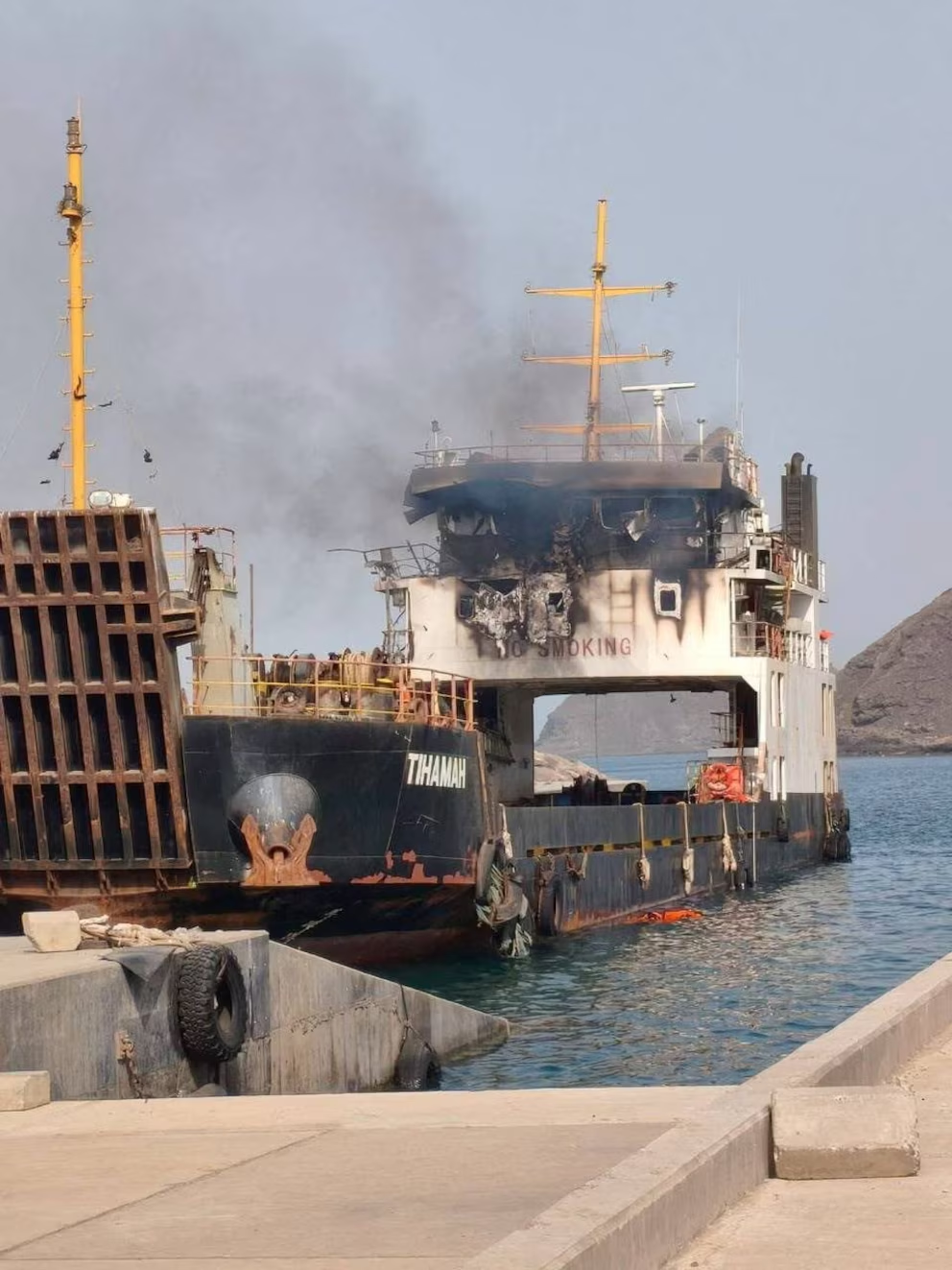
The Houthi rebels of Yemen, aligned with Iran, attacked a Saudi vessel carrying military equipment in the Bab el-Mandeb strait this Tuesday, reported the news agency Saba, which is controlled by the insurgent group. Saudi Arabia did not immediately confirm the incident.
The Joint Maritime Information Center (JMIC), a naval security body overseen by the United States Navy, reported that an unidentified cargo ship was struck by a projectile while anchored in Yemeni territorial waters, within the strait. The Houthi television station Al-Masirah broadcast photographs and a short video in which the name Tihamah can be distinguished on the hull.
The Houthis had warned last month that they would attack any Saudi vessel attempting to cross the strait, in response to what they define as a Saudi siege on the northern areas of Yemen under their control. On July 20, they formally declared a naval embargo against Saudi Arabia in the Red Sea, an accusation that Riyadh has denied.
We recommend reading:
The blockade had immediate effects: according to the firm Windward, several oil tankers with Saudi cargo reversed their route before reaching Bab el-Mandeb, and the Kpler platform recorded drops of more than 30% in vessel transit through the strait. On July 25, two supertankers from the state-owned Saudi National Shipping Co. suffered attacks that forced Saudi Arabia to temporarily suspend its exports through that route.
More Read

A Yemeni soldier operates a machine gun mounted on a military patrol truck on the coast of Bab el-Mandeb, Yemen.

Bab el-Mandeb connects the Red Sea with the Gulf of Aden and is one of the busiest maritime passages in the world, key for oil and containers linking Asia, Europe, and the Atlantic through the Suez Canal. Its narrowest point measures just 29 kilometers, which limits passage to two shipping channels and makes it a strategic bottleneck for global trade.
The immediate context of this attack includes a notable escalation within Yemen. Last Friday, the Houthis launched missiles and drones against camps for displaced persons and residential neighborhoods in Marib, a city held by the internationally recognized Yemeni government, in an attack that left two dead and fourteen injured, according to Saba. A day earlier, attacks against military camps in Marib and Hadramaut had left at least 30 government soldiers dead, one of the deadliest escalations recorded in months.
More Read

The UN special envoy for Yemen, Hans Grundberg, warned on Friday that these episodes, added to the resumption of the offensive against commercial shipping in the Red Sea, place the country at its greatest risk of a return to large-scale conflict since the truce sponsored by the United Nations in April 2022. Yemen has been going through a civil war since late 2014, when the Houthis took control of the north of the country, including the capital, Sana’a, which led in 2015 to the military intervention of a coalition led by Saudi Arabia in support of the internationally recognized government. The 2022 truce reduced direct fighting, but the conflict was never resolved and hostilities have reactivated intermittently in recent months.
Rashad al-Alimi, chairman of the Yemeni Presidential Leadership Council, warned this week that government forces will no longer allow the Houthis to “dictate” the pace of the confrontation, according to Saba, following days of intensified Houthi attacks in the oil-rich provinces of Marib, Hadramaut, and Shabwa. The maritime escalation also occurs in parallel to the tension in the Strait of Hormuz, where oil tankers have suffered attacks attributed to Iran in recent weeks, as expectations for an agreement between Tehran and Washington fade.
Without Saudi confirmation or details regarding potential damage, the episode adds to a chain that progressively erodes the viability of commercial transit through Bab el-Mandeb. The combination of an unresolved naval blockade and an expanding ground offensive anticipates greater pressure on one of the most sensitive commercial arteries on the planet.