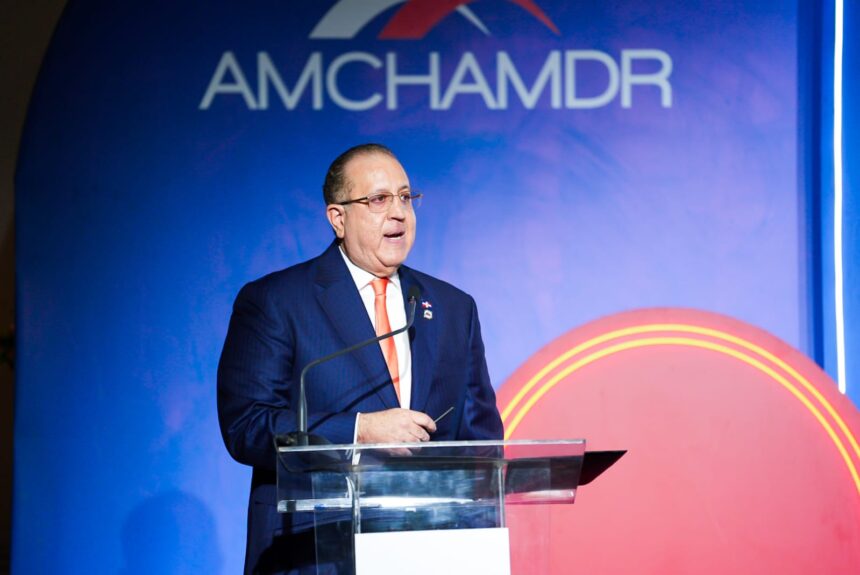
The growth of the Dominican economy doubled compared to the previous year despite the uncertainty that persists in the international landscape, stated the Minister of Finance and Economy, Magín Díaz, during the American Chamber of Commerce (AMCHAMDR) luncheon in the presence of the main representatives of the public and private sectors.
The minister described this event as evidence that “investment is outpacing bureaucracy.” In that context, he noted that the International Monetary Fund itself recently raised its growth projection for the country to 4%, while JP Morgan places it at 4.3% for this year, both figures above the average projected for Latin America and the Caribbean.
“The economy is responding,” noted Díaz while presenting official data to which he referred as “what the economic thermometer says and the street does not repeat,” among them, a 4.2% growth during the first 5 months, which is double that of last year.
In that sense, he stressed that public investment led the Government’s response: capital expenditure for the first half of 2026 grew by 29.7% compared to the same period in 2025, well above the increase in current expenditure (6.9%).
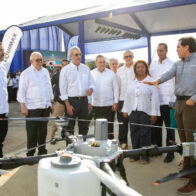
The activity was attended by ministers, representatives of business associations, and the main companies in the country that are part of the AMCHAMDR membership.
More Read
The official explained that, given the prolonged international oil price shock resulting from the recent war conflict, the Government set three objectives which, according to his presentation, are being met.
The first is to maintain macroeconomic and fiscal stability and, above all, social stability; the second, to reasonably cushion the local impact of rising international prices, preventing the external adjustment from being passed on in its entirety and abruptly to the consumer.
The third objective, he said, is to avoid, as far as possible, a fall in public investment, maintaining a fiscal policy that continues to drive economic growth.
More Read

The minister also reviewed the rest of the macroeconomic and social indicators that support that balance, stressing that general inflation stands at 5.67%, while core inflation, which excludes volatile items, is at 4.96%, within the Central Bank’s target range.
International reserves total US$15.8 billion and the Dominican peso has appreciated in the recent period. The unemployment rate remains at 5%, with the creation of 118,631 new net jobs during the first quarter, and monetary poverty fell to 15.4%, a reduction of 2.6 percentage points compared to 2025.

Regarding the financial sector, he stated that the bank credit portfolio grew by 9%, with a delinquency rate of just 1.89% and a solvency ratio of 18.56%, almost double the required regulatory minimum.
The external sector also showed strength: remittances exceed US$1 billion per month on average, total exports grew by 14.4%, tourist arrivals increased by 10.8%, and foreign direct investment expanded by 6.4% in the first quarter, while country risk, measured by the EMBI, remains at historic lows.
Regarding the impact of the oil shock, the minister presented a regional comparison that places the gasoline price increase in the Dominican Republic at around 17% between January and July 2026, a figure lower than the Latin American average (28.8%) and considerably below the adjustments observed in countries such as Venezuela, Cuba, or Panama.
The head of the Treasury closed his speech by citing an agenda of structural reforms under discussion, including a redefinition of the fiscal rule to adapt it to different growth scenarios without compromising public investment, the design of an automatic and transparent mechanism to moderate variations in fuel prices, and better targeting of monetary transfers based on the new poverty maps prepared by the Technical Committee on Poverty.

“This is a pro-market government that believes in private initiative as the engine of growth, with openness to trade, responsible macroeconomic policies, and social sensitivity,” stated the minister, who reiterated his commitment to fiscal responsibility, the technical independence of the Central Bank and tax administration, and the gradual strengthening of market competition.
Meanwhile, the president of AMCHAMDR, Francesca Rainieri, pointed out that the country today has a solid economy, recognized for its stability and dynamism; however, she asserted that the challenge is no longer just to grow, but to grow better: with greater productivity, stronger institutions, competitive human capital, and a long-term vision.
“It is the State’s responsibility to offer stability, transparency, efficiency, and legal certainty. It is the private sector’s responsibility to continue investing, innovating, creating jobs, and contributing knowledge to strengthen public policies. Because when the public sector and the private sector work together, better policies are built, competitiveness is strengthened, and, above all, a better country is built. Our eight Working Committees will continue to make available to the country and the Government their experience, technical capacity, and the vision of our member companies to contribute to the construction of policies that strengthen the competitiveness and development of the Dominican Republic,” he said.
Likewise, in welcoming everyone to the lunch, the Chamber’s Executive Vice President, William Malamud, noted that: “Just a few weeks ago, at our Business Vision event, we analyzed the risk of geopolitical conflicts significantly affecting global energy markets. Today, faced with an even more complex international reality, it is essential to understand how these events can impact our economy and what strategies are being implemented to preserve the country’s stability and competitiveness. Therefore, we value the opportunity to hear firsthand Minister Magín Díaz’s vision on the challenges and priorities of Dominican fiscal policy.”
This luncheon was made possible thanks to the support of the companies of the AMCHAMDR Elite Circle: Citi, Grupo Rica, Squire Patton Boggs, INICIA, AES Dominicana, Grupo Humano, HIT Puerto Río Haina, Grupo SID, Grupo Puntacana, Altice Dominicana, Grupo Estrella, Grupo Viamar, DP World, Claro Dominicana, Banco Santa Cruz, and Cervecería Nacional Dominicana.