Lima.- The 7.2 magnitude earthquake that was felt last Thursday in the southern Andes of Peru, without causing major damage due to the depth of its origin, is part of a chain of more than 500 seismic movements reported so far this year through this Saturday in a country nestled in the Pacific Ring of Fire, the area of greatest seismic activity in the world.
Peruvian Minister of Housing, Mauricio Arnillas, confirmed on Friday in the district of Coracora the damage to homes, a school, and the main church of that Andean jurisdiction in the province of Parinacochas, in addition to receiving the request from local authorities to declare a state of emergency in that locality to facilitate rehabilitation work.
While the regional governor of Ayacucho, Wilfredo Oscorima, detailed that the earthquake has left 498 people affected, one house destroyed and six homes uninhabitable, as well as 21 schools and 26 health facilities with some type of damage.
Since the earthquake’s epicenter was at a depth of 108 kilometers, surface damage was modest, with no fatalities and only three people injured, in contrast to the devastating effects of the recent earthquakes in Colombia and Venezuela, with magnitudes of 7.4 and 7.2 – 7.5, respectively.
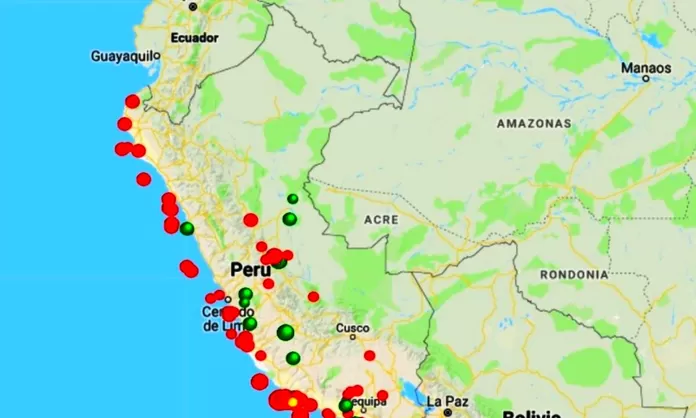
So far this year, Peru has reported the occurrence of 568 earthquakes in different regions of the country, and last July was one of the most seismically active with 115 events, according to information from the National Seismological Center (CENSIS), a service developed by the Geophysical Institute of Peru (IGP).

You can also read: Pope Leo XIV will visit Peru from November 11 to 16
The head of the IGP, Hernando Tavera, explained that the regions with the highest number of reported seismic movements are Lima (67), the southern regions of Arequipa (93) and Ica (56), where the last devastating earthquake occurred in 2007 leaving 500 dead, and the northern region of Piura (44).

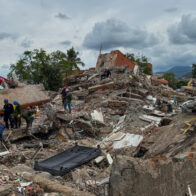
The latest earthquakes with serious effects in Peru occurred in Junín on July 18, with a magnitude of 5.4, which caused the death of five people and the destruction of dozens of houses in the rural provinces of Chupaca and Huayucachi, in the central Andes, and the one in Ayacucho, in the southern highlands of the country, last Thursday.
The IGP recorded several aftershocks in Chupaca, which affected the affected population who had to sleep in tents outdoors in an area of intense cold at night, which caused the death of an elderly woman.
More Read

Tavera explained that the earthquake in Junín had its epicenter 14 kilometers southwest of Chupaca and was caused by the reactivation of the Altos del Mantaro fault, at a depth of 9.5 kilometers, which generated ground shaking levels of up to 75 centimeters per second squared, capable of causing the partial or total collapse of adobe (mud brick) structures.
The expert pointed out that the soil characteristics amplified the seismic movement by more than 2.5 times in the Tinyari Chico and Pumpunya annexes, as well as in the Pachacutec and Estrellita neighborhoods, where there was greater damage to adobe houses and public infrastructure.
Subsequent aftershocks caused the collapse of homes that had already been affected by the main earthquake.