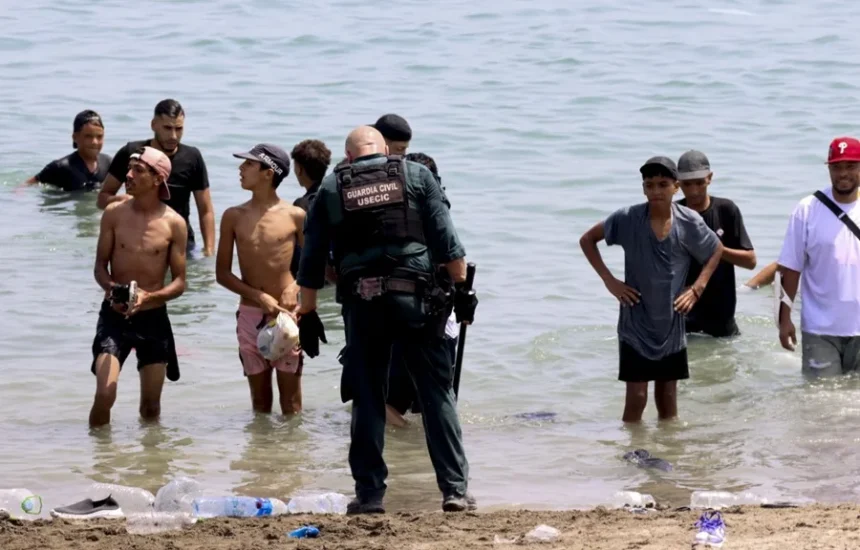
Ceuta .- The Civil Guard recovered the body of a man in the waters of Ceuta this Sunday, bringing the number of deaths related to the massive influx of migrants recorded on July 30 to 83, according to sources close to the case.
The body, in an advanced state of decomposition, has been located by members of the Maritime Service and the GEAS of the Civil Guard, approximately half a mile from the Juan XXIII area.
After its recovery, the body has been transported to the fishing port of Ceuta and the Organic Unit of the Judicial Police has been notified to initiate the proceedings aimed at determining their identity and the circumstances of their death.
This new discovery comes two days after two other bodies were recovered in the waters off the coast of Ceuta. One belonged to a young sub-Saharan man who died after falling into the sea while attempting to reach Ceuta by paraglider from Morocco, and the other to a North African man found in a swimsuit in the Almadraba area.
With the body recovered this Sunday, the death toll has reached 83 since the massive arrival of migrants on July 30. All of the deceased are men except for one woman, according to data collected during the identification and recognition of the bodies.
More Read

Establishing the identity of the victims
The Institute of Legal Medicine has reported that, so far, six of the deceased have been identified; three through fingerprints and the others through biological studies. All are men, of legal age, and of Moroccan nationality.
In addition, three other bodies remain pending confirmation through biological analysis, and direct DNA matching with samples from relatives is being carried out.

We recommend reading: Morocco raises death toll to 14 and 236 injured in the Ceuta migration stampede
Forensic teams have collected biological samples and fingerprints from all bodies recovered from the sea. Once autopsies are performed, the fingerprints are digitized and sent by the Civil Guard’s Criminalistics Service to establish the identity of the victims. When this is not possible, genetic comparison with relatives or sending fingerprint data to Morocco is used.
More Read
The identification device has been reinforced by professionals from different parts of Spain. In an initial phase, three forensic doctors from Ceuta, two from Cáceres, and one from Salamanca and Valladolid participated, in addition to autopsy technicians from Ceuta, Cáceres, Salamanca, and Valladolid.
Since August 5th, a rotation took place and two forensic experts from the Institute of Legal Medicine of Albacete, an autopsy technician from that province, and another from Toledo were incorporated into the operation.
Ante-mortem office for the relatives of the missing
In parallel, the Civil Guard has set up an ante-mortem office so that the relatives of the missing persons can file reports and provide biological samples to establish matches with the recovered bodies. So far, 19 reports have been registered, in addition to other checks and investigations to clarify the identity of the victims.
All information is centralized in the Integrated Data Center (CID), created to coordinate the response to this emergency in accordance with the national protocol for forensic medical and Scientific Police action in incidents with multiple victims.
The judicial apparatus has also been reinforced. The Ceuta duty court has a second judge to handle the proceedings derived from the emergency and opens a case for each of the bodies recovered at sea, to which the preliminary autopsy report is attached.
Once the identity has been judicially established, the court proceeds with the identification of the deceased and, when there are no relatives to claim the body, it processes the corresponding burial permit.