The United States, Japan, and South Korea formalized an agreement this Tuesday aimed at accelerating the expansion of modular nuclear reactors in Indo-Pacific countries, with the goal of strengthening energy security and consolidating technological and commercial cooperation between their nuclear industries.
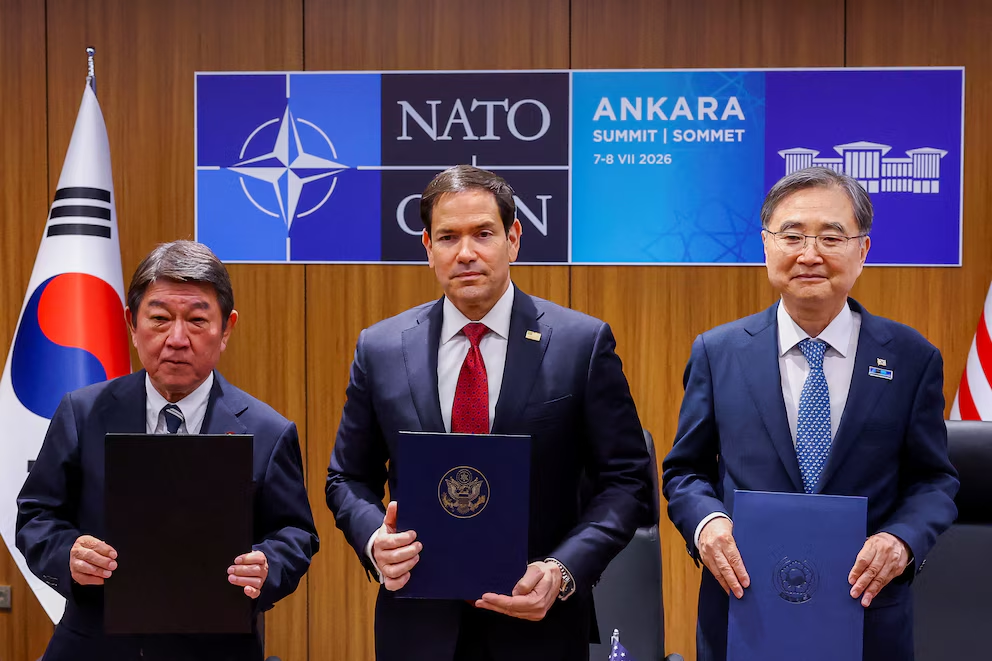
The memorandum of cooperation, signed by US Secretary of State Marco Rubio, Japanese Foreign Minister Motegi Toshimitsu, and his South Korean counterpart Cho Hyun on the sidelines of the NATO summit in Ankara, establishes a framework to promote the deployment of these systems in third countries.
A small modular reactor (SMR) is an atomic power plant smaller in size than conventional reactors, designed to produce electricity efficiently and safely. These reactors are manufactured in standardized modules, which allows for serial construction and facilitates transport and installation in regions that cannot host large nuclear power plants. Their development promises to reduce costs, increase operational flexibility, and maintain high safety standards.
The agreement proposes a joint strategy to facilitate the entry of small modular reactors (SMRs) into emerging markets, especially in Asia, where energy demand continues to rise.
We recommend reading: Trump criticizes his European allies for not helping the U.S. in Iran and questions spending on NATO
More Read

The image shows the interior of a cargo plane with a secured wooden crate, containing technology for small modular reactors, vital for the nuclear energy of the future.
The three nations, recognized for their expertise in the civil nuclear field, seek to create synergies that allow for the optimization of regulatory processes, the stimulation of private investment, the sharing of supply chains, and the guarantee of high standards of safety and non-proliferation.
“This cooperation supports our common security interests and paves the way for partner countries to meet their energy needs,” the US State Department noted in a statement.
More Read

The commitment includes an initial disbursement of more than 10 million dollars by the United States for the FIRST program, an initiative aimed at providing technical support and specialized training in SMR technology to Indo-Pacific countries that choose this alternative. In addition, the creation of a regional training center is planned to train local professionals and equip them with the necessary tools to operate and maintain these state-of-the-art systems.

In parallel with the memorandum, it was announced that the companies GE Vernova, Hitachi, Samsung C&T, and SGE will promote the commercialization of the BWRX-300 model, an advanced modular reactor, on the European continent.
Marco Rubio, Motegi Toshimitsu and Cho Hyun sign a cooperation agreement to boost the development and expansion of modular nuclear reactors during the NATO summit in Ankara (REUTERS
The text of the memorandum underscores that the trilateral coordination aims to offer countries in the region competitive, reliable alternatives that are aligned with the highest international requirements. Among the objectives is to facilitate the serial deployment of these reactors, reduce risks in the development phase, and promote economies of scale to lower costs and accelerate implementation timelines.
“The agreed framework fosters deployment models that reduce project uncertainties, incentivize investment, and optimize supply chains,” stated the State Department, which also highlighted that the initiative seeks to “position U.S., Japanese, and South Korean companies as preferred suppliers.”
The agreement also contemplates mechanisms to streamline approval processes and establish knowledge exchanges on nuclear safety and non-proliferation prevention.

Tension over nuclear development in Asia
The announcement of the memorandum comes one day after high tensions in Asia. The United States government expressed its concern this Monday regarding the “rapid and opaque buildup of nuclear weapons” in China, following the recent launch of an intercontinental ballistic missile from a Chinese submarine in the Pacific. Washington urged Beijing to regularly report on its missile tests and space operations, in line with the commitments made by the permanent members of the UN Security Council.
China launched a long-range ballistic missile from a nuclear submarine
State Department spokesperson Thomas Pigott emphasized that “the United States is striving more than ever to prevent nuclear proliferation,” while, in his view, “China is doing the opposite.” The Chinese military test sparked concern in the region. The government of Japan conveyed its “deep concern” and requested that China reconsider these exercises, “to ensure that the training does not pose a threat to Japanese security.” Australia also expressed its disagreement, warning that such maneuvers could “destabilize the region” and lamented the lack of transparency on the part of Beijing.