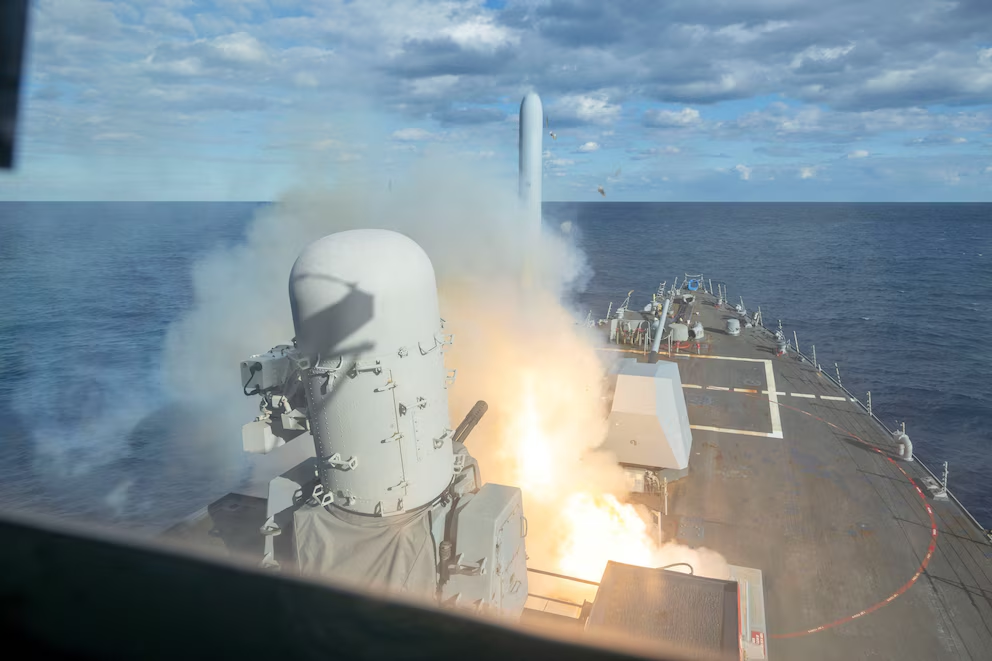
The United States Central Command (CENTCOM) reported this Tuesday that forces of the Islamic Revolutionary Guard Corps of Iran launched several ballistic missiles against U.S. positions in the Middle East, in what it described as an attempted surprise attack, although it assured that all projectiles were intercepted.
In a statement published on its official X account, CENTCOM indicated that the launch occurred at 5:45 p.m. U.S. Eastern Time and that the defenses managed to neutralize the threat before it reached its targets.
“The forces of the Islamic Revolutionary Guard Corps launched multiple ballistic missiles from Iran in an attempted surprise attack against U.S. forces located in the Middle East,” the military body noted.
The U.S. command confirmed that “all Iranian missiles were successfully intercepted” and assured that its troops remain prepared for potential new actions.
We recommend reading:A bar in the United States that promised free beer the day Trump died loses its license
More Read

“U.S. forces remain vigilant and in a high state of readiness,” CENTCOM added in its message.
The price of US oil rose more than 4% to stand near $82.75 per barrel
The news had an immediate impact on the financial markets. The price of U.S. oil rose more than 4% to reach nearly $82.75 per barrel, reversing three consecutive days of declines, while futures for major U.S. stock indices recorded a drop of nearly 0.1% following the news of the military operation.
More Read

The missile launch occurred after several days without clashes between both parties, following weeks of escalation linked mainly to tensions around the Strait of Hormuz, one of the most important maritime routes for global energy trade. Approximately one-fifth of the oil consumed globally passes through that route.
During the period of greatest tension, Iran threatened to limit maritime transit and attacks and warnings were recorded against commercial vessels operating in the area.
After a temporary pause in the clashes, the dispute over the control and security of that strategic route returned to center stage. Iran demanded that ships use routes near its coasts and raised the possibility of establishing transit fees, while several vessels began to move through alternative corridors under U.S. surveillance.
The missile launch occurred after several days without clashes between both parties, following weeks of escalation linked mainly to tensions around the Strait of Hormuz
This Tuesday’s episode occurred in a regional context also marked by incidents against Washington’s allies. Hours earlier, Saudi Arabia reported that its air defenses had intercepted drones launched against oil facilities in the eastern part of the country.

The Saudi Ministry of Defense stated that the attacks were carried out from Iraqi territory by armed groups linked to Iran. Iraqi authorities announced an investigation and assured that they will not allow their territory to be used to launch attacks against neighboring countries.
More Read

The mentioned groups denied responsibility for those actions and rejected Riyadh’s accusations.
Tension also reached the Red Sea, where Yemen’s Houthi rebels claimed to have attacked a Saudi oil tanker and forced the vessel to change course. The operation occurred after the group announced restrictions against maritime transport linked to Saudi Arabia.
The increase in hostilities occurred while U.S. and Iranian officials kept open the possibility of resuming diplomatic talks with the mediation of third countries. However, the new missile launch once again raises the pressure on efforts to reduce the confrontation
The Greek-flagged oil tanker Sounion burns in the Red Sea following an attack attributed to Yemen’s Houthis, in a file image
Iran previously claimed that U.S. attacks during the previous escalation caused damage to infrastructure, including sectors linked to military and transport facilities. Washington, for its part, maintained that its operations were in response to Iranian attacks against vessels in the Strait of Hormuz and threats against its forces deployed in the region.
The new episode also coincided with the visit of Israeli Prime Minister Benjamin Netanyahu to Washington to meet with U.S. President Donald Trump.
After nearly an hour and a half of closed-door talks, the White House described the meeting as “positive and productive,” while both sides agreed on the need to maintain coordination regarding Tehran and to advance diplomatic initiatives in the Middle East.
“I just finished an excellent meeting with President Trump. When I say excellent, it is not just a formal compliment,” Netanyahu stated in remarks translated from Hebrew and shared by his office.
“It was a conversation of full collaboration, of mutual support, with an understanding of the shared goal of ensuring that Iran does not have nuclear weapons, and also other goals,” he added.
Israeli Prime Minister Benjamin Netanyahu, alongside United States President Donald Trump, during a meeting at the White House, in Washington.
The meeting represented the first in-person encounter between both leaders since the start of the war against Iran at the end of February and took place after weeks marked by public differences over the handling of the conflict. Despite those disagreements, Washington and Jerusalem sought to convey an image of understanding at a time when a pause in the fighting remains in effect to make room for negotiation.