
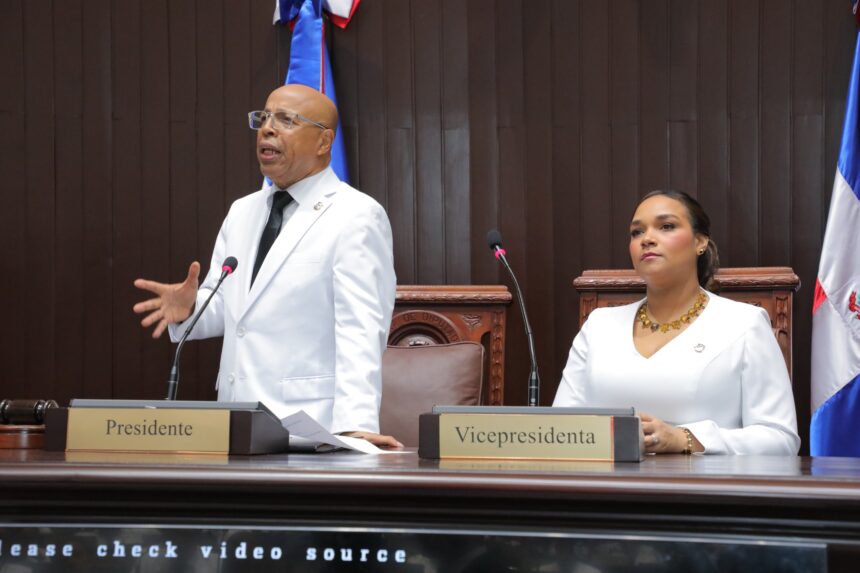
Santo Domingo.— Deputy Alfredo Pacheco was sworn in this Sunday, for the tenth time, as president of the Chamber of Deputies for the 2026-2027 legislative period, consolidating a long trajectory at the head of the legislative body.
Pacheco, representative of the Modern Revolutionary Party (PRM), once again heads the Lower House after his political organization ratified his tenure in the position. His re-election makes him one of the figures with the greatest continuity in the leadership of the Dominican Legislative Branch.
You might be interested in: Pacheco highlights labor reform, social security, and digitalization of justice as Congress priorities
During the installation session of the Second Ordinary Legislature of 2026, Pacheco formally assumed the presidency and will be accompanied on the executive board by Dharuelly D’Aza, as vice president, while Julio Emil Durán Rodríguez and Leyvi Bautista will occupy the secretariats.
Ten times at the head of the Chamber
The new swearing-in represents the tenth time that Pacheco has held the presidency of the Chamber of Deputies, a figure that highlights his tenure and political weight within the National Congress.
More Read

His legislative career has been characterized by a prolonged participation in the Lower House, where he has held leadership positions and has participated in different periods of Dominican political life.
With this new election, Pacheco will continue to lead the Chamber’s work during the 2026-2027 period, in a scenario marked by a broad agenda of pending projects and reforms considered a priority.

A broad legislative agenda
Upon assuming the presidency once again, Pacheco announced that the new legislative session will be marked by the study and eventual approval of important initiatives, including the new Labor Code, the amendment of the Social Security Law, and legislation related to the use of digital media in judicial and administrative processes.
More Read

He also mentioned among the priorities the updating of the Civil Code, the Water Law project, and the Mental Health Law, in addition to other proposals that remain in legislative committees.
During the start of the extraordinary session, Pacheco dedicated part of his speech to recognizing the trajectory of former deputies Andrés Matos (Licho) and Jorge Frías.
The Speaker of the House also announced the implementation of a new electronic validation system for voting, adapted to new technologies, because the mechanism currently in use is obsolete.
Likewise, he reported that modifications will be made to the Chamber of Deputies hemicycle to adapt its facilities and enable a space for officials invited by the legislators.
With his tenth swearing-in, Alfredo Pacheco begins a new term at the head of the Lower House, while Congress faces the challenge of advancing a legislative agenda that includes reforms of broad national impact.