
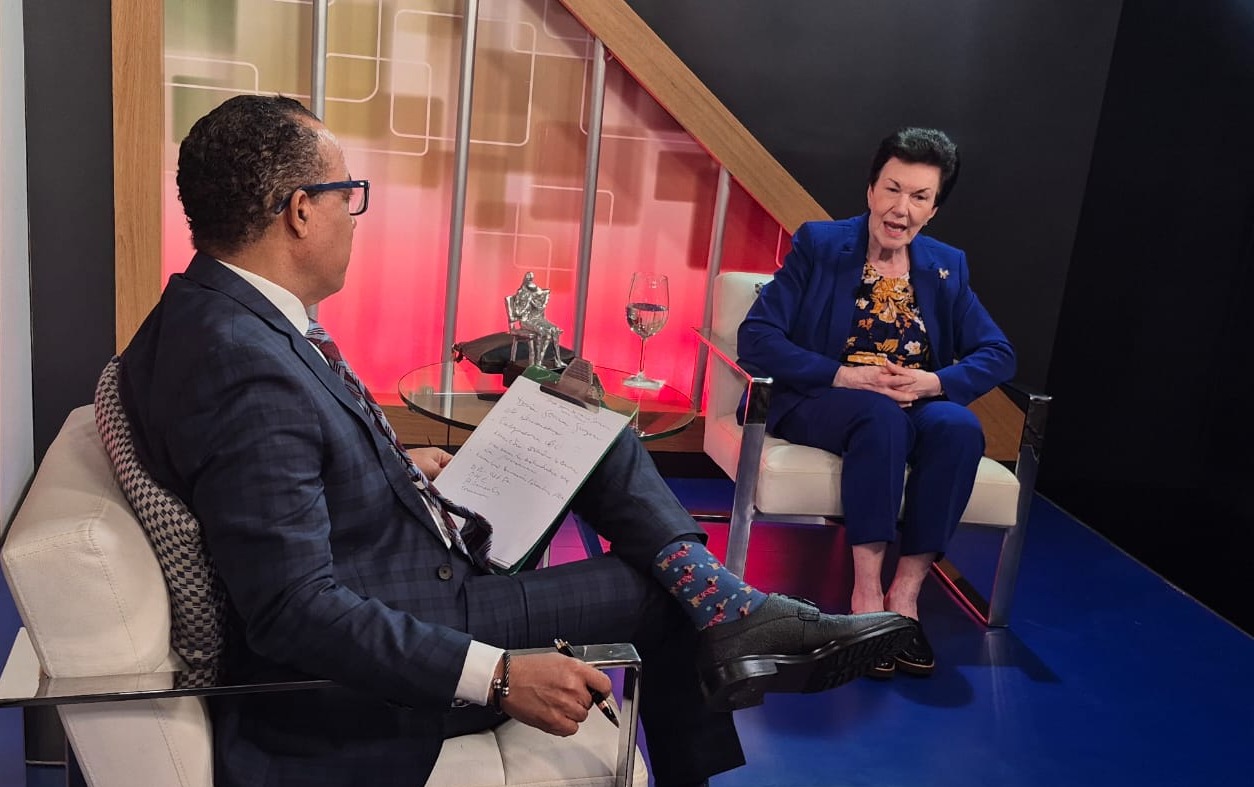
Santo Domingo. – Former Dominican ambassador to Washington, Sonia Guzmán de Hernández, attributed the fact that the Dominican Republic has not had an American ambassador for more than four years to the political struggle and interests being waged in the United States Congress, despite the excellent relations that, in every sense of the word, both nations have.
Guzmán de Hernández recalled that this situation coincided with the coronavirus pandemic and the arrival of Joe Biden to power, since in the first administration of President Donald Trump, Robin Bernstein was the ambassador, whom he defined as “extraordinarily good”, who bolstered the solid relations with the two countries, and won the affection of the Dominican people.
He insisted that it was during the Democratic administration that the country was left without a U.S. ambassador, and attributed that situation to interests, because while one group wanted a person for that position, another preferred a different one, and that was frustrated in the American congress.
Interviewed by Héctor Herrera Cabral on the program D’AGENDA, which is broadcast every Sunday on Telesistema channel 11 and TV Quisqueya for the United States, the diplomat said that the four years of Joe Biden’s presidency were spent in that struggle of interests.
He maintained that now, after the Democrats were ousted from power in the November 2024 elections, that fight continues, but now for political interests.

“That came as a result of the pandemic, not because of the pandemic itself, but it’s to place people in time; it was in 2020 that this situation occurred, in the administration of Joe Biden, because before we had ambassadors like Bernstein, who was extraordinarily good, that is, it was in the government of the Democrats, let’s not get lost in that, and I attribute it to interests, because one group wanted one person, another a different one; because of that struggle of interests, that in the American Congress was frustrated,” reiterated the educator and political leader.
He indicated that “now that the Democrats are not in government, but the Republicans, it is a struggle of political interests.”
“Note that one of the first nominations made by President Trump for ambassadors was the candidate to head the embassy in the Dominican Republic; however, that has stalled in Congress, they have not confirmed her,” he exemplified.
More Read

The former Minister of Industry and Commerce said she believed that the current struggle is that, “unfortunately, the Democrats” are not taking steps due to a political struggle with the Republicans.
He clarified that the situation of struggle of interests and political confrontations in the United States Congress that prevent the ratification of the ambassadors who are appointed in the diplomatic legation of this country “has nothing to do with us, but the reflection is negative for the Dominican Republic, which until now has not had an American ambassador for almost five years.
It says that the shift from globalization to Trump’s tariffs is a consequence of the effects caused by the pandemic on global trade.
The application of the tariff policy ordered by President Donald Trump is a direct consequence of the effects caused by the pandemic on global trade, with the disruption of the supply chain, which caused significant shortages to the North American economy, which depended on raw materials from third countries, according to Ambassador Sonia Guzmán de Hernández.
“That globalization that began in the late 90s and early 2000s had its reason for being, and I think it was very important because the commercial chains united the countries in a global production. Now, what happened in the end and why do we have Trump with those somewhat protectionist ideas in commercial matters? In the pandemic we realized that in that globalization there were countries that depended too much on others, and the production chains broke and were delayed because there was no exchange,” analyzed the Dominican ex-ambassador in Washington.

The diplomat recalled that the chips used in the manufacture of vehicles in the United States came from China, and if the Asian country could not send them, the manufacture of cars would be paralyzed.
More Read

“And I believe that gave rise to the world rethinking the situation we had fallen into, in such a brutal dependence, and the Chinese, who are very hardworking and calculating, helped themselves with a big spoon, and gave conditions to companies with cheap labor, which falls into labor exploitation, and many companies, including American ones, went to the Asian giant to manufacture products, and the United States understood that they depended in an extraordinary way on China’s production,” he argued.
Guzmán de Hernández, who was Minister of Industry and Commerce when the Free Trade Agreement between the United States, Central America and the Dominican Republic was signed, specified that “reversing that is the consequence of Donald Trump being there.”
“It’s my opinion, and I believe that, perhaps, to balance that trade a bit, that’s what the United States is thinking, to force, on the basis of tariffs, the manufacturing that went to the East to return to North American territories,” he argued.
Former ambassador in Washington urges productive sectors to take advantage of new tariff context
Former Minister of Industry and Commerce, Sonia Guzmán de Hernández, encourages official authorities and productive sectors to take advantage of the tariff policy that President Donald Trump’s government has implemented for the region, since the country, despite the 10% that was applied to it, has comparative advantages over other countries in Latin America and the Caribbean.
“To give an example, Uruguay, Argentina or any country that does not have a Free Trade Agreement has had an additional 10% applied to the tariffs they had, and we have 10% on zero, which is what the Treaty gives us; there is an absolute and total comparative advantage for the Dominican Republic,” the diplomat stated when answering questions on the D’AGENDA program.
The former Dominican ambassador to Washington insisted that the country has to focus on attracting investments, “because right now we have extraordinarily good trade conditions, because the tariff we are paying is 10% on zero, unlike other countries that must pay that new percentage on what they had before the new Trump measures came into effect.” She explained that, comparing the cost of labor in the United States with that of the Dominican Republic, even with 10% on zero, it is beneficial for many American companies to set up in the country.
“And that is why we have to focus on, with that comparative advantage, attracting investments, and I believe it is being done, and the proof is in how foreign investments have skyrocketed, especially those from the United States,” stated Ms. Sonia Guzmán.
In other news, the high-ranking leader of the ruling Modern Revolutionary Party said that President Luis Abinader should really be valued for three years of government, because the other two corresponded to the pandemic, where the world was semi-paralyzed and the main objective of the States focused on the health aspect and guaranteeing food and health for its citizens.
“I believe that the PRM, apart from the great things it has done in terms of infrastructure, and the population, we must take care of and value as citizens and as a country the institutionality that this model of the Modern Revolutionary Party has given to the country,” emphasized doña Sonia.
He mentioned among those institutional advances the achievements in justice, in the political-electoral sphere, and a series of institutional reinforcements, such as the constitutional reform to reinforce the never again of presidential re-election after two consecutive terms, in addition to the democratization of the construction of works throughout the country.