A woman was attacked by a 2.95-meter-long alligator on August 8, 2026, while swimming in the Silver River in Marion County, Florida. The incident resulted in the amputation of her right arm and prompted a rescue and wildlife control operation by local authorities. The event highlights the risks faced by Florida residents and visitors during the peak activity season for these reptiles.
According to information from the Florida Fish and Wildlife Conservation Commission (FWC) and media outlets such as Florida Today, the victim was assisted by a boater who managed to rescue them and apply a tourniquet before they were transported to a hospital. The animal was captured and euthanized by specialists, while the area of the attack remained closed until it was deemed safe for the public.
This event is part of a series of attacks recorded in the summer of 2026, a season in which alligator activity tends to increase due to climatic and reproductive factors. According to the FWC, although encounters with alligators are not unusual in the state, serious injuries and deaths are rare, which leads authorities to insist on safety recommendations.
How was the alligator attack on the Silver River, Florida?
The attack took place on the afternoon of Saturday, August 8, when the woman was swimming with a group of people near Ray Wayside Park, an area frequented by kayak and canoe enthusiasts. According to reports from ABC News and Florida Today, the alligator approached the group and bit the victim’s arm, pulling her underwater.
A boater who was in the vicinity responded to the cries for help, managed to scare the animal away with their vessel, and applied an improvised tourniquet with a rope. The woman was treated at the scene by emergency services and then transported to UF Health Shands Hospital in Gainesville, where her right arm was amputated. According to information provided by 352today.com, the victim has already been discharged from the hospital.
More Read

Authorities deployed an operation to locate and capture the alligator responsible for the attack, a specimen 2.95 meters long (equivalent to 9 feet and 8 inches). The animal was euthanized following the protocol of the state’s nuisance alligator management program, known as the Statewide Nuisance Alligator Program (SNAP), according to data from the FWC.
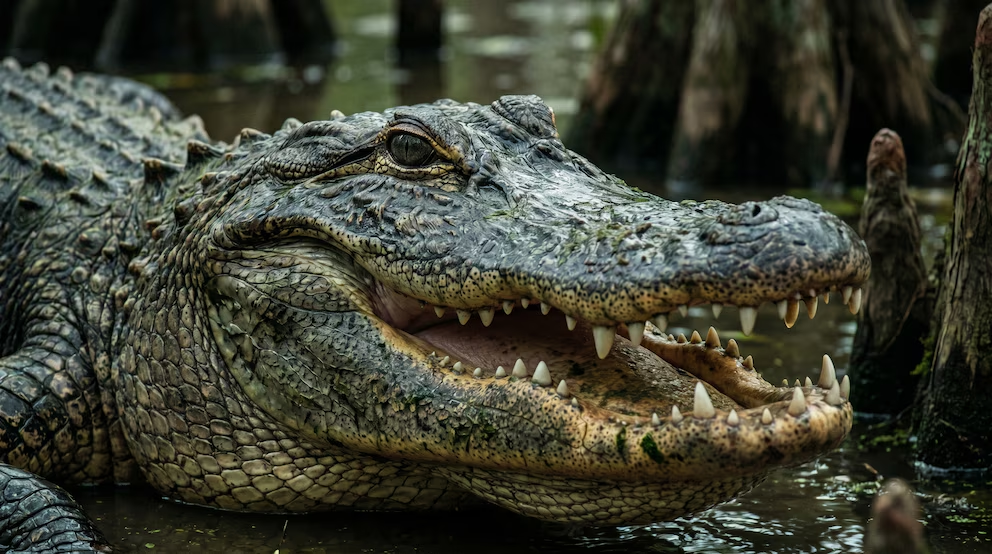
The alligator attack occurred on August 8, 2026, near Ray Wayside Park, when the animal bit the victim and pulled them underwater. (Illustrative Image Infobae)
Why are alligator attacks increasing in Florida?
Florida is home to an estimated population of more than 1.3 million alligators distributed across all of its counties, according to the FWC. The risk of dangerous encounters increases in the spring and summer, when the animals seek new habitats, mate, and nest. The courtship period begins in April, mating occurs in May and June, and egg-laying is recorded between late June and early July. The hatchlings are born between mid-August and early September.
More Read

During the summer of 2026, several serious attacks have been documented, including the death of a woman in the Econlockhatchee River, north of Orlando, and the amputation of a minor’s hand in Marion County. These events have motivated authorities to reinforce prevention and wildlife control campaigns, according to information cited by Florida Today and ABC News.
High temperatures and the drought affecting much of the state have reduced habitat availability, which increases the presence of alligators in lakes, rivers, and canals where residents and tourists often recreate. According to the FWC, these factors contribute to the reptiles being more visible and active during the warmer months.
What are the alligator attack statistics in Florida?
According to the Florida Fish and Wildlife Conservation Commission, more than 500 unprovoked alligator bites on people have been reported in the state since 1948. This represents an annual average of 6.5 incidents. Of these, approximately 350 have been considered serious attacks and 33 have resulted in fatalities.

The odds of a person suffering serious injuries in an unprovoked attack stand at 1 in 3.1 million, according to official figures collected by Florida Today. Despite these data, zero risk does not exist and authorities insist on the need to adopt preventive measures, especially during the season of greatest activity for these reptiles.
A boater rescued the woman in the Silver River, scared off the alligator with his vessel, and applied a tourniquet before she was transported to the hospital.
What recommendations do authorities give to prevent alligator attacks?
The FWC and media outlets such as Florida Today have disseminated a series of recommendations to reduce the risk of attacks:

- Swim only during the day and in designated areas.
- Keep children and pets away from the edge of freshwater bodies.
- Do not feed alligators or attempt to approach them.
- Avoid swimming in waters with dense vegetation or near nests.
- Do not hang limbs or objects over the side of small boats.
- If an alligator is spotted, move away and notify the Nuisance Alligator Hotline: 1‐866‐FWC‐GATOR (392‐4286).
The FWC reminds that feeding or attempting to handle alligators is prohibited by law, as this modifies their behavior and can increase the risk to people.
What to do if an alligator attack occurs?
In the event of an attack, the FWC recommends resisting immediately. “If an alligator bites, the best thing to do is fight back and make as much noise as possible. Striking or trying to injure the eyes can make the animal release the person,” the official guide notes. It is essential to seek medical attention as soon as possible to avoid infections and complications derived from the bite.
If a person observes an alligator that poses a danger to people, pets, or property, they should report it to the official FWC hotline. The SNAP program has trappers who remove animals over 1.2 meters (4 feet) that are considered a risk.
Florida records a higher risk of alligator attacks in spring and summer due to breeding, habitat seeking, and the reptiles’ seasonal activity. (Illustrative Image Infobae)
What was the institutional reaction after the attack on the Silver River?
The Florida Fish and Wildlife Conservation Commission confirmed the search and capture operation for the alligator, and reiterated the priority of public safety. “The FWC places the highest priority on public safety and maintains a statewide program to address cases of alligators that pose a threat,” the agency indicated in statements reported by Florida Today.
Access to the affected area was temporarily closed until specialists determined there was no immediate danger to park users. The reopening took place following the removal of the animal, as detailed by ABC News and The Independent.
How does an alligator attack impact daily life in Florida?
The incident has reinforced the importance of respectful coexistence between the population and wildlife, a central element of daily life in Florida. Residents and tourists must exercise extreme caution and follow the authorities’ instructions to reduce the risk of attacks. The FWC will continue with education, patrolling, and the capture of problematic specimens, in line with current protocols for the protection of the citizenry.
The presence of alligators is part of Florida’s natural environment, but prevention and attention to safety rules are essential to avoid further victims. State authorities keep their recommendations and emergency lines updated to respond to any similar incident.