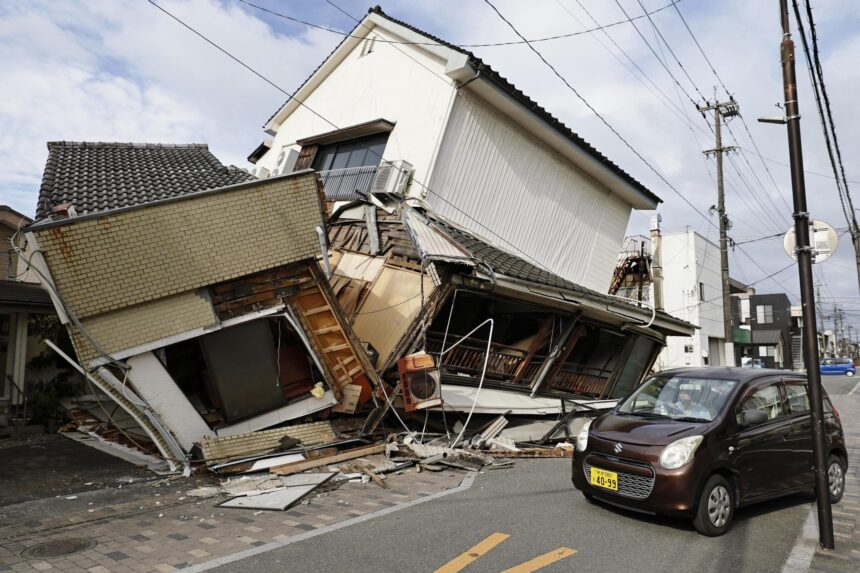
Kumamoto (Japan).- A new earthquake of magnitude 5.8 shook the Kumamoto prefecture in southwestern Japan again this Wednesday, one day after a 7.1 magnitude earthquake caused the death of 18 people and left several trapped under the rubble that rescue teams continue to search for.
The tremor took place at 22:19 local time (01:19 GMT) with its epicenter in the Amakusa islands, near the town of Kumamoto, according to the Japan Meteorological Agency (JMA).
Read more: Rescuers search for survivors after earthquake leaves 18 dead in Japan
The earthquake was felt strongly in the prefecture’s capital, EFE verified, and reached level 5 out of 7 on the Japanese scale, which focuses on measuring surface shaking and destructive potential.
At least 18 people have died and hundreds were injured following the 7.1 magnitude earthquake that struck the southwest of the archipelago this Tuesday, according to the latest figures from the central government and local authorities.
More Read


The movement has triggered hundreds of aftershocks in the region, with 48 earthquakes of magnitude 3 or greater according to the Japanese scale, and authorities have warned of the possibility of a larger tremor occurring in the coming days.
While authorities have not reported any new damage from today’s earthquake so far, Tuesday’s quake caused the collapse of a shopping center in the town of Kashima, operated by the Aeon chain, where an explosion possibly caused by a gas leak after the tremor caused part of the building to collapse.
This structural collapse caused at least three deaths, while three people remain missing according to the network.
More Read

In addition, rescue teams are trying to find survivors at the Nippon Paper Industries paper mill in the town of Yatsushiro, where the earthquake brought down a large chimney, causing at least five deaths, according to local government figures.
Japan sits on the so-called Pacific Ring of Fire, one of the most active seismic zones in the world, and experiences earthquakes with relative frequency, which is why its infrastructure is specially designed to withstand tremors.