

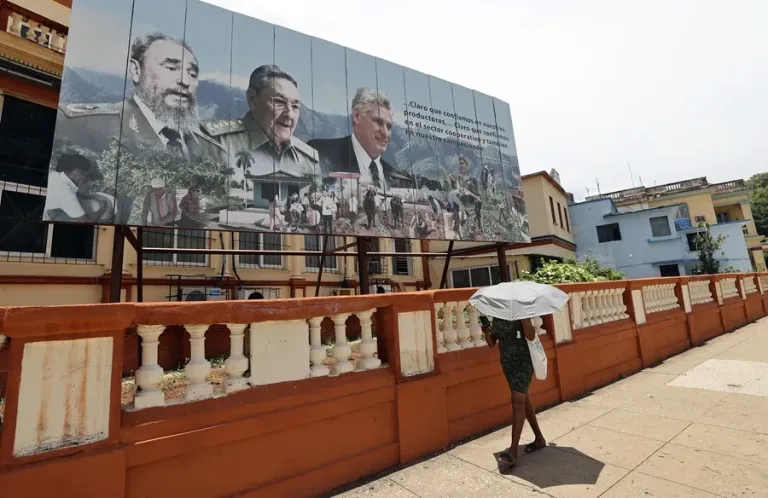

Havana.– The president of Cuba, Miguel Díaz-Canel, put forward several economic measures that seek to adapt the country, mired in a deep crisis, to “the demands of current times,” an announcement that this Saturday met with divergent positions among Cubans.
In a surprise appearance and exclusively before state media, Díaz-Canel reported yesterday on reforms that include changes to decentralize and assign greater “autonomy” to state-owned enterprises, to provinces and municipalities, as well as transformations in tourism, foreign trade, foreign investment, and the private sector.
“It seems to me that those measures had already been mentioned on other occasions. I don’t know why they even sound familiar to me and that in the end they hadn’t been implemented? That they were things that had been left aside, and it’s like now it’s a desperate thing,” Maydolis Oliva pointed out to EFE.
This 39-year-old woman from Havana, who was walking through the Playa municipality loaded with basic household products such as cooking oil and toiletries, commented suspiciously that the measures had arrived at a moment of mandatory definition for the country.

We recommend reading: 59% of Cuba will be without power at the same time this Saturday due to the energy crisis
“He already arrived as a top [player] in what they have to do; and he is not going to solve anything at this point in life,” he concluded.
Although the Cuban government did not link this Friday’s reforms to the negotiations with the United States, Washington is indeed pressuring Havana to introduce economic and political reforms. Díaz-Canel pointed out, for his part, that “these are times when change is necessary and the country cannot continue to function the same way.”
“Getting out of this”
Referring to the current context of the island, Díaz-Canel said that “the country is not at a standstill” and is facing “this entire situation with intelligence,” in reference to the serious energy crisis that Cuba has been experiencing since mid-2024, aggravated since January by the U.S. oil siege, to which reinforced sanctions against vital sectors of the economy have been added since May.

On the island, blackouts have multiplied, reaching two consecutive days in almost all provinces and more than 20 hours straight daily in Havana, which has fueled social discontent, and every day there are peaceful protests, trash burning in the streets, and pot-banging protests.
One of the measures announced this Friday seeks to encourage the island to be “less and less dependent on electricity generation using fossil fuels, especially due to the U.S. blockade, because of which “in the last five months only one oil tanker has entered Cuba,” added Díaz-Canel.
“He (Díaz-Canel) spoke about the food program, about opening up investments, and that some obstacles were going to be removed, and I think those are fair things,” commented Diosdado Licor, a 65-year-old retired Havana resident, more hopefully to EFE.
While chatting about the measures with another neighbor on 3rd Avenue in the Havana neighborhood of Miramar, one of the capital’s most affluent districts, Licor stated: “I think what we have to do is follow and keep pace with the law (…) I think we are going to get out of this”.
“We Cubans have to get out of this, if we have gotten out of worse things,” he asserted.
What do the reforms bring?
The broad package of economic reforms unveiled this Friday includes, among other aspects, increasing the “autonomy” of state-owned enterprises regarding wages, investment of profits, import and export, and association with other economic actors.
You can also read: Cuba receives a donation of 1,700 tons of basic products from Mexico and Belize
It is also planned to eliminate importing companies, state-owned enterprises that intermediate foreign trade, the end of limitations on vehicle imports; and the entry of “new actors” in the tourism sector, to “exploit” the island’s hotel infrastructure following the recent total or partial withdrawal of foreign hotel chains in order to avoid US sanctions.
Furthermore, it is expected to “incentivize” foreign direct investment, taking into account the role that Cubans residing abroad could play, who will have the same conditions as their compatriots on the island.
All these transformations will be presented for approval at the National Assembly of People’s Power (ANPP, unicameral parliament) in its upcoming session this July.