
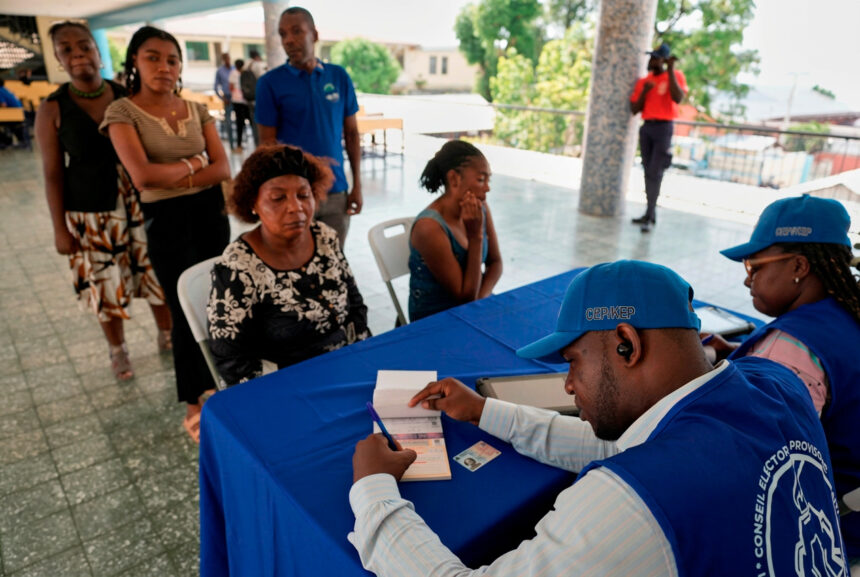
Port-au-Prince.- The electoral registry to return Haiti to the polls faces a challenge that goes beyond violence and political crisis: residents of rural communities must travel long distances to register as voters due to the limited availability of centers, a situation that threatens to become a barrier to the participation of part of the population.
The Provisional Electoral Council (CEP) launched the registration process on July 20, 2026, initially in the capitals of nine departments of the country, with the exception of the West due to the particular security and logistical conditions affecting that area.
For residents of remote locations, however, completing the procedure can mean traveling for hours to find an authorized office. Distance, the cost of transportation, and mobility difficulties represent additional obstacles in a country where large sectors of the population face a precarious economic situation.
Rural electoral registration
The situation gains greater relevance because Haiti seeks to rebuild an electoral roll capable of supporting its next elections after years of institutional instability. The president of the CEP, Jacques Desrosiers, has indicated that the organization intends to incorporate between 3 and 4 million voters before October 13, the deadline established to complete the registration.
To expand the coverage of the electoral registry, authorities are moving forward with the installation of approximately 1,400 registration and voting centers distributed throughout the territory. By the beginning of August, more than half were already operational, while the agency continued to enable new facilities.
More Read

In the South department, for example, all 20 municipalities already have structures in place to register citizens. The CEP also announced the opening of 15 new centers in Pétion-Ville, nine in Delmas, and one in Tabarre, in addition to other facilities planned for different sectors of Port-au-Prince.

The expansion seeks to reduce the difficulties citizens face in joining the electoral roll. However, the challenge is especially complex in rural communities, where the distances between towns, limited availability of transport, and road conditions can turn an electoral procedure into a journey of several hours.
Electoral registration and insecurity
In addition to the logistical difficulties of voter registration, there is the insecurity caused by armed groups, which maintain influence over large areas of the country and have forced the authorities to adapt the deployment of electoral structures. The Government assures that it is working together with the CEP to provide financial resources and logistical support to the process.

Prime Minister Alix Didier Fils-Aimé personally visited a registration center set up at the Pétion-Ville Lyceum on August 4, from where he urged Haitians to register and participate massively in the democratic process.
Registration constitutes one of the fundamental pieces of Haiti’s attempt to hold national elections again after years without authorities chosen by popular vote. The process is taking place while the country continues to face a deep security crisis, internal displacement, and institutional weakness.
The challenge for the authorities will not be solely to reach a high number of registered citizens. They must also ensure that where a person lives does not determine their real possibilities of registering and subsequently exercising their right to vote.
For thousands of Haitians in rural areas, the recovery of democracy begins long before reaching a ballot box: it starts with finding transportation, covering its cost, and traveling kilometers simply to find a place to register.