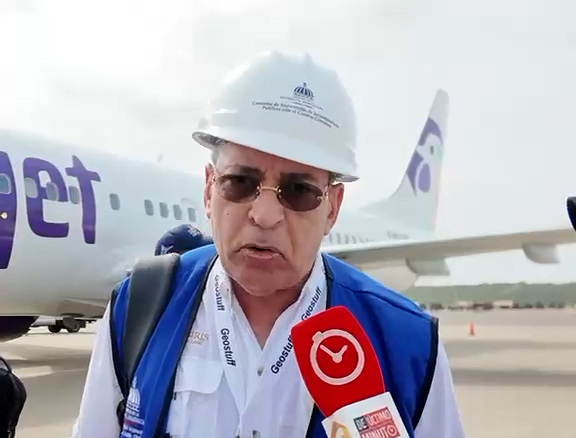
Maiquetía.– Dominican geologist Osiris de León asserted that the damage caused by the double earthquake that shook Venezuela on June 24 confirms, from a geological perspective, the biblical principle of building on rock rather than on sand. As he explained, the buildings constructed on rocky terrain remained practically intact.
During a tour of the affected areas with the De Último Minuto team, the specialist explained that one of the most relevant observations was the contrast between structures built on rock and those located on soft ground, near the coastline.
Osiris de León and geology
“I did not find a single structure destroyed on rock. Everything that was destroyed was near the sea, on loose, water-saturated material, where there was an amplification effect of the seismic spectrum and the structures could not withstand that horizontal seismic load,” he stated.
De León maintained that this reality coincides with a message that, as he said, he has disseminated for more than 40 years in conferences, articles, and interviews on geology and risk management.
“We have always said that the Bible is right when it says in the Gospel of Matthew, chapter 7, verses 24 to 27, that the wise man builds on the rock and the foolish man builds on the sand,” he expressed.
More Read

The geologist explained that houses built directly on rock withstood the seismic movement better because that type of soil transmits seismic energy differently than soft, water-saturated ground, where the movement is amplified and increases the possibility of building collapse.
YOU CAN ALSO READ: Volunteers continue search for survivors one week after earthquake in Venezuela

Earthquake damage
During the assessment carried out in La Guaira state, especially in the Caraballeda sector, Osiris de León observed a scene of widespread devastation, with destroyed roads, affected bridges, and hundreds of collapsed buildings, even though the epicenter of the earthquake was located in the San Felipe area, about 200 kilometers away.
More Read

“Anyone would say that the epicenter was there, but we all know it was in San Felipe. We saw total destruction there: buildings of all levels destroyed and homes collapsed,” he indicated.
Osiris de León explains
The specialist attributed much of the damage to the combination of soft soils with buildings constructed, in many cases, with hollow bricks that did not withstand the lateral forces generated by the earthquake.
Likewise, he warned that the tragedy must serve as a lesson for all countries in the region, recalling that the phenomenon occurred on the Caribbean tectonic plate, shared by Venezuela, the Dominican Republic, Puerto Rico, Jamaica, and other islands.
“This is an earthquake that concerns all of us who live in the Caribbean. We all have to pay attention to what has happened here, because this can occur in any other part of the region,” he concluded.
The statements were offered at the Maiquetía International Airport, at the end of a tour of the most affected areas, as part of the delegation of Dominican specialists who visited Venezuela to evaluate the effects of the earthquake that occurred on June 24.