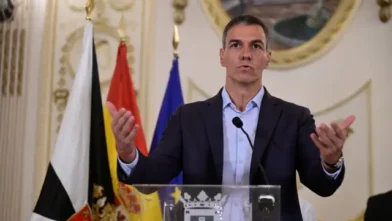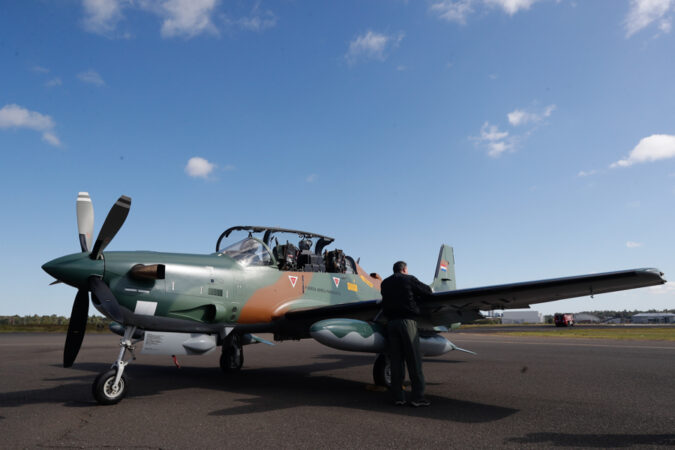
Luque (Paraguay), June 30 EFE).- Paraguay received this Monday four of six Super Tucano aircraft acquired from Brazil and which will reinforce, after 38 years since the last purchase of similar aircraft, the aerial fight against organized crime and drug trafficking, highlighted the president of the country, Santiago Peña.
The president attended the ceremony held at the First Air Brigade, located in the city of Luque, adjacent to Asunción, to receive those first aircraft. In total, the Super Tucano cost 105 million dollars.
“Today the Paraguayan State invests in defense and security, no longer to confront our neighbors. That remained in the past. Today we face different dangers. Organized crime, drug trafficking, transnational crimes know no borders, know no nationality, and this requires that States be increasingly organized,” Peña said in his speech.
The four ships arrived this Monday, although they were expected last Friday. According to the authorities, the delay was due to bureaucratic problems.
The authorities announced that the remaining two aircraft will arrive at the end of the year.
More Read
After the event, the president boarded one of the planes to receive an explanation of its characteristics and talk with the Paraguayan pilots who brought them from Brazil, including Lieutenant Cynthia Orué.
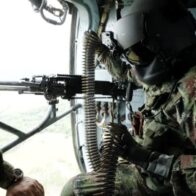
According to a statement from the Presidency, these are light combat aircraft for aerial patrol.

“They are effective in supporting ground forces operations”, they are also used for pilot training in combat techniques, in aerial maneuvers and “are equipped to intercept unauthorized aircraft”, the information added.
The purchase was considered “a milestone in defense and security investment after 38 years”, since the last time Paraguay bought Tucano aircraft from Brazil was in 1987, according to the statement.
In a brief appearance before the media, the ruler again justified the purchase of the planes and said that it is a “much broader action” that includes the strengthening of the Navy and the Army.
Referring to the dictatorship of Alfredo Stroessner (1954-1989), he maintained that when the military regime ended in 1989, “many wounds” remained that were “eroding and deteriorating the capacity for response” of the Armed Forces, which is why he considered it “fundamental” to strengthen military institutions now.
When asked by the media about how they would proceed if an airplane belonging to the alleged drug trafficker Sebastián Marset appeared in Paraguayan airspace, Peña stated that they would use the airplanes to intercept it.
“He intercepts it immediately, he is going to give him instructions to land, to abandon the airspace. This is going to give us a very efficient operational capacity”, the president expressed.
The alleged Uruguayan drug trafficker Sebastián Marset is accused of leading an international criminal network for drug trafficking and is wanted by the Justice of Paraguay, Bolivia, Uruguay, Brazil, the United States Drug Enforcement Agency (DEA), Europol, and Interpol.