Russia and Iran recruited teenagers in Europe and the Middle East for espionage, sabotage, and contract attacks, according to a Financial Times investigation based on interviews with police and intelligence officials from six countries. The case that raised the alarm occurred in September in Rotterdam, where police arrested a 17-year-old Dutch youth accused of providing services to a foreign power after being recruited by Russian agents on Telegram.
The novelty was not the use of intermediaries, a practice already attributed to Moscow and Tehran, but the incorporation of minors as low-cost, high-exposure executors. According to Ukrainian officials cited by Financial Times, 21% of those detained in 2025 for collaborating with Russia were teenagers, a sign that the method has ceased to be marginal and has become part of the logic of hybrid warfare.
The pattern repeated with few variations: contact on opaque or massive platforms such as Telegram, TikTok, Snapchat, Facebook, Discord, or video game sites; offers of money, often in cryptocurrencies; small tasks at the beginning and riskier missions later. For European intelligence services, that circuit turned a generation of digital natives into a battleground between states, organized crime, and extremist networks.
We recommend reading:The UN includes Russia on the blacklist for sexual violence in conflict zones
Europol placed minors as a priority
The outgoing director of Europol, Catherine De Bolle, told the Financial Times that preventing minors from being absorbed into these networks has become a central priority for the European agency. She explained that young people are more vulnerable when they seek recognition, attention, or belonging and find that connection in interlocutors who gain their trust online.
More Read

De Bolle further described the operational logic behind the recruitment: for those who use them, adolescents are expendable. If the mission succeeds, the benefit is high; if it fails, the political and judicial cost falls on the executor and not on the State that promoted it.
Russia and Iran thus exploited an ambiguous space between peace and armed conflict. A British security official cited by Financial Times maintained that digital anonymity allows minors to engage in behaviors they perceive as defiant, without initially measuring their consequences in the real world.
Ukraine detected the pattern and saw its escalation
The tactic first appeared in Ukraine. A little over a year ago, Ukrainian police arrested two groups of suspected Russian agents who were secretly photographing air defense systems on the outskirts of Kharkiv. They were not professional infiltrators: they were 15- and 16-year-old boys.
More Read

According to the Ukrainian SBU, they had been recruited by the FSB under the guise of a “mission” or urban scavenger hunt game. They received coordinates via chat, took photos, recorded videos, and described positions. Moscow then used that information to launch air strikes on the city.
The SBU told the Financial Times that the recruitment of minors and even children began a year after the start of the war and has now become commonplace. The Kremlin’s calculation was twofold: to replace sympathizers who distanced themselves due to the war and to internally destabilize Ukraine by incorporating its youngest generation into activities against the national war effort.
Analyst Laura Brady, of Earendel Associates, maintained to the Financial Times that minors represent the “path of least resistance” for Moscow. They are cheaper, ask fewer questions, and take more risks, she summarized. An SBU official explained that some teenagers were persuaded with the argument that setting fire to recruitment offices would prevent their relatives from being mobilized.
Extreme cases showed the human cost of that mechanic. According to the SBU, the youngest Ukrainians recruited by Moscow were just 11 years old: two boys, one in Kyiv and another in Odesa, who were tasked with setting fire to cars and electrical boxes in residential buildings.
The progression of tasks followed a defined ladder. First, anti-war pamphlets; then, minor fires; later, attacks that endangered lives; in the end, manufacturing and placing bombs.
In March of last year, in Ivano-Frankivsk, a 17-year-old died and his 15-year-old accomplice lost his legs when a device they had both manufactured exploded prematurely. Russian agents had recruited them via Telegram and offered them USD 1,700 to plant the bomb. The SBU defined them as “single-use agents.”

The network advanced from the Ukrainian border
The first signs of expansion into Europe appeared in countries neighboring Ukraine. In Poland, Ukrainian teenagers were discovered painting anti-Polish slogans on national monuments. In Latvia, young people distributed pro-Russian propaganda and attacked cars and buildings belonging to the Ukrainian diaspora.
Logo of the Russian Federal Security Service (FSB) against the background of a Russian flag. REUTERS/Dado Ruvic/Illustration
In Lithuania, a 17-year-old Ukrainian citizen, Daniil Bardadim, set fire to an Ikea store in Vilnius in 2024 on behalf of the Russian security services. He pleaded guilty and is serving a three-year prison sentence.
The SBU believes that the FSB directed the approaches to teenagers in Ukraine, while the GRU and SVR were behind operations to recruit minors in other countries. Ukrainian officials told Financial Times that they are now advising European allies to detect and curb that threat.

The director of Latvia’s internal security service, Normunds Mežviets, described to Financial Times the initiation sequence: burning a car, then attacking vehicles with Ukrainian license plates, moving on to trucks or properties of exiles, and finally advancing toward critical infrastructure. The goal, he said, was to prepare the perpetrator emotionally and psychologically to cross increasingly higher thresholds.
London detected a “parallel reality”
In the United Kingdom, the Metropolitan Police acknowledged arrests of teenagers for sabotage and hostile reconnaissance. Dominic Murphy, former head of the London force’s counter-terrorism command, told the Financial Times that the phenomenon appeared suddenly about 18 months ago and that he was surprised by both the scale and the speed with which digital activities turned into physical missions.
Murphy pointed out that the police began to see young people conducting hostile reconnaissance for foreign states, particularly Russia and Iran. He defined that behavior as a sort of “parallel universe.”
Previous Met data showed that 20% of those arrested in terrorism cases were 17 years old or younger. Murphy estimated that a similar proportion of minors now fall under detention in cases linked to national security.
This week, an Old Bailey court heard the case of a Norwegian teenager accused of being hired by a Swedish criminal gang used by the Iranian regime to commit a murder in the United Kingdom. According to the prosecution, Johannes Natland had just turned 18 when he arrived at Manchester Airport and was guided by his handlers to a hideout with weapons and a stolen car. Police arrested him in a hotel room in West Yorkshire before he could carry out the attack.
The answer to the central question has already taken shape in several files: Russia and Iran recruited minors through digital platforms, used them for surveillance, arson, intelligence, or assassination attempts, and thus shifted part of their confrontation with Europe and Israel into the hands of teenagers. The immediate consequence was that security agencies treated these recruitments as a hybrid warfare threat rather than mere juvenile crimes.
The Dutch case exposed a sensitive target
The 17-year-old arrested in Rotterdam and another accomplice of the same age are accused of using technology capable of intercepting Wi-Fi networks to spy on government and police buildings in The Hague, including the headquarters of Europol itself. According to the Financial Times, one of the boys was contacted on Telegram by a hacking group linked to the Russian government and received an offer of payment for his services.
Both are still waiting for a trial date. The father of one of them told the Dutch newspaper De Telegraaf that his son was “naive” and that he never imagined such a risk.
De Bolle told the Financial Times that the exploitation of minors by criminal and state networks is Europol’s primary focus of concern. She described them as “super simple” targets to identify and recruit on social media and gaming platforms.
Iran replicated the method in Israel and Europe
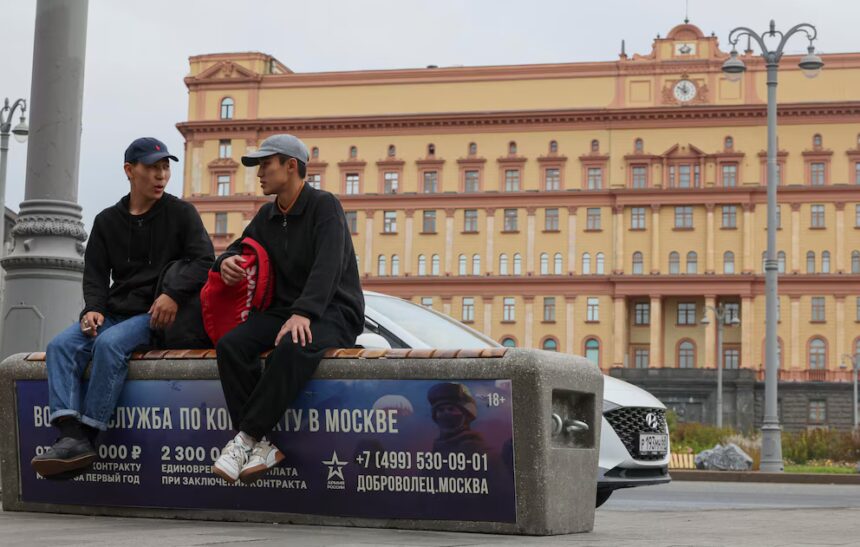
The expansion of the model also appeared in the conflict between Israel and Iran. In March of this year, a 14-year-old boy in Tel Aviv was accused of contacting a foreign agent and handing over intelligence to the enemy. View of the headquarters of the Federal Security Service (FSB, successor to the Soviet KGB) in Lubyanskaya Square in Moscow, Russia. (AP Photo)
According to Israeli prosecutors, eleven months earlier he had responded on Telegram to an Iranian agent offering cryptocurrency payments in exchange for subversive activities. He then filmed the Kirya military headquarters in Tel Aviv, recorded damage from Iranian missiles at two locations, and painted graffiti in the city. For those actions, he was paid more than USD 1,170 distributed across four digital wallets.
The Shin Bet had already warned families last summer about “seemingly innocent” messages asking them to photograph buildings and facilities, gather information, paint hostile graffiti, and identify sensitive sites. The agency specified that these requests were circulating on Facebook, Telegram, Instagram, and TikTok and attributed them to hostile Iranian elements seeking to recruit Israeli minors for espionage.
Security officials cited by the Financial Times maintained that Tehran designed these operations based on the Russian playbook. A former intelligence officer from the Israel Defense Forces added that the unrest of children raised between the pandemic, October 7th, and the current war favored this type of recruitment, while digital payments gave them a false sense of secrecy and autonomy from their parents.
Antisemitic attacks repeated the same pattern
The participation of minors also appeared in antisemitic attacks claimed this spring by Ashab al-Yamin, or Hayi, a militia that the United States Department of Justice defined as a front for terrorist objectives of Kata’ib Hizbollah, Hizbollah, and the Iranian Revolutionary Guard.
In France, three of the four suspects in a foiled attack plot in Paris in March were 16 or 17 years old. In the Netherlands, four young people between 17 and 19 years old were placed under investigation for setting fire to a synagogue in Rotterdam, also in March.
In the United Kingdom, the three defendants for an arson attack in March against Hatzola ambulances in North London were 17, 19, and 20 years old. Another 17-year-old boy has already pleaded guilty to an arson attack on a synagogue in northwest London at the end of April.
The most recent episode reached Volant Media, the parent company of a Persian television signal in London. Two men aged 19 and 21 and a 16-year-old minor were charged with attempting to attack its offices with firebombs. The youngest was placed under the guardianship of local authorities. An official with experience in Iranian foreign operations told the Financial Times that the profiles of the attackers in London showed marks almost identical to those detected by the Shin Bet in Tel Aviv.
Two years ago, the SBU launched a public campaign against offers of “easy money” for “simple tasks” and began visiting schools to explain the crimes and prison sentences that caught their peers. According to British and Swedish officials cited by Financial Times, agents also used video game platforms to initiate contact, just as in the game World of Tanks in Ukraine.