El Salvador became the first country in Central America to eliminate trachoma as a public health problem, after receiving official validation from the World Health Organization on July 13, 2026, as detailed in a statement on its website.
With that recognition, it joined a group of 64 countries certified for having eliminated at least one neglected tropical disease. It is, furthermore, the second country in the Americas to achieve this, after Mexico.
Trachoma is the leading infectious cause of blindness in the world. It is caused by the bacterium Chlamydia trachomatis, which is transmitted through contact with eye and nasal secretions from infected people.
How the disease manifests
Repeated infections scar the inside of the eyelid and cause the eyelashes to turn inward toward the eye, a phase called trachomatous trichiasis, which can lead to permanent vision loss.
The disease mainly affects communities living in poverty, with limited access to drinking water, sanitation, and medical care. In the Americas, it remains endemic in rural and remote areas of Brazil, Colombia, Guatemala, and Peru.
More Read

We recommend reading:WHO: More than 90% of the world’s population will be affected by cancer in some way
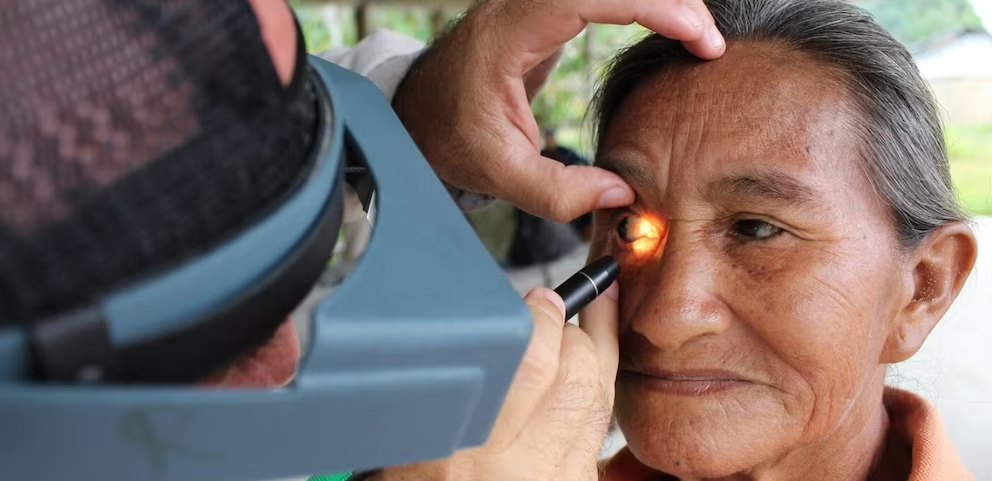
An ophthalmologist with specialized equipment examines an elderly woman’s eye to detect trachoma, an eye disease, while an informational poster about the condition is visible in the background. (Illustrative Image Infobae)
What evaluations did El Salvador make
Between 2023 and 2026, El Salvador conducted targeted assessments in communities prioritized based on environmental and social risk factors. The results found no active transmission of trachoma, nor signs of the disease in children or advanced cases at risk of blindness in adults.
More Read

For the WHO to grant validation, a country must meet three criteria: a prevalence of trachomatous trichiasis of less than 0.2% in persons aged 15 years and older, a prevalence of trachomatous inflammation-follicular of less than 5% in children aged one to nine years in each formerly endemic district, and the existence of an active system to identify and treat new cases. El Salvador met all three.

The applied strategy and institutional support
The achievement did not come from a single intervention. The country implemented a multisectoral strategy that included strengthening primary health care, improvements in access to water, sanitation and hygiene, and visual acuity screening in adults.
It also added the training of health personnel and the strengthening of surveillance systems to detect and treat cases of trachomatous trichiasis within the national health system.
“This validation reflects El Salvador’s commitment to reaching the most vulnerable populations,” said Dr. Jarbas Barbosa, Director of the Pan American Health Organization. “It is the result of sustained efforts to reach communities, identify potential cases, and ensure that no one is left behind,” he added.
The Salvadoran Minister of Health, Dr. Francisco Alabi, highlighted the support of PAHO and the Embassy of Canada in the process: “It is a source of pride that, three years later, we position ourselves in the region with this achievement that represents a positive impact on the visual health of the population.”
A close-up shows a human eye with the upper eyelid affected by characteristic papules of trachoma, an infectious disease that can cause blindness.

The regional outlook and the goal for 2030
PAHO supported the process through the Initiative for the Elimination of Trachoma in the Americas, with funding from the Government of Canada. The assessments also served to provide integrated health services to the included communities.
WHO Director-General, Dr. Tedros Adhanom Ghebreyesus, celebrated the result: “It is a demonstration of the power of political commitment, strategic investment, and community engagement.”
The WHO set a global goal to eliminate trachoma as a public health problem in all countries by 2030. El Salvador was under epidemiological investigation before completing its assessments and is now removed from that list with certification.
The organization recommends that validated countries maintain surveillance systems and ensure continuous access to eye care services to prevent a resurgence.