Santo Domingo. – The Dominican Republic will occupy a central position in the new submarine cable network announced by Google to expand connectivity between Latin America, the Caribbean, the United States, and Europe.
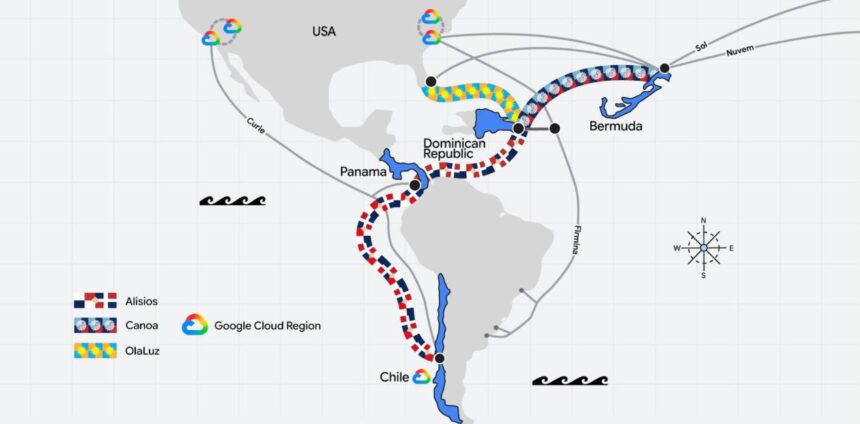
With the construction of the Alisios, Canoa, and OlaLuz systems, all with direct connection to the Dominican territory, a new branch of the Firmina cable, originally created to link North America and South America, will also be developed.
These infrastructures will be integrated with the Curie, Nuvem, and Sol cables to form Americas Connect, an initiative aimed at improving the reach, reliability, and resilience of digital communications on the continent.
The Alisios cable will connect the Dominican Republic with Panama and Chile, creating a corridor between the Caribbean, Central America, and South America. Its name refers to the trade winds that cross the tropics and historically helped sailors travel between continents.
For its part, Canoa will establish the first direct submarine connection between the Dominican Republic and Bermuda. The system will be integrated with the Nuvem and Sol cables, allowing for the creation of new routes from Latin America and the Caribbean to North America and Europe.
More Read


The OlaLuz system will directly connect the Dominican Republic with Florida. According to Google, this route will expand network capacity between the Caribbean and the U.S. East Coast, as well as provide an alternative path to maintain communications in the event of potential disruptions.
We recommend reading: Google announces a new submarine cable network between America and Europe
The company will also take a branch of Firmina to the Dominican Republic, extending to the Caribbean the capacity of a cable conceived to connect the Americas.
The simultaneous arrival of these connections will increase the country’s attractiveness for data centers, telecommunications companies, cloud service providers, and companies that need high-capacity international networks.
More Read

The infrastructure will also favor activities related to e-commerce, digital financial services, artificial intelligence, and regional business operations. With multiple international routes, the Dominican Republic could become an important hub for data exchange and processing in the Caribbean.
With Alisios, Canoa, OlaLuz, and the new branch of Firmina, the Dominican Republic is preparing to take on a more relevant role in international data transport. The challenge will be to convert that strategic position into investments, specialized jobs, and concrete improvements for businesses and citizens.