Rome.- The government of Giorgia Meloni will maintain the suspension of the Schengen agreement with Spain and the controls at ports and airports until security risks for Italy are completely ruled out, as stated this Thursday by the Minister of the Interior, Matteo Piantedosi.
«The decision to suspend the application of the Schengen agreement will not be reviewed before August 15th and, in any case, only after security risks for Italy have been completely excluded», stated Piantedosi in a parliamentary committee convened to explain the measures adopted by the Italian Executive following the migration crisis in Ceuta.
The Interior Minister argued that Italy’s decision fully complied with European law, while Spain followed a “logic of retaliation” by responding with the suspension of the free movement agreement, imposing controls on travelers arriving from Italy.
However, he wanted to emphasize that the temporary reintroduction of controls at the internal borders with Spain is not a measure directed against this country or other European Union partners: “Any hostile act towards Spain, a country linked to us by historic ties of friendship and brotherhood, is out of the question.”
As the Meloni Government has argued over the last two weeks, Piantedosi highlighted that this is a decision of a “precautionary and organizational nature intended to protect national security and the sustainability of the entire European control system at a time of great tension.”
More Read

Temporary and partial suspensions of the Schengen Agreement
In this sense, he recalled that temporary and partial suspensions of the Schengen agreement have been activated “hundreds of times” at Europe’s internal borders, and Spain itself, he said, has resorted to this measure “about 21 or 22 times,” as have states such as France, Austria, Germany, Denmark, the Netherlands, Poland, Sweden, and Norway.

The Italian minister also stressed that “one cannot look at what happened in Ceuta as if it were something that does not concern us. Every irregular entry on those coasts represents a vulnerability for the entire Schengen area that projects the risk directly into the interior of our common home.”
We recommend reading: “Macho Coca”, a key figure in drug trafficking in Costa Rica, extradited to the U.S.
More Read

He also explained that one of the reasons the Italian Government considered in reaching this decision was the potential risk of terrorist infiltration in uncontrolled migratory flows, since “various sources highlight how some areas of Morocco, including those near Ceuta, have historically been the subject of jihadist recruitment and radicalization, and this must be taken into account”.
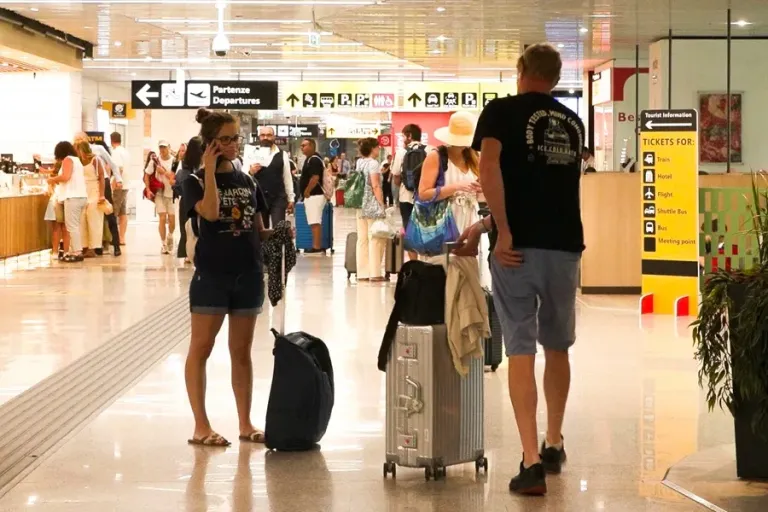
The migration crisis in Ceuta has strained bilateral relations between Spain and Italy, which on July 31 decreed the temporary suspension of the Schengen agreement with the reintroduction of controls at ports and airports for travelers arriving from Spain, following the irregular entry of tens of thousands of people into the Spanish autonomous city in North Africa, the vast majority of whom returned to Morocco shortly after.
Pedro Sánchez’s government, after unsuccessfully demanding that Rome lift these restrictions, responded by suspending the Schengen agreement with Italy until September 7, also applying controls to travelers arriving from that country.