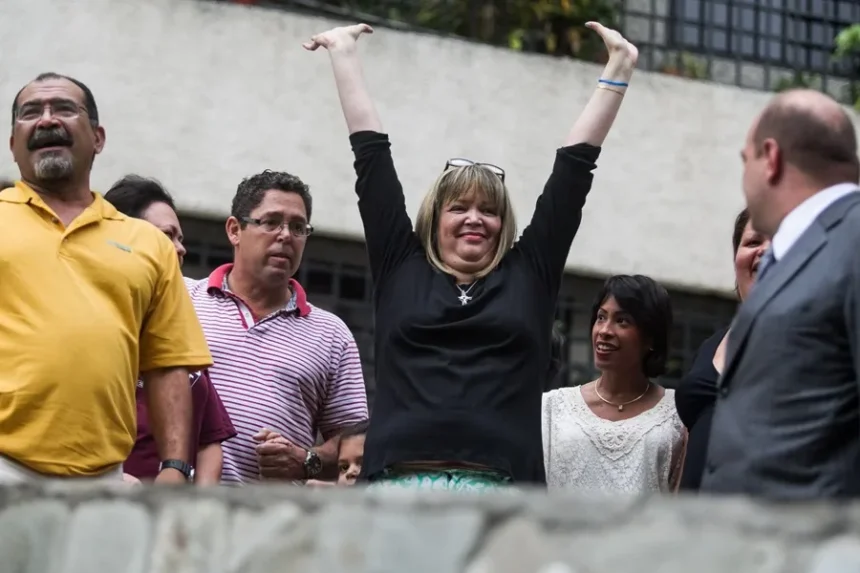
Caracas.- Venezuelan opposition leader and Nobel Peace Prize nominee, María Corina Machado, celebrated that judge María Lourdes Afiuni, considered a political prisoner of the late president Hugo Chávez (1999-2013), received full freedom this Friday and that her case was closed definitively “after 16 long and tortuous years of injustice.”
“We pray for her recovery and hope she can leave the country as soon as possible to receive immediate care. We continue for the freedom of all, until the end,” he wrote on the X network.
Afiuni is in a clinic after “presenting symptoms of dizziness, vomiting, and hypertension,” according to what her family reported on Thursday, and after undergoing tests, three “tumor lesions located in different parts of her body were detected, which require immediate medical attention in order to avoid irreparable consequences for her health.”
The Afiuni case
The judge’s arrest took place in December 2009 after she granted bail to a banker. Chávez requested that she be given the maximum sentence of 30 years in prison for allegedly facilitating the escape of the businessman, who left the country.
He was in prison until 2011, when he was moved to house arrest, and in 2013 he was granted parole.
More Read
In 2019, he received a five-year sentence for “spiritual corruption,” meaning the prosecution itself acknowledged that he did not receive any financial benefit.
Until today, Afiuni had conditional freedom that included, according to her family, a prohibition on speaking to the press or on social media and voting.

She also did not have the right to a passport and was politically disqualified.
More Read
Reactions from those close to the judge
Her brother Nelson Afiuni and the family’s legal representative, Thelma Fernández, stated this Friday in a press release that the closing of the case and the judge’s freedom represent “the end of a long and painful chapter marked by serious violations of human rights and due process.”
However, they pointed out that the definitive closure of the file “does not erase the suffering experienced nor does it, by itself, repair the damages caused.”
They asserted that the case “remains a warning to the entire region about the consequences of using the justice system as an instrument of retaliation against those who carry out their duties with independence and impartiality.”
We recommend reading: María Corina Machado and Edmundo González hope that the dialogue between Chavismo and an opposition group will lead to elections
This year, hundreds of political prisoners have been released and thousands of people have had their restrictions on freedom lifted, as part of what the authorities themselves define as the “new moment” the country is experiencing following the capture of Nicolás Maduro in Caracas by the United States last January.
His full freedom also coincides with a negotiation process promoted by the United States to move towards a democratic transition in Venezuela between a representation of the Government of the acting president, Delcy Rodríguez, and a group from the opposition.